
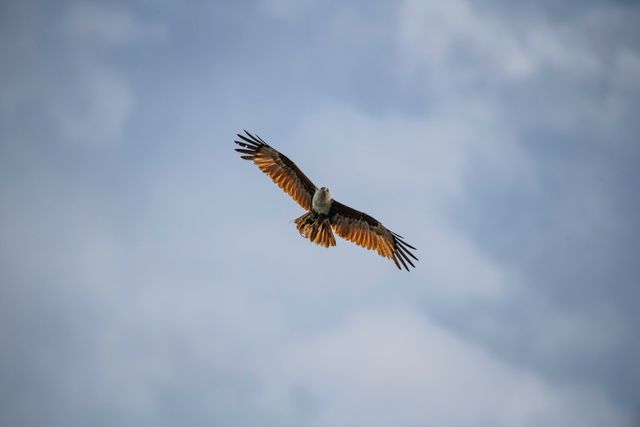
How do birds ride thermals? Birds ride thermals by flying in tight circles and by having specialized feathers and wings.
Some birds, such as eagles, are able to make use of thermals and fly to great heights without using much energy. If a bird wanted to fly to a height of 3 km, it would need to flap its wings a lot. Each wing flap uses muscles, which require energy. Thermals provide lift without the bird having to expend energy. Birds of prey want to get to great heights because it allows them to see more of the ground at once and spot prey. It also makes them harder to see because they are in front of the sun. And it gives them a great distance to drop down on their prey from. Once they are up high, they have incredible vision and can see their prey on the ground, far below. Eagles have retinas that are dense with light-sensitive cells, and their eyes are in deep pits to give them sharp focus. They can see a rabbit at roughly 5 km away.
So, what are thermals? Thermals are columns of warm air that rise vertically from the ground. Thermals generally reach to about 3,000 meters, but they can go to several thousand meters if the conditions are right. Thermals are caused by the sun warming the ground. The heat from the ground is radiated to the air just above it. As the air picks up this heat, the molecules move faster and spread out, lowering its density. This less dense warm air is lighter than the more dense cool air, and it rises like a hot air balloon in a column. As it rises, it loses the heat energy and becomes more dense. The rising air eventually slows and stops rising once it reaches air of a similar temperature. Hot air thermals often have cumulus clouds form at the top of them.
Birds can ride thermals to go higher because the warm rising air pushes on their wings. But a thermal doesn’t simply push a bird upwards. The bird still glides in the normal way, producing lift with its wings. The difference is that the air itself is rising, so the bird is carried upwards as it glides. Depending on the heat of the air, some thermals can move extremely rapidly and produce a lot of lift. Glider pilots and hang gliders also search out thermals because it can lift them up and make their flights longer. To do this, both birds and gliders fly in tight circles when they find thermals. Thermals tend to be fairly narrow columns of air, and birds need to keep moving forward. They have to have air traveling over their wings to get lift. Birds can hover in the air if the wind coming at them is fast enough to provide lift, but if the wind is only coming up from below, they won’t have enough lift. They have to move forwards, but they want to stay in the thermal, so they fly in small circles.
Birds that use thermals have a few adaptations with their wings and feathers as well. Their wings are very long and broad. The large surface area gives a lot more area for the hot air to push against and gives them far more lift. It also means they can stay airborne at slower speeds. Generally, the smaller the wings, the faster the bird needs to flap them. Their wings are also rounded. This helps them make sharper turns so that they can stay in the narrow thermals.
Birds that ride thermals have special feathers, too. They have slotted wingtips. The feathers on the edge of their wings can separate like fingers. The bird can spread these feathers out horizontally and vertically. These feathers act like separate little wings. They reduce turbulence at the wingtips and help the bird keep generating lift even when flying slowly. They reduce drag, which is one of the things that would make birds stall at low speeds.
One interesting thing about thermals is that birds don’t just fly into them by accident; they know what kind of ground produces them and they search for that. They look for rocky ground, ploughed fields, car parks, and anywhere with a dark surface. They also travel from one thermal to the next. They use a thermal to get high, then they glide, losing height, until they reach the next thermal and they go up again. They can stay aloft for ages without using any energy. And this is what I learned today.
Sources
https://en.wikipedia.org/wiki/Lift_(soaring)
https://en.wikipedia.org/wiki/Thermal
https://naturemuseum.org/cas/blog/facts-of-flight
https://en.wikipedia.org/wiki/Eagle_eye
Photo by Ravish Maqsood: https://www.pexels.com/photo/photo-of-an-eagle-flying-11498563/