
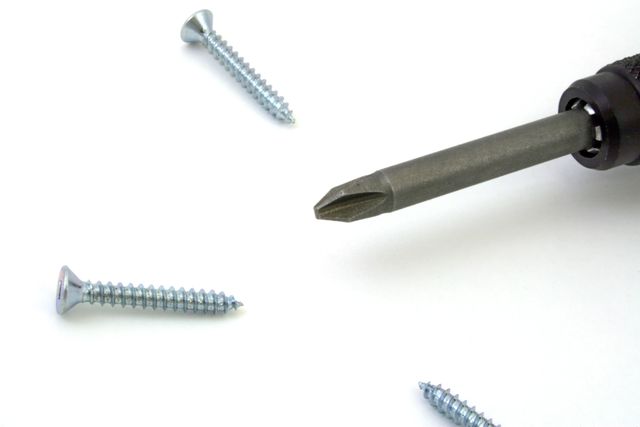
Why do screws tighten clockwise? Most screws tighten clockwise probably because the majority of people are right-handed.
That might sound like something that must have been decided thousands of years ago, but the direction of screws has only really been standardized since the 19th century. That was when machining improved to the point where a machinist could make thousands of almost identical versions of something. Before that, metal objects were made one by one, either by hand or on a machine that was not very exact. There was no point in standardizing everything because there was no easy way to make things standard.
Screws have been around for over 2,000 years. The first screw is traditionally said to have been invented by Archytas of Tarentum in about 400 BC, although it is difficult to know how true that is. Since then, many civilizations have used screws in different ways. The Romans used screw presses for pressing olives and grapes, and they also made hand-cut screws from bronze and silver. However, screws were much less popular than nails because they were incredibly difficult and time-consuming to make by hand. They are stronger than nails in many situations, but for most everyday uses they were largely impractical.
The rules for standardized screws were thought up by an engineer called Joseph Whitworth. In 1841, he proposed that screw threads should be standardized. He said that the angle of screw threads should be 55 degrees and that the number of threads per inch should be set according to the diameter of the screw. Before that, different workshops made screws in slightly different ways, which meant a bolt from one workshop might not fit a nut from another. Whitworth’s system was a huge step toward modern engineering because it meant parts could be made separately and still fit together. By the late 19th century, standardized screw threads had spread widely, although different countries later developed their own standards.
So, why do most screws tighten clockwise? The reason is probably because roughly 90% of people are right-handed. Today, the majority of screws we use are for holding pieces of wood, metal, or plastic together, and we either put them in with a manual screwdriver or with an electric drill. Before modern manufacturing, though, many screws were used for tightening things, such as presses, clamps, and vises. When a right-handed person wants to turn something strongly, they can usually apply more force when they turn it to the right, in a clockwise direction. This direction engages stronger and more stable muscles in the forearm, shoulder, and upper body, and the elbow moves in toward the body rather than out away from it. This allows the person to apply more torque. If they turn the other way, the elbow moves out from the body and the arm is working more on its own, without as much help from the upper body muscles.
This might be unfair to the left-handed people in the world, but it is probably the reason clockwise became the normal direction for tightening screws. You can buy anticlockwise tightening screws, but they are not aimed at the left-handed market. They are called left-hand threads, and they are used in machines where the natural motion of the machine would gradually loosen a normal right-hand thread. A bicycle is a good example. One of the pedals uses a left-hand thread so that the movement of pedaling does not slowly unscrew it.
Nobody knows the exact reason why the vast majority of people are right-handed, but there are several theories. The main reason is probably something called brain lateralization. Our brain has two halves, and the left half of the brain controls the right side of the body, while the right half of the brain controls the left side of the body. The reason for that needs to be the subject of another article. Each side of the brain has a specialization, and in many people the left side of the brain is heavily involved in language and some motor skills. Because of that, it is thought that the left side of the brain may be better at controlling complex movements, which it would do through the right hand. That is difficult to prove, and left-handed people don’t seem to have any trouble with fine motor skills, which casts doubt on a simple version of the theory. There is also an argument that right-handed people were better at fighting because they faced their opponent with their heart more protected. The reason may be less complex than that. The majority of people could be right-handed simply because the majority of people are right-handed. Once tools, training, and social habits are built around the right hand, right-handedness reinforces itself.
Many other animals show left and right handedness, but there are also those that don’t. Parrots and kangaroos are often left-handed or left-clawed. Chickens tend to be right-clawed, and many primates show some kind of hand preference. Humpback whales turn to the right more than the left when they feed. Cats don’t seem to have a single species-wide preference, with males and females sometimes showing different patterns. And this is what I learned today.
Sources
https://www.bbc.com/future/article/20141215-why-are-most-of-us-right-handed
https://gizmodo.com/why-screws-tighten-clockwise-1639456879
https://www.linkedin.com/pulse/why-screws-tightened-clockwise-eye-opener-gavin-yi-uea1c
Photo by 500photos.com: https://www.pexels.com/photo/gray-screw-near-screw-driver-93396/