
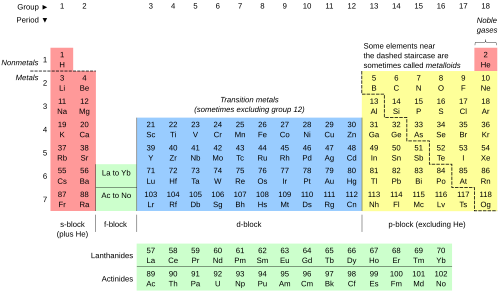
Who came up with the idea for the periodic table? The periodic table was first made by a Russian chemist called Dmitri Mendeleev in 1869.
You have definitely seen the periodic table of elements. Currently, it has 118 elements on it. The first 94 of those are naturally occurring elements and the other 24 have to be synthesized in a lab. Theoretically, there are more elements that could be synthesized, but as elements become heavier, they become much more unstable. This is because as nuclei get larger, proton–proton repulsion increases, and it becomes harder for the strong nuclear force to keep the nucleus stable, so very heavy elements tend to be radioactive and decay.
The periodic table organizes elements by their atomic numbers. Atomic numbers are the number of protons that are in an element’s nucleus. An atom of any element has a nucleus that is surrounded by orbiting electrons. The nucleus is made up of protons and neutrons. The number of protons is the atomic number of an element and an atom always has the same number of electrons as protons. (Unless they have been knocked off or added to.) Protons have a positive charge, and electrons have a negative charge. Neutrons are neutral. Several different forces hold an atom together. The negative electrons are attracted to the positive protons through the electromagnetic force. The protons and the neutrons are attracted to each other by the strong nuclear force.
Dmitri Mendeleev came up with the periodic table idea, but he organized it by atomic mass and not atomic number, because atomic numbers would not be discovered until the early 20th century. The atomic number is the number of protons in the nucleus. The mass number is the number of protons plus neutrons in a particular atom. Atomic mass had been proposed by an English chemist called John Dalton in about 1800.
Mendeleev wasn’t the first person to attempt to organize the elements. Chemists had been trying to do it for about 50 years with no real success. They tried to group them together in groups, such as metals, and non metals. That is tricky because that doesn’t give a very useful table. A German chemist called Johann Wolfgang Dobereiner tried to order them in groups of three. He noticed that the middle element in each group of three had an atomic weight that was the average of the other two. This worked for a lot of groups, but it didn’t work for all of his groups. Meanwhile, people had been working out the atomic weights of as many elements as they could and in 1860 a fairly comprehensive list of elements and their atomic weights was published. Hydrogen was taken as 1 because it had the lowest atomic weight and all the other elements were ordered by their comparison with hydrogen.
A British chemist called John Newlands tried to make a table with the elements organized by atomic mass. It worked for the main elements, but didn’t work for all of the elements. The elements seemed to follow a pattern and then suddenly they didn’t. He couldn’t solve the problem.
Dmitri Mendeleev decided he was going to work it out and he realized what the problem was. It took him about a day. The 17th of February 1869. He was looking at all of the elements and he suddenly realized that the reason they didn’t seem to fit in the system was because the atomic weights had either been calculated incorrectly or there were still elements that hadn’t been discovered. He didn’t know what these elements were, but he could clearly see how they would go in the spaces. He wrote up his periodic table and published it in the journal of the Russian Chemical Society. He was proved correct a few years later when a French chemist discovered gallium in 1875, an element that Mendeleev had predicted existed. Then, again, in 1879 when a Swedish chemist found scandium, which was another element Mendeleev had predicted. The last one he was missing, germanium, was discovered shortly after that.
Today, the periodic table is ordered by atomic number rather than atomic weight. Despite all of Mendeleev’s work, there were still a few elements that didn’t fit into the table, and it was only after the discovery of atomic numbers in the early 20th century that the reason was known. Some elements, such as iodine, have a higher atomic number but a lower atomic mass. These discoveries fixed that and gave us the periodic table that we have today. And this is what I learned today.
Sources
https://www.asbmb.org/asbmb-today/science/020721/a-brief-history-of-the-periodic-table
https://en.wikipedia.org/wiki/Periodic_table
https://ehss.energy.gov/ohre/roadmap/achre/intro_9_3.html
https://en.wikipedia.org/wiki/Atom
https://en.wikipedia.org/wiki/Henry_Moseley
https://en.wikipedia.org/wiki/Atomic_number
https://en.wikipedia.org/wiki/John_Dalton
Image By Lekritz – Own work, CC BY-SA 4.0, https://commons.wikimedia.org/w/index.php?curid=185001042