
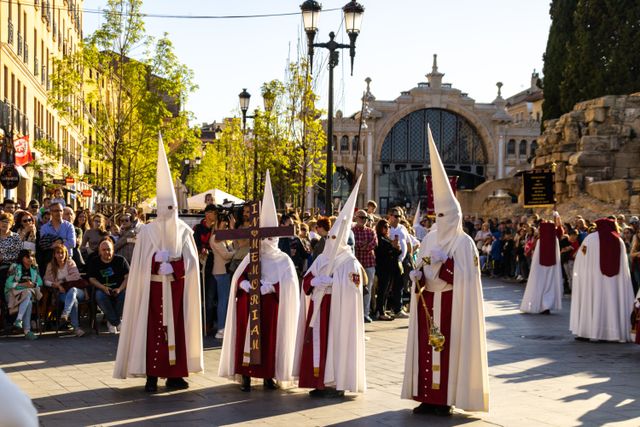
What was the Spanish Inquisition? The Spanish Inquisition was a judicial institution, run as a royal court, that investigated and prosecuted heresy and religious nonconformity in Spain (and later the Spanish Empire), and was used by the monarchy to enforce Catholic religious conformity.
“Inquisition” just means “inquiry.” The Catholic Church had investigated suspected heresy long before Spain created its own tribunal, but the institution we usually mean by “the Inquisition” developed in medieval Europe in the late 1100s and 1200s. In 1184, Pope Lucius III issued the bull Ad abolendam, which instructed bishops to seek out and punish heresy in their dioceses. Over the following century, the papacy increasingly relied on inquisitorial procedures and appointed inquisitors in some regions. Later inquisitions existed too (including the Roman Inquisition), and they differed from place to place. The key point is that “the Inquisition” is not one single, unchanging organization. It’s a family of institutions and methods, and Spain built the most famous one.
The Spanish Inquisition (Tribunal del Santo Oficio de la Inquisición – “Tribunal of the Holy Office of the Inquisition”) began in 1478 and lasted, with interruptions, until it was finally abolished in 1834. It was created when Ferdinand II of Aragon and Isabella I of Castile asked Pope Sixtus IV for permission to establish an inquisition in their realms. Sixtus IV agreed, but what made this one distinctive was the balance of power. It became closely tied to the Spanish crown: the monarchs appointed inquisitors and directed the institution in a way that made it far more of a political tool than earlier inquisitions usually were. Proceedings were secret, and this tribunal did not operate as a court that people could simply appeal past to Rome.
That royal character also helps explain why it came to be known as the Spanish Inquisition. “Inquisition” was a general word, and by the 1500s there were multiple inquisitions people might be referring to. In English, the phrase “Spanish Inquisition” appears by 1560 (the Oxford English Dictionary’s earliest citation is in a translation by John Daus), which suggests it was being used to specify which inquisition someone meant. Over time the phrase also became a loaded label outside Spain. Spain’s rivals, especially in Protestant Europe, helped popularize a deeply negative image of Spain and its institutions (sometimes called the “Black Legend”), and the Inquisition became one of the most powerful symbols in that story.
Why did Ferdinand and Isabella want it in the first place? Two big reasons are usually given. First, they wanted religious unity as they consolidated power across the crowns of Castile and Aragon and pushed toward a more unified kingdom. Religious uniformity was a tool of state-building, especially as the Reconquista was reaching its end and the last Muslim kingdom on the peninsula (Granada) would be conquered in 1492. Second, there was intense hostility toward Jews across Europe, and Iberia had already experienced waves of anti-Jewish violence and pressure to convert. That meant there was a large population of conversos (Jews who had converted to Christianity), and many Christians suspected that some of these converts were still practicing Judaism in secret. In other words, yes: anti-Jewish prejudice and suspicion of “false converts” were central to the Inquisition’s early purpose, even though the institution later expanded its targets.
In the first years, the system was relatively small, with tribunals established in major cities, but it grew quickly and harshly. In the early 1480s, some tribunals executed large numbers of people, especially in cases connected to alleged judaizing. The crown also created a central governing body, the Suprema (Council of the Supreme and General Inquisition), and in 1483 the office of inquisitor general was formalized, with Tomás de Torquemada becoming the first to hold it for Castile. Over time, the Inquisition’s focus widened. It pursued different kinds of “heresy” depending on politics and fear at the time, including alleged crypto-Judaism, later suspicion toward Moriscos (Muslims who had converted), and later still concerns linked to Protestantism and the policing of books and ideas. It also spread beyond Spain into the Spanish Empire, with tribunals established in parts of the Americas.
So what did the Inquisition actually do day to day? It investigated accusations and encouraged denunciations. The details varied by time and region, but a few features show up repeatedly. Proceedings were secret, and witnesses could be protected, which made it difficult for the accused to confront the evidence directly. Denunciations could be misused for personal, political, or financial reasons, because anybody could accuse anybody. Property could be seized, partly to prevent people from fleeing and partly to cover the costs of the trial. The accused could be held for long periods while the court gathered testimony and tried to build a case.
It is also worth pointing out that it was not a totally “anything goes” system. The Inquisition had rules, paperwork, and internal procedures, and defendants had some limited options. In some places, defendants could try to disqualify testimony by giving the court a list of “mortal enemies” who might have a motive to lie. Defendants could receive legal counsel, but that counsel operated within the Inquisition’s framework and could not simply argue the case the way a modern defense lawyer would.
Punishments ranged widely. Many people received “penances” (fines, public humiliation, religious obligations, or restrictions). Some were “reconciled” to the Church, sometimes with long-term penalties that affected their social standing. The famous public ceremony was the auto-da-fé, where sentences could be announced and religious unity displayed as a kind of theatre. In the most serious cases, the condemned were “relaxed” to the secular authorities for execution, because church courts typically did not carry out executions themselves. In other words, the Inquisition condemned, and the state executed.
Despite the legends, it is worth being precise about torture and executions. Torture did happen, but modern research generally finds that it was not used in every case and that its frequency varied by tribunal and period. Some studies find torture used in only a small minority of cases overall, while other studies of particular tribunals and decades show it being used more often. Executions were also real, and the earliest decades were the bloodiest, but most trials did not end in death. The popular image of nonstop burning is exaggerated, yet the combination of secrecy, confiscation, imprisonment, and occasional executions made the institution profoundly intimidating.
By the late 1700s, the Inquisition’s influence was declining, but it still existed. It was abolished and restored multiple times in the early 1800s amid political upheaval, and it was finally abolished permanently in 1834. Even after earlier abolitions, local “boards of faith” sometimes operated in the Inquisition’s shadow, and one case that shocked opinion was the 1826 execution of the schoolteacher Cayetano Ripoll in Valencia for heresy-related charges. The consensus across Europe was that they were beyond such medieval methods. And this is what I learned today.
Sources
file:///C:/Users/three/Downloads/2019-09-25_AlecRyrie_SpanishInquisition-T.pdf
https://en.wikipedia.org/wiki/Spanish_Inquisition
https://en.wikipedia.org/wiki/Tom%C3%A1s_de_Torquemada
https://en.wikipedia.org/wiki/Papal_Inquisition_in_Spain
https://www.ebsco.com/research-starters/history/spanish-inquisition
Photo by Sebastián Valencia Pineda: https://www.pexels.com/photo/priests-with-capirotes-and-cross-standing-on-street-in-spain-20895380/