
What is the interstellar medium? The interstellar medium is the matter that fills space between the stars in a galaxy.
The atmosphere of a star varies depending on its size, but they are all similar in that they get thinner the further out from the star you go. Once you leave the surface of the star, you have the first layer of the atmosphere, which is called the photosphere. This is the lowest layer and actually the coolest layer. All of the light that comes from a star comes from this region, which is why it is called the photosphere. The next layer up is called the chromosphere. The bottom of this layer is cool, but it gradually heats up to roughly ten times the layer of the photosphere as you go up. The temperature continues to increase until the corona, which is the outermost layer of the star’s atmosphere. The temperature here is enormous and the atoms exist in a plasma. No one knows why the corona is so hot. Beyond the corona, the star constantly releases a stream of charged particles. This creates an enormous bubble around the star called the astrosphere. Eventually the pressure of these particles becomes balanced by the surrounding interstellar medium. This boundary is called the astropause. Beyond the astropause, we are in interstellar space. The area after the astropause, until we reach the astropause of the closest star, is the interstellar medium.
The interstellar medium has very little matter in it. On average, there is roughly one atom per cubic centimeter. The air around you right now has roughly 10,000,000,000,000,000,000 atoms per cubic centimeter. That value for the interstellar medium is an average because it is not even throughout the universe. Gravity causes matter to clump together and some areas can have more atoms than others. If enough of these atoms clump together, they can start to attract more atoms, and that is the beginning of a star.
The interstellar medium consists of 99% gas and about 1% dust. A lot of the gas has been ionized. That means the electron has been removed from the atom. This can happen for many reasons, but it is most commonly caused by the energy coming from stars. Stars give off lots of energy in the form of photons. If one of these highly energized photons hits a hydrogen atom floating in space, it can give the atom’s electron enough energy to escape. When massive stars explode in supernova, these shockwaves of energy can ionize the atoms as well. Usually, this ionized atom would pick up an electron, but in the interstellar medium, there are not enough other electrons for it to get that chance.
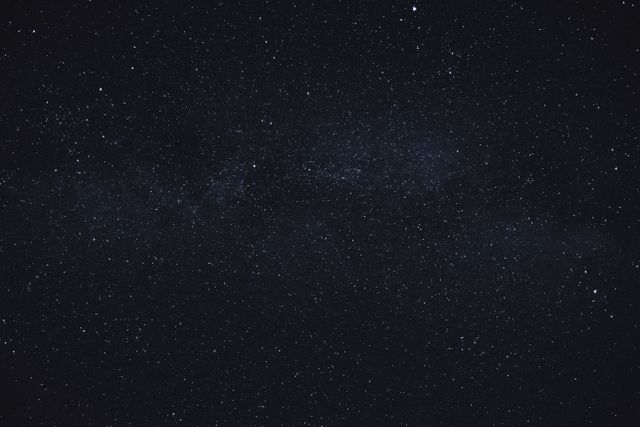
And that is one of the most interesting things here. The interstellar medium is inside the galaxy, but if we look at the intergalactic medium our distances become even more vast. When we look at pictures of space, we see all of the stars and there are enough to completely cover a photograph with specks of light. But, we forget how far apart those stars actually are. The universe appears to be large amounts of mass and then vast stretches of nothing between them, but it is actually the other way around. The average number of atoms in a cubic centimeter of space might be incredibly low, but there is an enormous amount of space. The distances between the stars is unbelievably vast. Because of this, there is far more matter in the intergalactic medium than there is in the visible stars and the planets that surround them. Probably only 10% of all matter is in the parts we can see. Most of the ordinary matter exists as extremely thing gas in the enormous spaces between and around galaxies.
The universe as a whole was much denser in the past because the same amount of matter occupied much less space. Early galaxies were also generally much richer in gas than galaxies such as the Milky Way are today. As the universe expands, the amount of space between gravitationally bound groups of galaxies increases, but the amount of matter doesn’t, which means the intergalactic medium is getting thinner and thinner. If the expansion of the universe continues forever, as scientists currently expect, distant galaxies will become increasingly separated and the intergalactic medium will become extraordinarily thin. Eventually, star formation will cease as galaxies use up or lose the gas available to make new stars. This is part of the universe’s gradual journey towards what is known as heat death. Matter that is gravitationally bound, such as stars, planets and galaxies, won’t simply be pulled apart by the expansion, but isolated atoms in intergalactic space will become increasingly far apart. The current density of the intergalactic medium could eventually feel positively crowded by comparison. And that is assuming the particles that make up atoms survive forever. The nucleus of an ordinary hydrogen atom is a single proton, and no proton has ever been observed to decay. However, some theories predict that protons may eventually decay over unimaginably long periods of time. If that happens, then in the far, far future, even much of the ordinary matter we know today could eventually disappear. And this is what I learned today.
Sources
https://en.wikipedia.org/wiki/Interstellar_medium
https://www.jhuapl.edu/destinations/interstellar-medium
https://fiveable.me/intro-astronomy/key-terms/stellar-atmosphere
https://en.wikipedia.org/wiki/Stellar_atmosphere
Photo by Kai Pilger: https://www.pexels.com/photo/cluster-of-stars-1341279/