
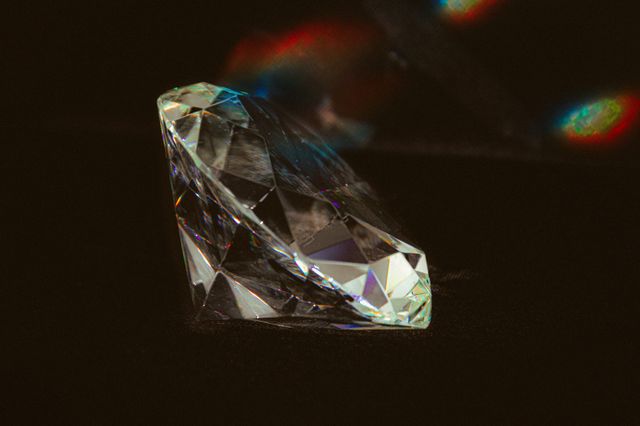
What is the largest diamond in the world? It turns out that this simple sounding question is slightly more complex. There are three different diamonds that vie for the title of largest cut diamond in the world, but each one of them is recognized for a different reason. The largest cut colorless diamond is called Cullinan I (Great Star of Africa) and weighs 530.2 carats. The largest cut gem-quality diamond is called the Golden Jubilee Diamond, and it weighs 545.67 carats. For many years, it was commonly described as the largest cut diamond in the world, although it has a yellow-brown hue, which puts it in a different category to the Cullinan I. The third is the largest cut black diamond, called the Black Falcon, and weighing in at 612.34 carats. This makes it larger than the other two, but it is not considered to be gem-quality.
The Golden Jubilee Diamond is the largest gem-quality cut diamond, but people often ignore it because of its color. They think that a diamond should be colorless. However, there are many different colors of diamond, and a diamond is defined as “a natural mineral made of pure carbon in a crystal structure.” Inside the diamond, all of the carbon atoms connect to four other carbon atoms in a repeating pattern known as a tetrahedral pattern. A tetrahedron is a three-dimensional shape that has four triangular faces. This structure gives diamond its strength and its beauty when polished.
Different colors have different causes. Nitrogen can make diamonds yellow, while boron can make them blue. Green diamonds are often colored by radiation damage, while the colors of many pink and brown diamonds are associated with distortions in their crystal structure. Black diamonds usually get their appearance from large numbers of dark inclusions and structural defects.
Another reason why the Cullinan Diamond is cited as the world’s largest is that it was enormous before it was cut up into smaller diamonds. When the Cullinan Diamond was found, it was a rough diamond of 3,106 carats, weighing 621 g. It was cut up in 1908 and made into the Cullinan I, Cullinan II, and a lot of other smaller diamonds. When it was found, the Cullinan showed signs of having been cleaved from another part. This suggested that the Cullinan itself might once have been part of an even larger diamond. If other pieces existed, they have never been found.
OK. Let’s look at each diamond. The Black Falcon is technically heavier than any of the conventional cut diamonds, although it is an opaque black diamond sculpted into a falcon’s head rather than a transparent faceted gemstone. It was found in Guinea in 2008 and sent to a diamond cutter called Peter Herbosch. He took seven years to cut it into the head of a falcon, hence its name. It took him so long because black diamonds don’t have cleavage planes, which are the lines along which diamonds are usually cut. He had to do all of the cutting with high energy lasers. The Black Falcon knocked another large diamond off the list when it was made. Another black diamond called the Enigma had been the largest black diamond up until the Black Falcon. Although, the Enigma wasn’t just a simple black diamond. It is a carbonado, which is made from masses of microscopic diamond crystals that fused together. There is also a theory that it formed in space.
The Golden Jubilee Diamond was found in the Premier Mine, east of Pretoria. It is also where the Cullinan Diamond was found. The diamond was cut in 1990 by a diamond cutter called Gabriel Tolkowsky. The finished stone was displayed in several places and ended up in Thailand. A group of Thai businessmen loved the diamond and they purchased it to celebrate the Golden Jubilee of King Bhumibol Adulyadej. It is now part of the Crown Jewels of Thailand.
And the Cullinan I diamond was found at the same mine in 1905. It was cut by a Dutch diamond cutter called Joseph Asscher. The prime minister of the Transvaal colony, which became part of South Africa, called Louis Botha had his government buy the diamond to present to King Edward VII of Britain. Britain had just defeated the two Boer republics and the Transvaal government wanted to demonstrate its loyalty to Britain. The diamond was placed in the top of the Sovereign’s Scepter with Cross and is part of the crown jewels. Whether it was ok for the king to accept such a gift is another matter. And this is what I learned today.
Sources
https://shimansky.com/pages/learn-about-diamonds-famous-diamonds
https://en.wikipedia.org/wiki/Cullinan_Diamond
https://www.rct.uk/collection/stories/the-crown-jewels/the-cullinan-diamond
https://internetstones.com/golden-jubilee-diamond-famous-jewelry.html
https://museumsvictoria.com.au/article/how-do-diamonds-get-their-colours
https://en.wikipedia.org/wiki/Golden_Jubilee_Diamond
https://en.wikipedia.org/wiki/Black_Falcon_(diamond)
Photo by Lany-Jade Mondou: https://www.pexels.com/photo/close-up-of-gem-11099147/