
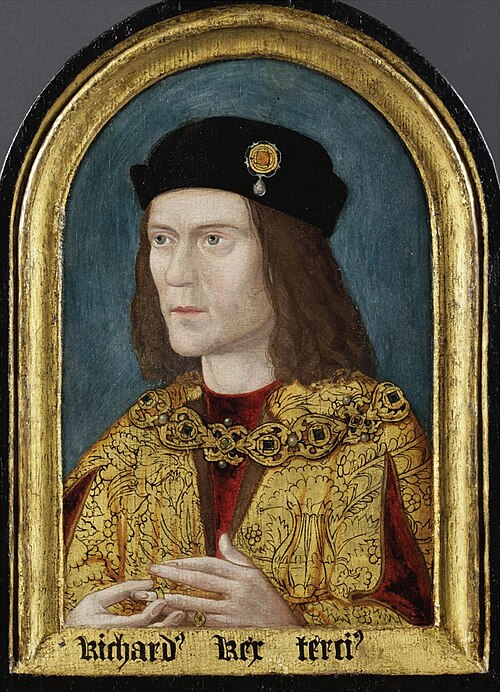
Who discovered Richard III’s body? Richard III’s body was found by the screenwriter Philippa Langley and archaeologists from the University of Leicester.
Richard III was born in 1452, and he was king from 1483 to 1485. This rule of 2 years and 57 days makes him the monarch with the shortest reign in English history, if you don’t count King Edward V who was probably murdered in the Tower of London and King Edward VIII who abdicated just inside of a year. Richard III was killed at the Battle of Bosworth during the Wars of the Roses. He is the last king to have been killed in battle and the last king in the Plantagenet dynasty. His death made way for King Henry VII, a Tudor, to take the throne and the line of royal succession changed.
Richard III is famous for many things, but one of the most famous is probably the incident of the Princes in the Tower. His elder brother Edward and younger brother Richard were imprisoned in the Tower of London. Richard declared Edward illegitimate and took the throne for himself. Later in the year he was crowned, the two princes disappeared from the Tower and were never seen again. There are many theories and no evidence, but in all likelihood, they were murdered to remove any danger of a challenge to Richard’s throne. Whether Richard had someone do it, or it was done without his knowledge, is not known. He was also famous for his distinctive curved spine that developed when he was young.
Among the many mysteries surrounding King Richard III was his burial place as well. It wasn’t a secret, it was just lost through the passage of time.
King Richard was killed at the Battle of Bosworth. There was an ongoing war between the houses of York, of which Richard belonged, and the Roses, which were the Tudors. Things came to a head at the Battle of Bosworth and at the start it looked doubtful that Henry could win. His forces were outnumbered almost two to one. However, after the battle had started, several of Richard’s closest supporters switched sides, changing the odds in Henry’s favor. When Richard saw this, he led a cavalry charge into Henry’s ranks and came very close to being able to kill Henry. For all his faults, he was very brave. He was stopped before he could harm the king and surrounded by the troops that had earlier been on his side. He was unceremoniously killed.
After his death. Henry proclaimed victory and Richard’s body was stripped and carried back to Leicester. Henry needed to display the body to establish his right to become king. After being displayed for a couple of days, the king’s body was buried in Greyfriars Church in Leicester. 10 years later, King Herny VII appears to have paid for a marble monument to go over the burial place. Perhaps he felt bad at the way Richard’s body had been treated, or perhaps he felt secure enough in his own kingship that he could afford to be gracious.
After the burial, time passed and the church and monument were both demolished when Henry VIII had the monasteries dissolved. The land was bought by a nobleman and a series of buildings were built over Richard’s grave. In the late 18th century, a road was built there and several buildings were put up along it. In the 19th century, a school was built before more roads were built and the area became very urbanized. However, the name stayed and Grey Friars and Friar Lane met there. By the early 21st century, there were more buildings and a car park over the king.
Fast forward to the modern day and many historians believed that they new roughly where Richard was buried. However, nobody could get permission to dig for him. Finally, in 2012, Philippa Langley and the University of Leicester had another go. Their research narrowed down the possible site to an even smaller area and they managed to get permission to dig. The asked and received half of the necessary funding to dig from the Richard III society and went ahead. They had a two week dig planned, but on the very first day they unearthed a skeleton that had been buried in a too small grave. The skeleton had severe head and battle wounds and a pronounced spine curvature. They believed they had found King Richard III’s body.
It took five months to verify the body. The first step was DNA. They took DNA from the skeleton and tested it against King Richard’s living relatives. The researchers were able to trace Richard’s family tree down to a cabinetmaker and an Australian resident, both living in London. They tested their DNA and it showed a strong connection. They also looked at the skeleton and the age of the person when they died was judged to be late twenties to early thirties, which Richard had been. He was 32. And finally they carbon dated it, which gave a date of 1455 to 1540, which was just right. After five months, it was confirmed to be Richard III.
After the discovery, King Richard’s skeleton was given a proper burial in Leicester Cathedral. And this is what I learned today.
Sources
https://en.wikipedia.org/wiki/Exhumation_and_reburial_of_Richard_III_of_England
https://en.wikipedia.org/wiki/Greyfriars,_Leicester
https://en.wikipedia.org/wiki/Richard_III_of_England
https://kriii.com/about-kriii/an-incredible-discovery
https://en.wikipedia.org/wiki/List_of_monarchs_in_Britain_by_length_of_reign