
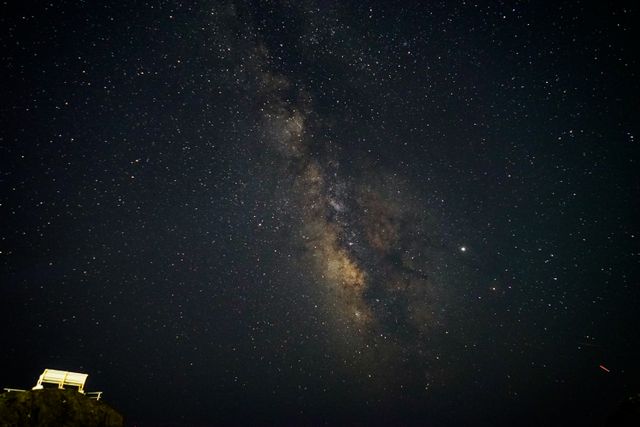
What will happen to the Milky Way in 1 trillion years time? Some or perhaps most of the galaxies in the Local Group may have merged by then, although it is no longer certain that even the Milky Way and Andromeda will merge. No stars outside of that galaxy would be visible to any beings living in our galaxy. We would be able to see far fewer stars in our Milky Way.
In 1 trillion years, there will be no trace of our planet Earth left. When the sun reaches the end of its current stage, it will expand and burn up the Earth. There will still be traces of the sun left, though. After it finishes its current phase, in about 5 billion years, it will shed its outer layers and shrink into a glowing white dwarf about the size of Earth. Over the next trillion years, that white dwarf will slowly radiate its remaining heat into space and once it has cooled enough, it will become a black dwarf. It will be a dark ball of carbon and oxygen floating in the galaxy. However, what that galaxy will look like is conjecture.
The Milky Way is roughly 13.6 billion years old Some of the oldest stars in the Milky Way formed very early in the history of the universe, and the galaxy grew over billions of years through the merging of smaller structures. There are older galaxies, but it is one of the oldest ones that we know of. It has undergone a lot of changes over the last 13 billion years, and it will undergo a lot more over the next trillion. Let’s have a look at some of them.
The first question is whether the Milky Way and all of the galaxies in the Local Group will collide or not. There are only really two possibilities. They will collide and make one enormous galaxy, or the smaller galaxies will collide with Andromeda and the Milky Way and make two very large galaxies. Up until last year, it seemed likely that Andromeda and the Milky Way were on a collision course. However, recent simulations have shown that there is only a 50 50 chance that this will happen. For them to merge, they need to come within 650,000 light years of each other. That sounds like an enormous distance, and it is, but if they come within that, the huge halos of dark matter that each galaxy has interact, this removes orbital energy, and the two galaxies slowly spiral into each other. If that happens, then we have Milkomeda. If they don’t come close enough, they sail past each other and probably continue orbiting separately for the remainder of the life of these galaxies.
Whether or not the galaxies join, what happens next will happen everywhere. As we get up towards 100 billion years, there is not much gas left and there are fewer and fewer young stars. The galaxy becomes dominated by smaller, much longer lived stars. Then, once we get beyond 100 billion years, any intelligent beings left in the Milky Way would no longer be able to see galaxies outside the Local Group. The expansion of the universe would have carried all other galaxies beyond the horizon of the visible universe. We are lucky to have been born when we are. Future astronomers could potentially conclude that their galaxy was the entire universe. Evidence for the Big Bang and cosmic expansion would be enormously harder to discover.
Once we get to a trillion years, star formation would probably be extremely rare because most of the usable gas for making new stars would have been exhausted, locked into stars and remnants, or otherwise unavailable. The stars that are left are mostly red dwarfs and the galaxy is much dimmer and redder than it is today. If Earth was still here, someone looking up at the night sky wouldn’t see the brilliant band of the Milky Way that we can see today.
And what if we go past a trillion years? The smallest red dwarfs continue to shine, so the Milky Way isn’t dark. By 100 trillion years, almost all red dwarfs have exhausted their supply of hydrogen and the galaxy is dominated by the remains of stars. It is full of white dwarfs, neutron stars, brown dwarfs, and black holes. Most of these objects don’t emit light and the majority of the Milky Way would be dark. Except for when they crash into each other. Two brown dwarfs might collide and form a star massive enough to start burning hydrogen again. These collisions might occasionally put a new star, a new point of light, in the heavens.
However, the remains of the Milky Way could last much longer than 100 trillion years. Over unimaginable lengths of time, gravitational interactions would gradually throw stars and stellar remnants out of the galaxy, while others would fall towards its center. Eventually, perhaps around 10¹⁹ or 10²⁰ years from now, the galaxy itself would cease to exist as a recognizable gravitational structure. Black holes could survive vastly longer, with the largest taking perhaps as long as 10¹⁰⁰ years to evaporate. And this is what I learned today.
Sources
https://www.pbs.org/wgbh/nova/article/physics-in-1-trillion-years
https://en.wikipedia.org/wiki/Future_of_an_expanding_universe
https://www.universetoday.com/articles/cosmology-in-the-year-1-trillion
https://spaceplace.nasa.gov/galaxies-age/en
Photo by S S: https://www.pexels.com/photo/milky-way-3083808/