
How was the City of Ur lost and then found again? Ur was lost because of political collapse, terrible invasions, and environmental changes. There was a suspected ancient city known about at the site for hundreds of years, but it was finally excavated and identified at the end of the 19th century.
The City of Ur was a powerful city state in Sumer, in ancient Mesopotamia. It is located in the southern part of modern Iraq. At its peak, between 50,000 and 70,000 people lived in the city, making it probably the largest city in the world at the time. It reached its peak in roughly 2000 BC, a time when most people on Earth were living in tiny agricultural communities.
People first settled the area that became Ur in about 5000 BC. The area was a relatively small settlement surrounded by marshland. Over then next two thousand years, the town gradually grew as southern Mesopotamia urbanized. Irrigation was set up to allow the farmers to grow more in the arid conditions. Once they could produce more food, the town was able to grow and trade with other towns developed. Once the town was big enough, it became necessary to have a government system to manage the city and Ur developed one of the earliest and most complex systems of government in the ancient world. Ur was close to the head of Persian Gulf and it was surrounded by rivers, channels and marshes. However, they lacked a lot of necessary resources, such as good building stone, useful metals, and timber. Archaeological discoveries found objects made with materials that had come from places like Afghanistan, showing that Ur participated in international trade 4,500 years ago.
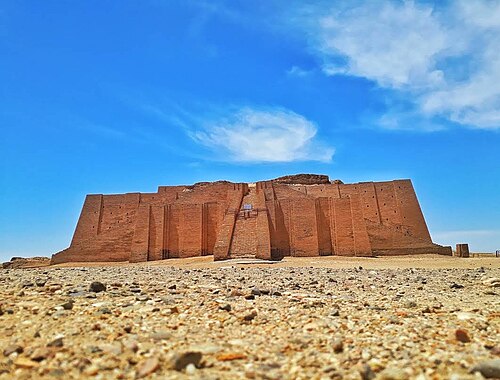
By 2600 BC, Ur is one of the wealthiest city states in Mesopotamia. In 2112 BC, Ur-Nammu takes power and he founds the Third Dynasty of Ur, which lasts for slightly over two hundred years. This is the point where Ur reaches its peak of population and power. Ur-Nammu also commissions the Great Ziggurat of Ur, a building which is still standing over four thousand years later. In 2004 BC, the Third Dynasty collapses and Ur is invaded. It loses its position as an imperial capital and is ruled by other Mesopotamian powers. It is still an important city and a religious center, but it has no real power. Then, between 500 and 300 BC, the city slowly declines and by 300 BC it has been abandoned. When the last person left is unknown, but it would remain empty for the next two thousand years.
Exactly why Ur was abandoned is not known, but there are several likely reasons. Firstly, as its power and its ability to defend itself waned, Ur was invaded by other powers. People living in a city will only put up with being invaded so many times before they decide to go and live somewhere safer. Secondly, the government probably collapsed. Constant invasions and a fleeing population make it very difficult for a government to rule. Whether the people leaving caused the government to collapse or the government collapsed because the people were leaving is unknowable, but it was certainly a factor. And, lastly, there was significant environmental change. The rivers in the area deposit a lot of silt, which means they constantly move. The rivers moved too far away from the city to be useful for irrigation and the coastline of the Persian Gulf was also changed by the sediment. It became too hard to get water and grow food.
The city was abandoned, but people did still know something was there. Most of the buildings were made of mud brick, rather than stone, so there weren’t many ruins left. The wind and sand turned them into mounds. In 1625, an Italian composer called Pietro Della Valle was traveling through the area and he noticed ancient bricks that were stamped with strange symbols. He also found pieces of black marble that looked like official seals.
Then, in the 19th century, people began to decipher cuneiform. The British vice-consul at Basra was sent to investigate the location in 1853. He conducted a dig and found many inscribed clay cylinders, which had information about the city. They were able to identify it as Ur. Then, in 1922, Leonard Woolley spent 12 seasons excavating the site. Interestingly, this was the same time Howard Carter was excavating Tutankhamun. They found graves, houses, temples, more tablets, and the royal cemetery. They also found an enormous number of artifacts. Many of these structures were over a thousand years older than the tombs being excavated in Egypt. And this is what I learned today.
Sources
https://thedarkatlas.com/posts/ur-mesopotamia-first-city-iraq
https://stuffaboutlondon.co.uk/stuff-about-london-blog/the-4500-year-old-standard-of-ur
https://en.wikipedia.org/wiki/Ur
https://www.worldhistory.org/ur
Image By مجتبى حميد (Mojtaba Hamid) – Own work, CC BY-SA 4.0, https://commons.wikimedia.org/w/index.php?curid=95083247