
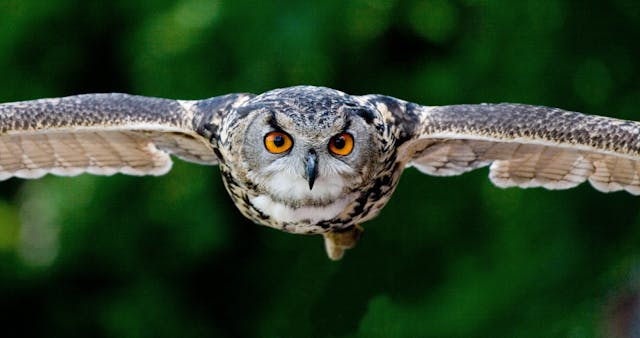
How do owls fly silently? Owls have specialized feathers that allow them to fly silently.
If you live outside of a city, you may have heard owls hooting at night. You may even have heard them if you live in a city, because these days there are a lot of urban owls. It is not easy for them, but they live on buildings and hunt along the streets at night. You may have heard owls rustling around on the branches or in their nests, although that is unlikely. However, one thing you will definitely not have heard is a flying owl. They fly almost without making any sound. The majority of birds make a rustling sound as they fly because their feathers are fairly hard and their wings rub against their bodies a little as they flap them up and down. The air turbulence that they make with their flapping wings also makes a noise. Owls don’t make this sound. Let’s look at why.
Owls fly in the same way as any other bird. Birds use powerful muscles in their chests to flap their wings up and down. The shape of their wings generates lift and thrust, carrying them up and forwards. To keep them aloft, the feathers in their wings have to be very strong and stiff. They have a very strong central shaft that is shaped to withstand the forces and attached to their bones with strong tendons. The feathers also interlock with each other for extra strength. This all enables them to fly, but stiff wings make a lot of noise.
Owls can obviously fly. They don’t fly as quickly as a lot of birds, but they can still reach speeds of 64 km/h. Instead of speed, they prioritize silent flying. They have wings that are relatively large for their body mass, which let them fly very slowly and glide easily. The slower they fly, the less noise they produce. Owls are nocturnal birds, and they hunt mostly at night. They will eat insects, small birds, reptiles, and even fish, but their main source of prey is mammals. Mammals that move at night have a very good sense of hearing and are far more likely to detect predators that make a noise than animals that are awake during the day. At night, sound carries further because there are not as many background noises to swallow it up. Owls have evolved the ability to hunt silently for this reason. There is also the possibility that they have evolved to fly silently so that they can hear their prey more accurately. We often think about the eyesight of an owl, but they also have exceptionally good hearing. Their ears are slightly offset, with one of them being lower than the other, which allows them to pinpoint the location of a sound more accurately than we can. Their hearing is said to be so good that they can hunt in pitch darkness. Rustling from their wings would get in the way of that sense, so they have evolved to fly silently.
Owls can fly silently because of their wing feathers, and they have three basic adaptations that make their feathers different from those of other birds. The first adaptation they have is comb-like serrations on the leading edge of their wings. When normal birds flap, there is a swooshing sound. These comb-like teeth cut up the wind as it flows over the wind and break it into smaller streams, which produce much less sound. The second adaptation they have is a soft velvety texture on the surface of their wings, like a soft down. This down dampens the air that is coming over the bird and absorbs any of the sound that is over 2,000 hertz. The third adaptation is a soft fringe on the edge of each feather that breaks up and dampens the sound even more. All of these things make owls silent.
Although it is not correct to say all owls, because the amount of noise an owl makes when flying depends on the kind of prey it hunts. Owls live all around the world, and owls that eat fish, which can’t hear them coming, tend not to have the same sound dampening properties as owls that hunt mammals. Owls also don’t have this ability when they are born. Their adult feathers have to grow in first. And this is what I learned today.
Sources
https://www.audubon.org/magazine/silent-flight-of-owls-explained
https://animals.howstuffworks.com/birds/owl-fly-silently.htm
https://en.wikipedia.org/wiki/Flight_feather
https://www.bto.org/get-involved/volunteer/projects/completed/owl/learn-about-owls/owl-hearing
Photo by Pixabay: https://www.pexels.com/photo/tanning-photography-of-flying-eagle-owl-357159/