
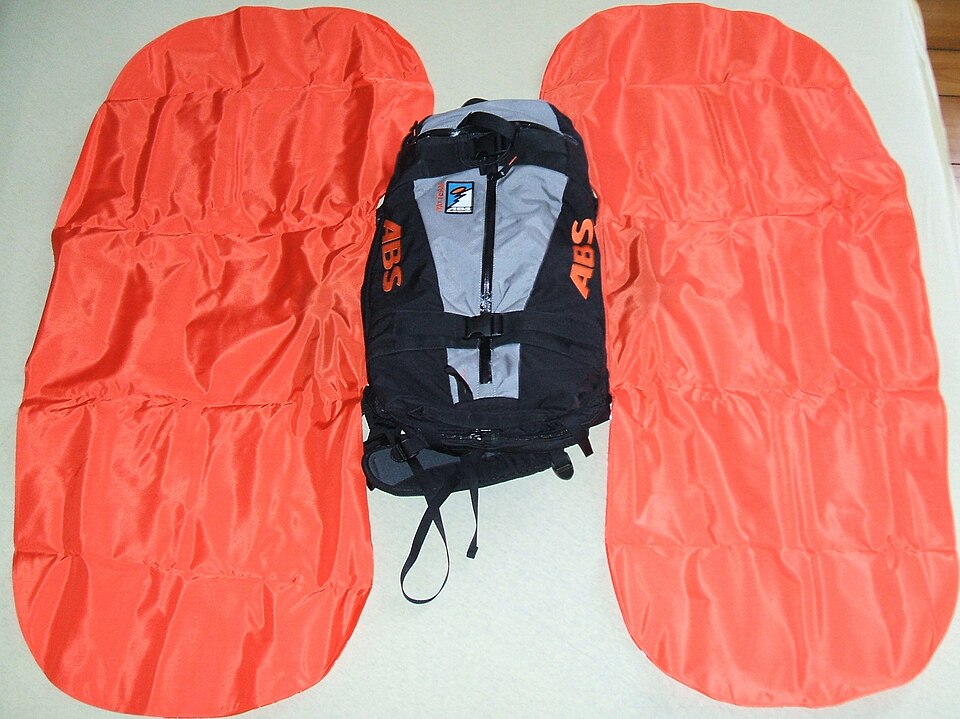
What is an avalanche airbag? An avalanche airbag is a backpack that contains an inflatable balloon to increase the wearer’s volume.
An avalanche happens when the snowpack separates from the ground and is pulled down the mountain by gravity. They can happen when there has been heavy snowfall, and the snowpack becomes too heavy to stay anchored to the ground. They can happen when the snow starts to thaw and freeze, which can break it loose from the ground. Or it can happen when vibrations shake the snowpack loose. These vibrations can be caused by earthquakes or even single skiers skiing across the snowpack. 90% of avalanches that trap are killed by people are triggered by the victim or someone in the victim’s party. That makes sense because you need people to be there for the avalanche to trap or kill people. The size of the avalanche depends on the amount of snow, the type of snow, the gradient of the slope, and many other factors. There is no way of knowing when an avalanche will start, but it is possible to see where an avalanche is likely. In area where a lot of people ski, avalanche patrols often trigger avalanches to get them out of the way when there are fewer people around.
Avalanches kill more than 150 people every year. If people are caught in an avalanche, they can be killed either by blunt force trauma, suffocation, or hypothermia. Blunt force trauma comes from the rocks and trees that are carried along by the avalanche. Depending on the size of the avalanche, it can pick up large boulders, and being hit by one of those is often a cause of death. The second cause of death is suffocation. While the snow is moving, it has a lot of air in it, but as soon as it settles, the air gets pushed out, and it sets hard like concrete. If somebody is buried by an avalanche, it is almost impossible for them to dig themselves out, and unless they have an air pocket in front of their face, they won’t be able to breathe. Their body heat also melts the snow around them, which then refreezes, becoming even harder and air-tight. Their mouth and nostrils may also have been packed with snow during the descent. If someone can be dug out quickly enough, they may survive, but they need to be found very quickly. Dogs can smell people stuck in avalanches, and there are balls on ropes that a person caught in an avalanche can release. The ball (hopefully) stays on top of the avalanche, and it has a 12 meter long rope that leads to the buried person. These days, balls and ropes are not very common. Radio beacons are far more common, and they can transmit a signal through the snow. The last cause of death is hypothermia, and that will set in if it takes a long time to rescue the person. Chances of survival are said to be 85% if the person is found within 15 minutes, 50% if they are found within 30 minutes, and 20% if they are found within an hour.
This is where avalanche airbags come in. An avalanche airbag is a backpack that contains a large inflatable airbags inside it on either side. When someone is caught in an avalanche, they pull a toggle, like a ripcord on a parachute, to deploy the airbag. Gas canisters fire, and the airbags fill in milliseconds. The idea of the airbags is not to protect the person from impact with rocks and trees because the airbag will not be able to help there. The idea is to make the person as large as possible. When an avalanche streams down a mountainside, the pieces of snow and ice in it move like a fluid, but they are granular materials. They are subject to something called granular convection. If a granular material is shaken, the largest pieces will slowly move to the top, and the smallest pieces will sink to the bottom. This is because there are more spaces for the smaller pieces to fit into, and as they fill the spaces, the larger pieces get pushed upwards. You can see this if you shake a bowl of mixed nuts. The nuts will move in a circular pattern, and the large pieces will gradually come to the top. The idea with an avalanche airbag is to make the person one of the larger pieces, so that they stay on top of the avalanche as it is moving. They have far more chance of being rescued and surviving if they are on top of the avalanche when it settles. Some skiers have trouble taking the compressed gas cylinders through airports, and they are very expensive to get refilled. A company has created an avalanche airbag that is inflated by a battery-powered fan. It only takes 3.5 seconds to inflate, which is fast enough, and it can be rescued. It will even work if the airbag is ripped because the airflow from the fan is constant. An avalanche airbag can reduce your chances of dying by about half. If you are going to be skiing in avalanche areas, they are definitely worth getting. And this is what I learned today.
Sources
https://beaconreviews.com/airbags.php
https://en.wikipedia.org/wiki/Avalanche_rescue
https://en.wikipedia.org/wiki/Granular_convection
https://www.livescience.com/health/more-people-are-surviving-avalanches-than-decades-ago-here-s-why
https://education.nationalgeographic.org/resource/avalanche
Image By User:Nolispanmo – Own work, CC BY-SA 3.0, https://commons.wikimedia.org/w/index.php?curid=6007084