
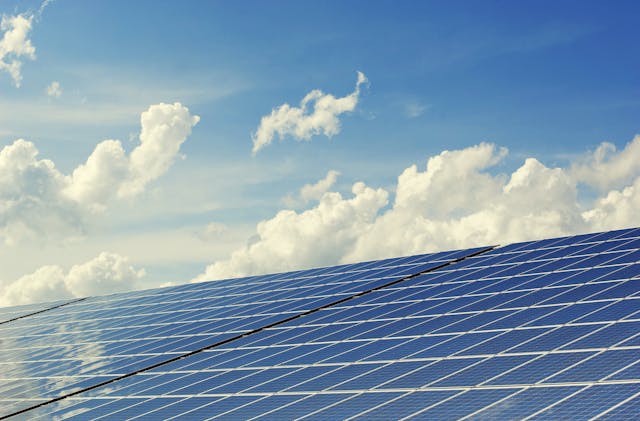
What are perovskite solar cells? Perovskite solar cells are a type of solar cell that could potentially replace regular solar cells because they are thin, lightweight, cheap to make, and potentially very efficient.
There are different types of solar panel technology at the moment, but the majority of them work with silicon semiconductors. Silicon is abundant (it ultimately comes from silica in sand), and its atomic structure makes it excellent for electronics. A semiconductor is a material whose conductivity can be controlled by adding tiny amounts of another element, a process called doping. A conductor, like metal, conducts easily all the time, and an insulator, like plastic, hardly conducts at all. A semiconductor sits in the middle, and you can “tune” how it behaves.
In a typical silicon solar cell, the silicon is doped in two different ways to make two layers. One layer is made “n-type” (it has extra electrons, often by doping with phosphorus). The other layer is made “p-type” (it has extra “holes,” often by doping with boron). Where these two layers meet, they form a p–n junction, which creates an internal electric field. That field matters because it helps separate electrical charges created by sunlight. When sunlight hits the cell, a photon can transfer energy to an electron and create an electron–hole pair. The internal field pushes electrons and holes in opposite directions, so they don’t immediately recombine. Once you connect the cell to a circuit, those separated charges can flow through a wire and do useful work.
For what they do, silicon based solar panels are excellent, but they have several drawbacks. They have to be large and heavy in order to generate enough electricity. They require a lot of energy to be constructed. And they can never be more efficient than 32%. That 32% is in a lab. Commercial solar panels can only reach about 20%. This is defined by something called the Shockley-Queisser Limit. This limit is because silicon has a specific bandgap, which is the range of energy that the silicon electrons can absorb. The light from the sun contains a huge range of energy, but the silicon can only absorb a certain amount of it, which means if the energy is too low, it can’t be absorbed, and if it is too high, it is wasted as heat. Commercial solar panels are even lower because they don’t operate in perfect conditions. There may be faults in the panel, dust buildup, more reflection, and many other reasons. So, no matter how good the solar panel is, it will never be able to take more than 32% of the sun’s energy. That is obviously still far better than fossil fuels, but it is not as good as the potential for perovskite solar cells.
A perovskite solar cell is not made from a particular material. Perovskite refers to the structure of the atoms within the material. The atoms are arranged in a crystal structure, which means they are very ordered. They are called perovskite because they have the same crystal structure as atoms in the mineral perovskite. In a perovskite solar cell, a combination of materials are used to increase their bandgap as much as possible. They are sometimes also paired with a thin layer of silicon because they have different bandgaps, which will increase the amount of available energy even more. Currently, lab tests have produced perovskite solar panels that are 34.6% efficient. The theoretical maximum efficiency of these cells is 43%, but that is a long way off. Still, anything above the 32% of silicon solar panels is great. These materials are not yet widely commercially available, but when they are, they will have many other advantages over simple silicon solar panels.
Apart from its efficiency, perovskite solar panels would be very thin, light, and flexible. This would allow them to be placed on the outside of buildings, even in curved sections, and they could make wearable electronics a thing. It might be possible to add solar charging to a jacket or a bag, so you can charge your devices while you are out. They could be fitted to aircraft, making electric-powered flight more of a reality. It would make it more possible to have stable electricity in developing countries as well. Perovskite solar panels can be made at a far lower temperature than silicon solar panels, which means they are more environmentally friendly, and easier and cheaper to make. This could bring down the cost of electricity.
There are still a few problems that need to be solved before perovskite solar panels become common. They are very sensitive to UV radiation and moisture. Any solar panel is going to come into contact with both of those things, so making the cells more stable is an issue. The solution would be to encase the cells in something, which would reduce their efficiency, or to use a different, more stable material. Research is ongoing. There are some commercial versions available at the moment, but estimates are that they will start to become mainstream in 2028. And this is what I learned today.
Sources
https://www.energy.gov/eere/solar/articles/pv-cells-101-primer-solar-photovoltaic-cell
https://www.energysage.com/solar/monocrystalline-vs-polycrystalline-solar
https://www.energy.gov/eere/solar/solar-photovoltaic-cell-basics
https://en.wikipedia.org/wiki/Band_gap
https://en.wikipedia.org/wiki/Shockley%E2%80%93Queisser_limit
https://en.wikipedia.org/wiki/Perovskite_solar_cell
https://en.wikipedia.org/wiki/Perovskite_(structure)
https://www.energy.gov/eere/solar/perovskite-solar-cells
https://www.longi.com/en/news/2024-snec-silicon-perovskite-tandem-solar-cells-new-world-efficiency
Photo by Pixabay: https://www.pexels.com/photo/blue-solar-panel-board-356036/