
Is there a center to the universe? No, the universe has no center. Every part of it is expanding away from every other part.
When we think of the beginning of the universe, we think of the Big Bang, and when we think of the Big Bang, we think of an explosion from one point that is expanding outwards, just like an explosion on Earth would do. If you pulled the pin on a grenade and tossed it into the air, the explosive in it would fire, and the force would head out from the point of origin, equally in every direction. The grenade would be the center of that explosion. All of the bits of metal and shrapnel would head out in equal directions, continuing until the energy they carried was lost to air resistance, and they would stop expanding. That is how we imagine the start of the universe. However, that is not accurate when we come to the Big Bang.
An analogy that is often given to explain the expansion of the universe is an ant walking on a balloon. If you put grains of sugar in a one centimeter by one centimeter grid all over the balloon and the ant walks at one centimeter an hour (I know that is slow, but it is easier mathematically), it will take the ant one hour to go from one grain to the next. If you inflate the balloon so it doubles in size, then the distance between grains of sugar has now become 2 centimeters, and it will take the ant two hours to reach the next grain. The distance from the ant to the nearest grain of sugar has doubled, but the distance from any other grain to any other grain has also doubled. The distance has increased at every point on the surface of the balloon. This is good, but a balloon is a sphere and obviously has a center, so it doesn’t work quite as well.
If we do use the balloon analogy, we need to think about it differently. To us, the center of the balloon is the point at the middle of the sphere, but that is in the third dimension and there is no way that the ant can get to it because it lives on a two dimensional plane. To the ant, there is no center in any dimension it can see. With our universe, the center could be in another dimension that we cannot see, or there may not be any “outside” at all. On the surface of the balloon, there is no actual center, but to the ant, the center appears to be the point it is at. Everything is expanding away from the ant, making it seem that the ant is at the center. The center of the universe for us is also where we are, because everything is expanding away from us, but that is the same for every other point in the universe as well. It would be easier if we took the balloon, peeled off its skin, and made it completely flat, but still gave it the ability to expand.
The Big Bang was not a single point with a single explosion; it happened everywhere in space (whatever the full size of space is), at the same time. Let’s take our grains of sugar on the balloon again. We have lots of grains of sugar, and there is a centimeter between each one. As the surface of spacetime expands, the centimeter between each grain increases, as it does with all other grains. If the grains are not equally distributed, the distance between them increases in relation to how far apart the grains are. If two grains are a centimeter apart and two other grains are two centimeters apart, when the fabric doubles in size, the distance between the various grains has become two centimeters between the first two, but four centimeters between the second two.
To find the Big Bang, you have to go the other way and reduce the space between each grain of sugar until it is 0 centimeters. At every point on the surface of spacetime, the distance between the grains of sugar is 0 centimeters. When the Big Bang happens, the distance between the grains of sugar suddenly increases. This works as an analogy, except there were no grains of anything at the very beginning. It was far too hot. It was only when the universe cooled down to about a billion degrees that protons, electrons, and neutrons could form. And that heat is another way to see that there is no center to the universe. The remains of the heat from the Big Bang is still visible. It is called the Cosmic Background Radiation. If the universe had a center, a starting point, and it exploded out like a grenade, that heat would have travelled outwards. In our universe, the CMB looks almost the same in every direction, which is what you would expect if the early universe was hot and dense everywhere, not if we were watching heat expanding away from a single blast point inside space. And this is what I learned today.
Sources
https://en.wikipedia.org/wiki/Big_Bang
https://math.ucr.edu/home/baez/physics/Relativity/GR/centre.html
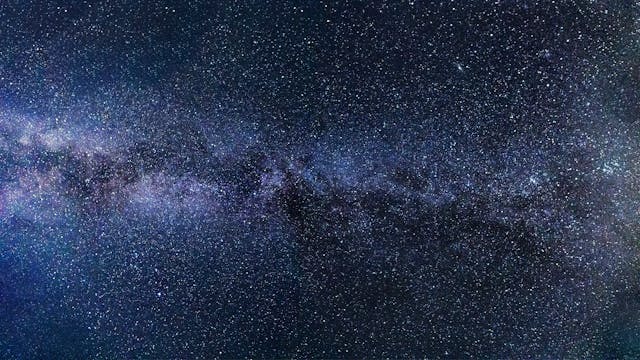
Photo by Felix Mittermeier: https://www.pexels.com/photo/blue-universe-956981/
Pingback: #1562 What is the cosmic microwave background radiation?