
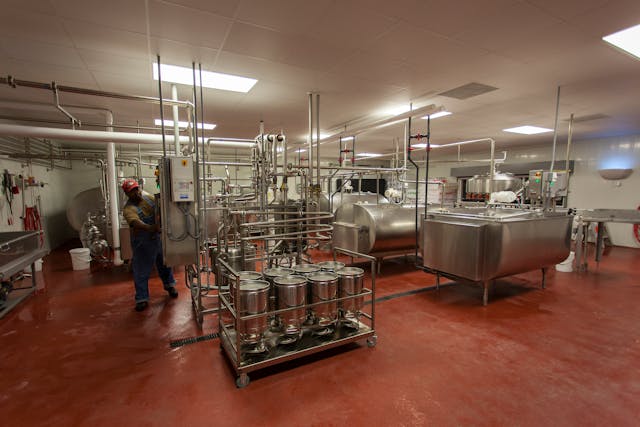
What is pasteurization? Pasteurization is the process of heating food to reduce harmful microbes and slow spoilage, giving it a longer shelf life. The process is named after Louis Pasteur, although people had been using heat to preserve food and drink long before him.
We tend to associate pasteurization with the milk industry, but all foods that are canned or bottled have to be heat treated before we buy them. Fresh food is usually safe to eat, but if you leave food for any length of time, bacteria will start to colonize the food. Some bacteria are harmless, some bacteria we actually need, but many bacteria produce pathogens that can make us sick or be fatal in extreme cases. Viruses and parasites can be involved too, and some bacteria can produce toxins that cause illness even if the bacteria themselves are no longer alive. The goal of pasteurization is to get rid of these bacteria. It is also worth being clear about terms, because we mix them up all the time. Pasteurization is a relatively mild heat treatment (typically below 100°C) designed to kill or deactivate disease-causing microorganisms and many spoilage organisms. It does not make food sterile, because some microbes (especially bacterial spores) can survive it. If you want something to sit on a shelf at room temperature for months or years, that is usually achieved by sterilization, which uses higher temperatures (often above boiling under pressure) to destroy spores and make the contents stable.
Bacteria are single-celled organisms that can make their own food, but they are not all the same. Some of them, such as blue-green algae, produce energy by photosynthesizing, but a lot of them produce energy by living off organic material. To do this, they rely on enzymes, which are the catalysts for chemical reactions. A bacterium has a cell wall that is made of proteins and fatty acids. Inside the cell wall is the cytoplasm, which contains water, nutrients, the cell’s DNA, and the important enzymes. It probably also has flagella, which it can use to maneuver around. To make food, the bacterium absorbs nutrients through its cell wall. These nutrients are then converted by the enzymes into sugars, lipids, and proteins, which are all of the things that the bacterium needs to live and to reproduce. There are many byproducts of this process that depend on the bacteria. Some of them are things that our bodies cannot produce, and those are the bacteria that we need. Some of them are pathogens that make us sick.
Bacteria have comfort zones where they function most efficiently. If the temperature is too low, as it is in a fridge, the bacteria go dormant and can’t make energy. If it is too dry, as it is in dried food, they struggle because they need water. If it is too acidic, as it is in pickled food, they cannot function. And if it is too hot, they die. Heat does three things to the bacteria. First, it denatures the enzymes, which means they lose shape and stop working, and with no enzymes, the bacteria cannot make energy. Second, the water inside them expands, and they can rupture. Third, the heat weakens the fats and proteins that holds the cell wall together. Different types of bacteria are resistant to different temperatures. Some of these are called hyperthermophile and they can survive temperatures of over 100℃. However, they need temperatures close to this range to reproduce, so they are not found in food. The bacteria that causes botulism is called Clostridium botulinum, and its spores can survive very high temperatures. Pasteurization can kill the live bacteria, but it cannot kill the spores. They need to be heated to over 115℃, which is why canned foods are heated under pressure to temperatures higher than this.
The basic idea behind pasteurization is to heat the food enough to knock down the microbes that matter, but not so much that you ruin the taste and texture. Then you cool it quickly and protect it from recontamination. Pasteurization can be done before packaging (as with most milk, which is pasteurized, cooled, and then filled into clean containers) or after packaging (as with some bottled drinks that are heated in their sealed containers). Either way, pasteurization makes the product much safer, but it does not make it immortal. If you contaminate it again after heating, microbes can grow again, which is why pasteurized foods are usually refrigerated and have a limited use-by date.
Different foods are heated to different temperatures and for different amounts of time, and those numbers come from long experimentation and safety standards. Milk is the classic example. A common modern method is high-temperature short-time (HTST) pasteurization: about 72°C for about 15 seconds. Ultra-high temperature (UHT) treatment is more intense: roughly 135–150°C for a few seconds, followed by aseptic handling and packaging. That is why unopened UHT milk can be stored at room temperature for months. (Once it is opened, it can be recontaminated, so it still needs refrigeration.)
Louis Pasteur’s main contribution was to realize where the bacteria were coming from. He had been tasked by the wine industry to work out why their wine turned to vinegar when it was aged. He worked out two things. Firstly, he worked out that the yeast was responsible for the fermentation of the fruit, producing the alcohol. And, second, he worked out that a second bacteria was entering the wine, producing the sour tasting acetic acid. He showed that this second bacteria was entering the wine from the air and was not generating spontaneously, as had been previously believed. He showed that heating the wine for a short period of time and then sealing it killed the bacteria and stopped the wine from going sour, without ruining its flavor. This led to our current understanding of how to make food safe, and the process was named Pasteurization in honor of him.
The process is named after Louis Pasteur, a French chemist, but he didn’t invent it. He did do a lot of work to prove why it worked, which is why it was named after him. Pasteur was not working with milk. He was mostly interested in wine. The first records of heating food to keep it safe for longer come from China, about one thousand years ago. Then, in 1768, an Italian scientist called Lazzaro Spallanzani showed that heating could make something sterile. Then, at the end of the 18th century, a French chef called Nicolas Appert came up with a way of preserving food in bottles. He sealed the food in the bottle and then boiled it to kill all the bacteria. A British inventor called Peter Durand ran with this and invented food canned in tin cans in 1810. Interestingly, these cans were so thick they had to be opened with a hammer and chisel, and never became popular until a way of opening them, the can opener, was invented close to 45 years after the invention of the can itself. And this is what I learned today.
Sources
https://science.howstuffworks.com/life/cellular-microscopic/pasteurization.htm
https://en.wikipedia.org/wiki/Pasteurization
https://en.wikipedia.org/wiki/Louis_Pasteur
https://www.scientificamerican.com/article/what-is-pasteurization-and-how-does-it-keep-milk-safe
https://en.wikipedia.org/wiki/Clostridium_botulinum
https://en.wikipedia.org/wiki/Hyperthermophile
https://www.britannica.com/science/bacteria/Bacterial-metabolism
Photo by Mark Stebnicki: https://www.pexels.com/photo/milk-processing-in-a-factory-2889347/