
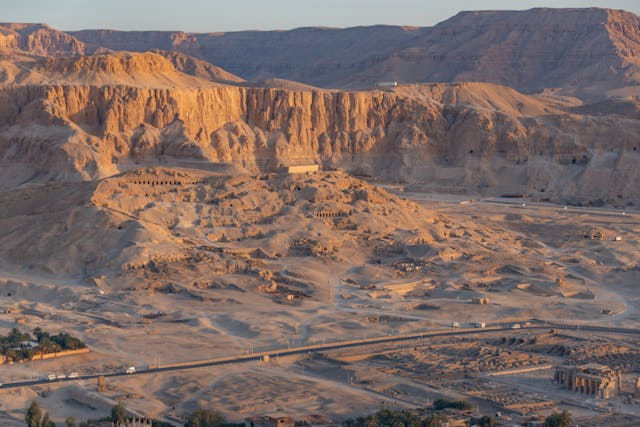
Why were so many pharaohs buried in the Valley of the Kings? So many pharaohs were buried in the Valley of the Kings because it is fairly well hidden, close to the capital, in a very religious place, and it became the done thing.
The Valley of the Kings is very close to the city of Luxor in Egypt and about 600 km south of the capital Cairo. It is an area of long limestone cliffs that curve around, all facing towards the Nile River, which is about a kilometer away. Over 60 royal tombs have been found cut into the cliffs, so far. A few more have been found this century. It is likely that there are more tombs still to find because there are several famous rulers whose tombs are not yet known. There are also several areas in the valley that haven’t been properly explored yet, and modern ground-penetrating radar makes it likely that more tombs will be found in the future. The Valley of the Kings contains many famous tombs, including Ramses II, Ramses III, and, of course, Tutankhamun.
The Valley of the Kings was not used for the entirety of Ancient Egypt. The first tombs were dug in 1539 BC, and the last tombs in 1075 BC. The entire history of Egypt runs from its unification in roughly 3100 BC to its conquest by Alexander the Great in 332 BC, so the Valley of the Kings was only used for about a fifth of the history of Egypt. So, why did they start to use it, and why did they stop?
The period that the Valley of the Kings was used corresponds to the New Kingdom period of Egypt, which ran from 1570 BC to roughly 1070 BC and the reason to move tombs to the Valley of the Kings has a lot to do with the changes that were happening in Egypt at the time. Egypt was unified by King Menes in 3150 BC, which is the beginning of Ancient Egypt. Memphis became the capital of the nation, which only remains in ruins, but was located just south of where Cairo is today. Egypt grew stronger, and kings were buried near to the capital city, which is generally the way in any country. The Pyramids of Giza were built as tombs for pharaohs in roughly 2600 BC, and they are not far from Memphis. Over time, Egypt went through periods of fragmentation and reunification until about 1650, when it was invaded by a group of people called the Hyksos. It took about a hundred years before they could be defeated, and the New Kingdom period started. The new ruler, Ahmose I, moved the center of power from Memphis to Thebes, which is where modern day Luxor is. This slowly became the new capital of Egypt. So, the obvious reason why pharaohs were buried in the Valley of the Kings for this period of time was because it was very close to the new capital city. The New Kingdom fell in roughly 1070 BC, and the capital city moved away from Thebes, never to return, which means there are no more royal burials in the Valley of the Kings.
The Valley of the Kings was also chosen because it was far more secret and easily defended location. In the Old Kingdom, burials tended to be in large, easily found tombs. The Pyramids at Giza are a good example. The idea was to make massive monuments that were a testament to the greatness of the pharaoh who was buried there. The problem with that idea was that it made them very easy for thieves to find and loot. When the capital was moved to Thebes, the Valley of the Kings seemed like a much more secret location, and all of the tombs were cut out of the rock rather than being massive monuments. The impressive constructions could be built underground, where they were hidden. The entrance to the valley was also narrow, so it would theoretically be easier to keep people away.
It turned out that that didn’t work. Almost all of the tombs were looted, and many of them almost straightaway. Often, the priests responsible for the burial, or the people who built the tombs, gave the location away in return for a share of the spoils. Some of the looters even turned into archaeologists, going over ancient sources to work out where the tombs were. When the tombs were found by archaeologists in the 19th century, they were all empty, except for that of Tutankhamun. His tomb was only left alone because its entrance was hidden by the construction of the tomb for Ramases IV.
The location for the Valley of the Kings was also chosen because of its religious significance. It was on the Nile’s west bank, which was closely tied to death and the afterlife, in part because it aligns with the setting sun. The area was already filled with temples, memorial complexes, and sacred associations. There was also a large pyramid shaped mountain there, called al-Qurn, which symbolized Hathor, the mistress of the west and the afterlife. Deities connected to the west, to protection, and to the afterlife were strongly associated with this landscape, and as more kings were buried there, the area’s sacred status only grew.
Finally, tradition did what tradition always does: it locked in the pattern. The first pharaoh to have a tomb built in the Valley of the Kings was probably Thutmose I, and once a few kings had been buried there, it became the only place that a king could be buried. The pattern ended when the New Kingdom ended, and the country’s political center shifted away from Thebes. As power moved and as the state’s ability to protect and fund major royal projects weakened, the old system of a single royal necropolis became harder to sustain. Royal burial practices changed, and the Valley of the Kings became, increasingly, a place of the past rather than the obvious future. And this is what I learned today.
Sources
https://en.wikipedia.org/wiki/History_of_Egypt
https://en.wikipedia.org/wiki/Thebes,_Egypt
https://en.wikipedia.org/wiki/New_Kingdom_of_Egypt
https://en.wikipedia.org/wiki/Valley_of_the_Kings
https://www.nationalgeographic.com/history/article/valley-of-the-kings
https://www.ebsco.com/research-starters/history/valley-kings
https://en.wikipedia.org/wiki/Memphis,_Egypt
Photo by Diego F. Parra: https://www.pexels.com/photo/aerial-view-of-archaeological-site-15131579/