
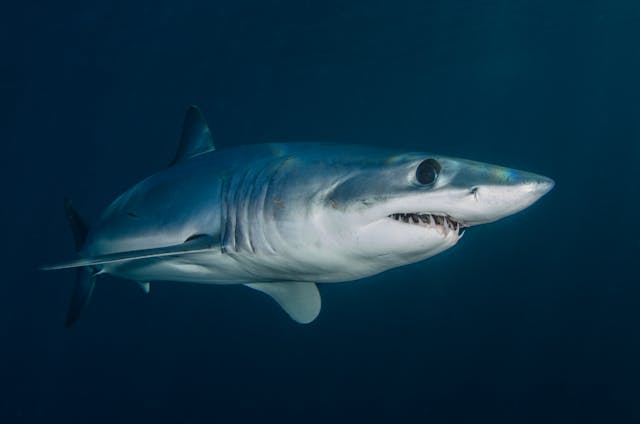
Can sharks really smell blood from a mile away? Sharks do have an incredibly sensitive sense of smell, but they can’t smell blood from a mile away. The basic problem with the myth that sharks can smell blood from a mile away is that the chemicals required for scent don’t travel that far, even in seawater.
Not all sharks have an equal sense of smell, and there are over 500 different species of shark, ranging from the tiny dwarf lantern shark, which is about the size of a human hand, to the largest, the whale shark, which can grow up to over 20 meters long. The different sizes affect the size of their nostrils, and some sharks have evolved a much stronger sense of smell than others.
A shark smells using its nose, but, unlike our noses, they don’t breathe through theirs and it is dedicated to smelling. Sharks’ nostrils are called naves and they have one on either side of their snout. Water flows through the naves as they swim and travels into two olfactory chambers, which contain flaps covered in sensory cells called olfactory epithelium. They are on flaps to increase their surface area and give chemicals more chances to land on them. These receptors detect chemicals dissolved in the seawater, translate them into electrical signals, and send them to the olfactory bulb in the shark’s brain. This is an enlarged area of the brain that is devoted to detecting scents. Because they have naves on both sides of their heads, they can use the strength of a scent in one side or the other to detect which direction the scent is coming from and track prey. Sharks also have something called ampullae of Lorenzini in their snout as well. These are used for detecting electrical fields, and they can use that to detect prey as well.
When sharks are trying to detect scents, they are helped because the chemicals that they are detecting travel further when dissolved in water than they do in air. We smell when the receptors on our nostrils pick up chemicals that have been carried to us through the air. This works, but chemicals are very light, and it is easy for them to be scattered by the wind. That is why you can’t smell something under your nose when the wind is blowing strongly in the other direction, but you can smell the sewage works 5 km away from your house on those days when the wind blows your way. In water, the chemicals dissolve, but they are carried a long way by the ocean currents, which tend to move in predictable directions. The scent chemicals don’t travel as quickly as they do in air, but they do travel a lot further.
When we smell blood, we are detecting the iron in our hemoglobin, which is why blood smells metallic. When sharks smell blood, they are detecting the amino acids from proteins that have dissolved in the seawater. Other than blood, they can also detect urea and other substances produced by their prey. They need this incredible sense of smell because light is limited where they hunt, and the sea is a big place. Out of all the sharks, the Great White Shark reportedly has the most effective sense of smell. Experiments have shown that a Great White Shark can detect one part of blood in ten billion parts of water. That means, if you put a Great White Shark in an Olympic swimming pool and dropped in one drop of blood, the shark would be able to smell it.
That is where the myth that they can smell a drop of blood from a mile away comes from. However, just because they can smell one drop in a swimming pool doesn’t translate up to a mile. A swimming pool is 50 meters long, and a mile is 1600 meters long (rounding down), which is the length of 32 swimming pools. If we make our one Olympic swimming pool 78 cm wide and 1600 meters long, the shark could potentially detect the blood, but it couldn’t fit in the pool. Logically, there is too much ocean for blood to be detected a mile away. And, if by chance, the blood happened to drift in the direction of a shark one mile away, the shark would find it very difficult to know which way it came from because it would have dispersed too much.
Sharks hunt the same way that bloodhounds follow a scent. They come across a scent and turn their heads from side to side to work out where it is strongest, and then they swim in that direction. They constantly turn their head to work out the path of the scent and follow it, hopefully to a food source. So, if your blood was trailing a mile behind you into the ocean, a shark could theoretically track it to you, but when the shark reached you, you probably wouldn’t be very worried about it. And this is what I learned today.
Sources
https://www.sciencefocus.com/the-human-body/how-do-sharks-smell-blood-underwater
https://www.oceanconservation.org/pdf/press-kit/2020_08_05_Sharks_Smell_Blood.pdf
https://www.fieldandstream.com/stories/survival/wilderness-survival/how-far-can-sharks-smell-blood
https://www.dfw.state.or.us/fish/ohrc/docs/2011/Shark%20Senses.pdf
https://ocean.si.edu/ocean-life/sharks-rays/sharks
https://en.wikipedia.org/wiki/Whale_shark
Photo by Ben Phillips: https://www.pexels.com/photo/grey-shark-swimming-in-blue-waters-4781932/