
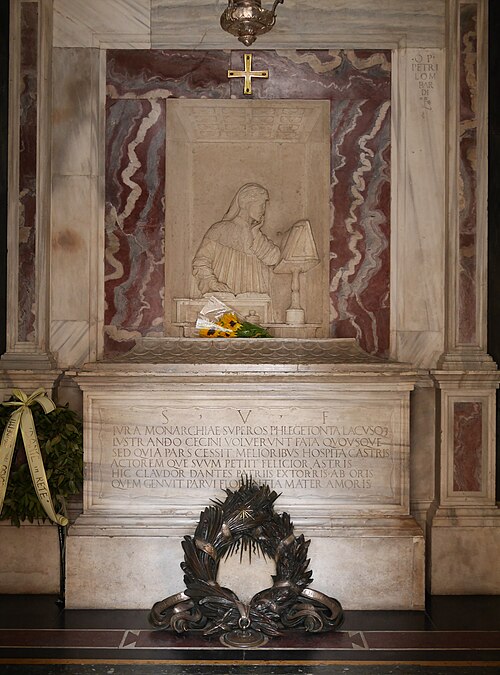
Where are Dante’s remains? Dante’s remains are in the city of Ravenna in Northern Italy, not Florence, which has an empty tomb for him. Dante was exiled from the city state of Florence in March 1302 because he was found guilty of corruption and financial wrongdoing. He was never able to return to the town of his birth and died in exile in Ravenna. He was pardoned by Florence in 2008, which was a little too late for him, and not reason enough to send his remains back.
Dante is one of the most famous Italian poets and is best known for his Divine Comedy series of poems. Of its three parts, his Inferno is probably the most well known. Dante himself is the main character in these poems. He is a pilgrim, and he embarks on a journey through Hell (Inferno), Purgatory (Purgatorio), and Paradise (Paradiso). He is looking for spiritual salvation and he is led by the poets Virgil and Beatrice. He needs to confront his own sins and repent so that he can reach Heaven. On the surface, the Divine Comedy is a religious epic poem, but it is also a deeply political one. He wrote it between 1308 and 1321, and he was strongly affected by his exile from Florence.
Dante’s full name is Dante Alighieri, and he was born in Florence in roughly 1265. His birth date is not exactly known. He was born in Florence, which is part of Italy now, but it was a powerful city state at the time of Dante. It had its own government, its own currency, and a very strong trade network. It was a rich and powerful state, ruled by the wealthy merchant families that controlled its politics. It would stay independent until 1860, when Italy was united.
Dante’s family had been wealthy, but they had fallen on hard times. Nobody knows where he was educated, but from looking at his poems, it is clear that he was very highly educated and very intelligent. He started writing poetry and commentaries from a young age. In 1295, he managed to join the Guild of Physicians and Apothecaries, which meant he was able to hold public office, and he entered public life as a politician.
Florence was a very politically unstable place as Dante was growing up. There were factions that supported the pope, and there were factions that supported the Holy Roman Emperor over the pope. By the end of the 13th century, the old “pope versus emperor” struggle had fractured into local rivalries, and Florence was split between the White Guelphs, who wanted to limit the pope’s influence, and the Black Guelphs, who did not. Dante was a White Guelph, and he openly opposed what he saw as papal interference in Florentine politics. In 1301, Pope Boniface VIII demanded that Dante and two other politicians meet him in Rome to negotiate. While they were out of Florence, he sent the French prince Charles de Valois into the city to subdue the White Guelphs. The ruling Black Guelphs issued proclamations listing the crimes of various White Guelph politicians, and Dante’s name was on it. He was accused of corruption and financial wrongdoing. He could not return to Florence for fear of being arrested and burned.
Dante went to several places, but ended up in Ravenna. He refused to admit his guilt or pay the fine demanded by Florence, which meant his sentence remained in force. He started to write his Divine Comedy. It is an incredible work of literature, but it was also his way of striking back at the people who had harmed him. Pope Boniface VIII and many known politicians are found in Dante’s Hell. He judges their actions by placing them in different circles and giving punishments that fit the sin, as a way of passing final judgment on their lives..
Dante died in Ravenna in 1321 from malaria. He was only 56. He is buried in a tomb in the Church of San Pier Maggiore. He never set foot in Florence after his exile, but, shortly after his death, his fame started to grow. Florence began to regret banishing him and decided that, as he had been born in Florence, he should be buried there, too. The government of Florence petitioned Ravenna for Dante’s remains, but Ravenna refused. Then, in 1519, the government of Florence petitioned the pope to make Ravenna turn over the remains. The pope, who was related to the ruling family of Florence, the Medicis, agreed, and a delegation went to Ravenna to get the remains. The monks in the church found out and hid Dante’s remains in a box inside a wall. The Florentines went home empty handed. Dante’s remains stayed hidden for another 262 years.
In 1810, Napoleon conquered Italy, and the monks fled the church, leaving Dante’s bones hidden. Nobody knew where they were. But Florence still wanted the remains back, so they built a huge tomb for them. The remains really were lost, though, and were only found in 1865 when construction work was being carried out. Then, the newfound bones were slowly stolen, one by one, until there were none left. They were, luckily, all returned about 13 years later, and buried again in Ravenna. Florence continued to ask for them, but finally gave up. Then, in 2008, the pardoned Dante. So, if you are looking for the remains of Dante, he has two tombs: one in Florence and one in Ravenna. His remains are in the tomb in Ravenna, assuming all of the bones that were returned were actually his. And this is what I learned today.
Sources
https://www.laphamsquarterly.org/roundtable/dantes-exile
https://www.historytoday.com/archive/months-past/dante-exiled-florence
https://en.wikipedia.org/wiki/Dante_Alighieri
https://en.wikipedia.org/wiki/Divine_Comedy
https://www.sparknotes.com/poetry/inferno/context/historical/guelphs-vs-ghibellines
https://www.ijrar.org/papers/IJRAR19D5640.pdf
Image By Petar Milošević – Own work, CC BY-SA 4.0, https://commons.wikimedia.org/w/index.php?curid=56077296