
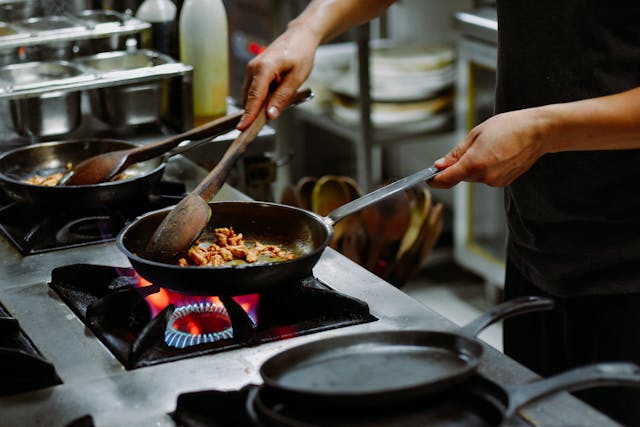
Why do chefs use iron, copper, and ceramic pans? Chefs use iron, copper, and ceramic pans because of the different ways they conduct and store heat energy. There isn’t a one-size-fits-all pan for professional chefs, and they change the type of pan they use for different foods. Each pan has a different set of properties that make it more suitable for a certain kind of food preparation.
Cast iron pans are used for searing, baking, frying, roasting, and often for outdoor cooking. They are heavy, but they are very durable. The main reason they have so many uses is that iron doesn’t conduct heat as well as other metals, but it does store it for a long time. That means they are very good at releasing this heat fairly slowly, and their temperature doesn’t drop when cold food is added. Iron is a dense metal, and the base of the pan is very thick, which means it takes a lot more energy to heat it up than other metals. When a cast iron pan is placed over a flame, thermal energy enters the bottom of the pan and makes the molecules there vibrate. This energy moves from atom to atom until it has passed all the way through the metal, and the inside of the pan becomes hot. It takes a relatively long time for the energy to travel through the pan, and when you turn the heat off, it again takes a relatively long time to cool down because so much energy is stored in the metal. That makes iron pans useful for slow cooking. One problem with cast iron pans is that they can heat a little unevenly, causing hotspots. This can be solved by preheating them carefully. Oil used in cooking can also polymerise on the surface of cast iron pans over time, making them non-stick.
Copper pans are used for delicate sauces, egg dishes, searing, sauteing, and sweets like chocolate and jam. Copper pans are useful because they are extremely conductive and respond very rapidly to changes in heat. They can apply heat or cut off the heat to whatever you are cooking almost instantly. For something like a sauce, cooking it just slightly too long can make it split or scorch, so a chef needs to have very responsive cookware. Copper is very good at conducting heat and electricity, which is often why it is used in wiring. It conducts heat well because of its structure and the high number of free electrons it has. Heat enters the bottom of the pan and makes the atoms vibrate, but it also makes the free electrons move. These electrons carry the thermal energy very quickly to other atoms, and it rapidly spreads through the pan. Copper also has a very pure crystalline structure, which gives the electrons a lot of space to move freely without being scattered. Copper pans are also good because they are naturally antibacterial. Copper pans do have a downside, though, because they react to acidic foods like tomatoes and vinegar, which can discolor the metal and dissolve a little of the copper into the food, giving it a metallic taste.
Ceramic pans are another popular alternative. Despite their name, they are not entirely ceramic. They usually have a metal body, usually aluminium, and a ceramic coating. The ceramic coating is made from silicon sand, which is mixed with minerals and chemicals, painted on as a gel, and then heated. You can buy 100% ceramic cookware, but they are very heavy, very expensive, and very brittle. They are also only oven dishes because the thermal shock of putting them on the stove would probably crack them. Ceramic pans are good because they heat up very quickly, although not as quickly as copper pans, and they distribute the heat evenly. They also don’t react with acidic food, and the coating material shouldn’t leech off into the food. They are also supposed to be better for the environment because the materials used are all natural, but that, of course, depends on what you buy and where it was made.
A lot of pans at home are made of stainless steel because it is cheaper, corrosion resistant, and strong. However, they don’t distribute heat well, don’t heat up quickly, and it is very easy for food to stick to them. If professional chefs are going to use steel, it is usually carbon steel, which is made from mostly iron with 1 or 2% carbon. Carbon steel is similar to iron in that oils will form polymers on it and make it non-stick. It is much lighter than iron, and it distributes heat more equally. It heats up and cools down more rapidly as well. Chinese chefs usually use woks made of carbon steel for these reasons. Woks are also shaped to give a large surface area for the food to cook on, which cooks the food more quickly. And this is what I learned today.
Sources
https://www.sinteredfilter.net/does-copper-conduct-heat
https://madeincookware.com/blogs/ceramic-cookware-pros-and-cons
https://www.canr.msu.edu/news/the_many_benefits_of_using_cast_iron_pans
https://www.thekitchn.com/ceramic-pans-260086
https://www.carawayhome.com/blog/what-is-ceramic-cookware-made-of
https://madeincookware.com/blogs/carbon-steel-vs-stainless-steel-cookware
Photo by Cihan Yüce: https://www.pexels.com/photo/frying-pan-in-kitchen-in-restaurant-12181750/