
How do skyscrapers withstand wind? Skyscrapers use a combination of aerodynamics, structural materials, and counterweights to withstand the high winds they are subjected to.
The first skyscrapers appeared in the 1880s. The Chicago Home Insurance Building of 1885 is often said to be the first true skyscraper, although there are a few others that vie for the title. There were no skyscrapers before this date because of several reasons. The first was that the passenger elevator didn’t exist. It was only with the invention of the passenger elevator that people could reach the higher floors and buildings could get taller. Before then, the lower floors were more expensive because you didn’t have to climb the stairs. After the invention of the elevator, the higher floors became more expensive. The second development was the iron frame. There was no way to build a brick building high enough because the walls would have to be massively thick to support their own weight. Iron allowed for taller buildings. There were also developments in the depth of the foundations, and building heating, lighting, and ventilation systems. When the Home Insurance Building was built, people thought the wind would knock it down. It lasted until it was demolished in 1929 to make way for another building, so it obviously did withstand the winds.
Modern skyscrapers are much taller than the Home Insurance Building and they need to be able to survive much stronger winds. Generally, wind gets stronger with altitude. There are three reasons for this. Firstly, there are fewer obstacles to block the wind. At ground level, you have other buildings, trees, and lots of features that can block or divert wind. At the height of the tallest skyscrapers, there is nothing to stop the wind. The second reason is that there is less friction the higher you go. At ground level, the wind drags the air over the ground, and it loses energy to the ground through friction, slowing it down. At height, there is less friction, and the wind isn’t slowed down. And, thirdly, there are more air pressure differences at height. Wind is caused by air moving from areas of high pressure to areas of low pressure. As height increases, the temperature and the air pressure decreases, but there are pockets of hot air that rise up. These create very strong winds. Winds are also stronger when the air is less dense because the air flows more easily.
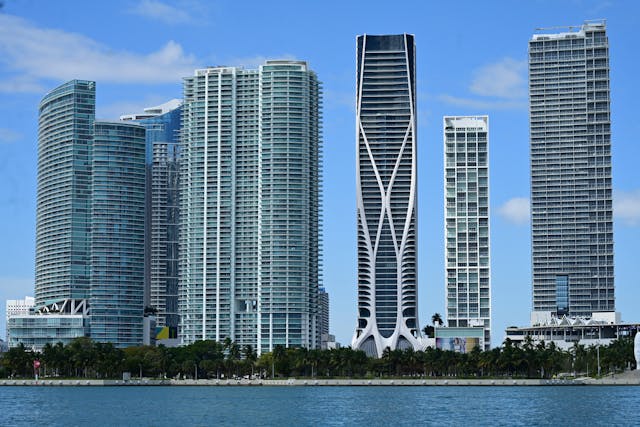
So, how do modern skyscrapers cope with the wind? The first thing they do is to have an aerodynamic design. Tall skyscrapers usually taper as they go up, and they usually have rounded edges, rather than flat surfaces. They may also have cut out pieces as well. Some buildings have blow-through floors. These are an entire floor with no windows that are open to the elements. The wind can sail straight through these gaps, which reduces its impact on the building. The new 111 West 57 building in New York is the thinnest skyscraper in the world and it has several of these blow-through floors to reduce the load of the wind. The idea is to allow the wind to slide past the building rather than smacking into it.
The second method is to make the structures as strong as possible, yet light. The support of the building is moved to the external frame and very tall buildings are built with a system of stacked tubular sections. These tubes distribute the load of the building and help it to survive strong winds. The materials that skyscrapers are built from have to be strong, light, and flexible. Any skyscraper is going to be buffeted by winds and allowing the building to move a little can reduce the impact of the wind.
The third method is to use counterweights, also called dampers. The most common of these are extremely heavy large balls suspended in the middle of the building. When wind hits the building and it sways, the damper inside the building sways the other way and counteracts the movement, pulling the building back into line. The same method is used when earthquake proofing buildings. There are another type of damper called viscous dampers. These are similar to the shock absorbers in a car, except they are filled with a very viscous fluid. When the wind blows a skyscraper, the building moves and the energy from the wind is absorbed by the viscous fluid in the dampers. They move a little, allowing the building to flex, but not too much. They are also very effective for earthquakes.
As buildings get taller, newer methods of protecting them from the wind will have to be found because current technology becomes impractical at greater heights. And this is what I learned today.
Sources
https://science.howstuffworks.com/engineering/structural/skyscraper4.htm
https://en.wikipedia.org/wiki/Early_skyscrapers
https://en.wikipedia.org/wiki/Home_Insurance_Building
https://opensnow.com/news/post/why-does-wind-usually-increase-with-altitude