
Does vitamin C prevent colds? No, vitamin C doesn’t prevent colds, but it can reduce the length of time people are sick by about 8 to 10%.
Many of us believe that taking a lot of vitamin C will help to keep off colds, or cure us if we are sick. Research shows that such a belief is not true. People who have a lot of vitamin C in their diet, or who take supplements, are no less likely to get sick than people who don’t have much vitamin C. There is no connection between the amount of vitamin C people take and their chances of catching a cold. However, the same studies did show that people who had a lot of vitamin C in their diet often had slightly milder symptoms than people without much vitamin C, and they recovered from their colds roughly 10% faster. It is very difficult to separate the cause of this, though, because people believe vitamin C is good for their cold, and just taking vitamin C might convince us that we are feeling better or not as sick.
Where does this belief come from? It stems from two things, really. The first was the discovery in the 1600s that citrus fruit was the cure for scurvy, an illness that struck down many people, including sailors. This was hundreds of years before vitamin C was identified, but it gave vitamin C a powerful health reputation later. The second thing was Linus Pauling’s 1970s book, “Vitamin C and the Common Cold.” Pauling was a scientist and one of the few people in the world to win two Nobel Prizes. He was highly trusted and also very persuasive. His work carried authority, and it was seized upon by the media. Pauling looked at several studies, one of which was a study on Swiss schoolchildren at a ski camp. This study seemed to show that giving the children more vitamin C cut down their risk of getting sick. Pauling put a lot of emphasis on this single study. He also looked at other groups of people where vitamin C does actually prevent colds. People who are stressed or exhausted have a very low immune system. Giving them vitamin C can actually reduce the number of colds they get. But with most people, it does not. Pauling took these studies and extrapolated that more vitamin C cut the risk of colds. He wasn’t correct, but he really did believe what he saw. The results said vitamin C helps a little bit with colds, and he took that as preventing colds. And then the media blew it up even more. Vitamin C doesn’t stop you from getting a cold. Although, as you can find vitamin C in fruit, and people who eat a lot of fruit tend to be healthier, eating more fruit will certainly have benefits for you. Healthier people, on the whole, tend to get sick less often than unhealthy people.
This cold myth is also a good excuse to explain what vitamins actually are. Vitamins are essential nutrients that we are mostly unable to produce ourselves. They all have different functions, but they assist with chemical processes in our bodies. Without them, we cease to function and break down. There are 13 vitamins and they range from A to K. Vitamin A, B1, B2, B3, B5, B6, B7, B9, B12, C, D, E, and K. They were all discovered between 1910 and 1948 and the list jumps from E to K because the vitamins that were called F, G, H, I, and J were reclassified as other vitamins or as something that is not a vitamin at all. For example, vitamin F was reclassified as the fatty acids omega-3 and omega-6. It was realized that rather than being one vitamin, B was actually eight different vitamins.
We need all of the vitamins to be healthy, but our bodies can only make three of them. We can make vitamin D if we are exposed to sunlight. Our gut bacteria can make vitamin K and vitamin B3 for us. The rest we have to get from our food. (This is obviously not an exclusive list.) We can get vitamin A from fish, dairy products, fruit, and leafy vegetables. If we can’t get enough vitamin A, it can affect eyesight and the immune system. Vitamin B1 comes from pork, grains, and potatoes, and a deficiency causes metabolic and cardiovascular problems. B2 comes from dairy, meat, and some grains, and a deficiency causes inflammation of the skin, mouth, and throat. B3 comes from meat, fish, eggs, and vegetables, and a deficiency causes dermatitis and dementia. B5 comes from almost all foods. A deficiency causes fatigue and irritability. B6 comes from meat and vegetables. A deficiency causes metabolic problems, rashes, depression, and confusion. B7 comes from egg yolk, liver, and vegetables. A deficiency causes hair loss and brittle nails. B9 comes from leafy vegetables and beans. A deficiency causes DNA synthesis and cell division. B12 comes from fish, eggs, and dairy. A deficiency causes impaired red blood cell production and nerve damage. C comes from fruit and vegetables. A deficiency causes scurvy. D comes from fish, eggs, dairy, and mushrooms. A deficiency causes bone density loss, leading to rickets. E comes from fruit and nuts. A deficiency causes nerve and muscle damage. K comes from leafy vegetables and meat. A deficiency causes excessive bleeding and easy bruising. The most common vitamin deficiency is vitamin D.
If we eat a balanced diet, we get all the vitamins we need. Unless you have a deficiency, there is no need to take supplements. Our bodies cannot store many water-soluble vitamins, so excess is excreted. And this is what I learned today.
Sources
https://en.wikipedia.org/wiki/Vitamin_C
https://health.clevelandclinic.org/can-immune-boosters-with-vitamin-c-or-zinc-help-my-cold
https://www.ncbi.nlm.nih.gov/books/NBK279544
https://www.mayoclinic.org/diseases-conditions/common-cold/in-depth/cold-remedies/art-20046403
https://www.bbc.co.uk/food/articles/vitamin_c
https://en.wikipedia.org/wiki/Vitamin
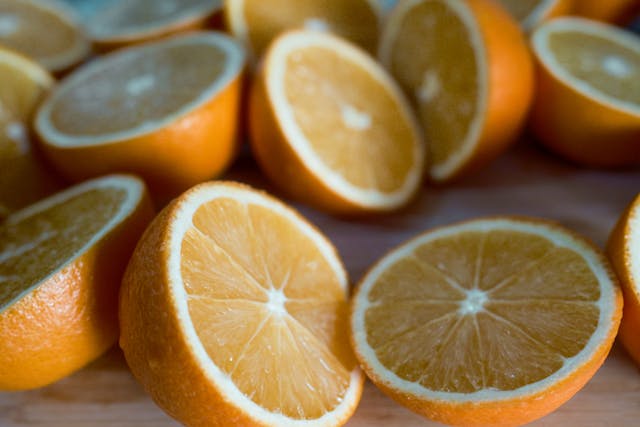
Photo by Özge Sultan Temur: https://www.pexels.com/photo/fresh-sliced-oranges-on-wooden-surface-30454405/