
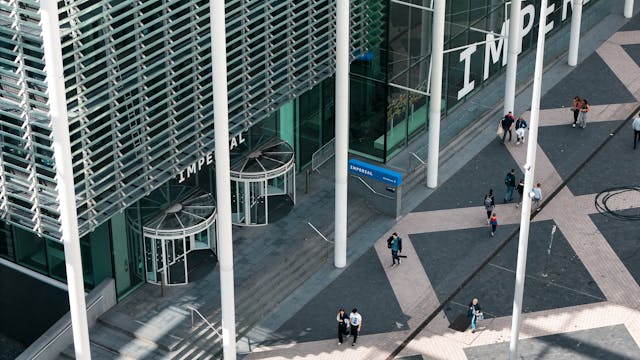
Why do some places use revolving doors? A lot of places use revolving doors because they reduce heating and cooling loss, they keep noise and dirt out, they are easy to open, they are quiet, they don’t need power, and they can regulate the flow of people into a building.
The first patent for something like a revolving door was granted to H. Bockhacker of Berlin in 1881. This was a door in a cylinder that a person walked through. The whole cylinder revolved, and once someone stepped inside, they had to turn the cylinder themselves so it faced the right direction. This doesn’t seem to have caught on. An American inventor called Theophilus Van Kannel invented the revolving door that would be recognized today. His design had three doors centred in a cylinder, and the doors themselves, rather than the whole cylinder, rotated. There is an urban legend that Van Kannel invented the revolving door because he didn’t want to hold doors open for women, but there is no evidence for this. The first revolving door based on his patent was installed in Rector’s restaurant in New York, and they rapidly became popular because of the benefits they offer.
Van Kannel called his door the “storm door”, and that gives an idea of how revolving doors are useful. They help keep the outside outside and the inside inside. Buildings have to be heated in the winter and cooled in the summer. With automatic sliding doors or regular swing doors, every time the entrance opens, a large amount of indoor air escapes and is replaced with outdoor air. In winter, warm air spills out, and cold air rushes in. In summer, cool air spills out, and hot air rushes in. That is a waste of energy because owners are effectively paying to heat or cool the sidewalk. Revolving doors reduce this exchange because the opening is never fully exposed. They function a bit like an airlock, limiting how much air can rush through at once. That increases efficiency and reduces running costs.
This is connected to another benefit. Because revolving doors limit air exchange, they help keep wind, snow, and rain out. They also keep out trash and dust that wind might blow into a lobby. They can reduce road noise as well. Many are made with thick glass, and the rotating compartments act as buffers, separating the outside from the inside. Revolving doors are also quiet. They do not slam shut, and there is no sudden bang of a heavy door closing.
Another advantage is that revolving doors can be easier to use in tall buildings. Tall buildings can develop a pressure difference between the inside and the outside, especially in colder months. Warm indoor air rises through stairwells and elevator shafts, which can reduce pressure near the bottom of the building. The result is that, at street level, outside air is pulled toward the lobby. If the outdoor air is much colder than the indoor air, the pressure difference can make a standard swing door hard to open, and once it opens, cold air can surge in. In summer, the direction can reverse depending on the building and the ventilation system, but the basic problem is the same: big buildings can create strong drafts through their entrances.
Revolving doors are also useful for controlling the flow of people. Swing doors need space to open, and because they move back and forth, they can create bottlenecks at busy times. Revolving doors can keep a steadier rhythm. People move through in small groups, and the entrance stays organized even when the lobby is crowded.
So, why wasn’t the revolving door invented until the 1880s? The basic reason is that several problems became more common at the same time. In the second half of the nineteenth century, elevators had been invented, and buildings were slowly getting taller. Pressure differences at entrances became more noticeable than they had been in smaller buildings. Heating became more widespread, and in some cases, cooling followed later, which made heat loss and energy waste harder to ignore. Cities were becoming busier, too, which meant entrances had to handle heavier foot traffic. On top of that, this was an era when people were surrounded by new machines and new systems. A new contraption at the front of a building did not seem as strange as it might have in an earlier age. And this is what I learned today.
Sources
https://www.invent.org/inductees/theophilus-van-kannel
https://en.wikipedia.org/wiki/Revolving_door
https://www.snopes.com/fact-check/revolving-door-inventor-women/
https://godoors.com.au/blog/purpose-of-revolving-doors/
https://ea-group.co.uk/whats-the-purpose-of-revolving-doors-we-break-it-down/
https://www.australiandesignreview.com/architecture/revolving-doors-history/
Photo by Chengxin Zhao: https://www.pexels.com/photo/imperial-collage-london-28288861/