
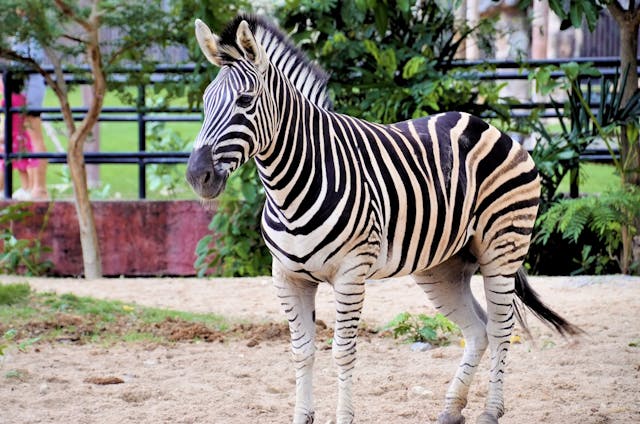
Why do zebras have stripes? Nobody knows the actual reason, but the main theory is that they deter biting flies. Other theories are that they could also be for camouflage or thermoregulation. There doesn’t have to be one single reason, and it could easily be a combination of all of these.
There are three different species of zebras. These are Grevy’s zebra, plains zebra, and mountain zebra. They are all from the equine family, which is the same family as horses, but they are not horses. The three types of zebras live in different places in Africa, and they are different sizes, but they all share the same stripey pattern. The stripes are unique to each individual zebra, but they always follow a similar pattern. There is a black line along the spine, and the stripes spread down from that. The skin of a zebra is black, but the stripes are produced by hair. The black stripes are hair with a lot of melanin in it, and the white stripes are hair with no melanin in it. We have the same thing when we get older. As our hair stops producing melanin, it becomes white.
So, why do zebras have these stripes? The oldest theory is that they are for camouflage and to confuse a predator. The majority of animals have different colored or patterned coats so that they blend in with their environment. The theory with zebras is that the stripes would allow them to blend in with trees and make them especially difficult to see at night. This is a sound theory, except for the fact that zebras usually live in open grassland and not in places with a lot of trees. Their stripes have no background to blend in to. Also, lions and other predators probably don’t even perceive the stripes at a distance and certainly have no difficulty catching zebras. They could also be there to confuse the predators because they live as herds, and their stripes would make it difficult for predators to make out individual animals. Again, though, when they flee, they flee as individuals, and lions have no problem finding individuals to take down.
The second theory is that they are for thermoregulation. Obviously, white material reflects most of the light that hits it, and black material absorbs most of the light that hits it. This is why white materials stay cool in sunlight, and black materials heat up. The theory is that the mix of heat being absorbed by the black stripes and reflected by the white ones makes a convection current that moves along the skin of the zebra and cools it down. There is no real evidence for this.
The most likely theory, and the one with the most evidence, appears to be that black and white stripes deter biting flies. There are many insects that live by sucking blood from mammals in the areas that zebras live in, the horse fly being the most dangerous because of the diseases they can carry. Studies and experiments have shown that, for whatever reason, horse flies prefer landing on shapes with solid colors than shapes with stripes. Experiments were carried out on horses, and the horses were covered in zebra stripe sheets. When the horses were uncovered, horse flies made a beeline for them and landed on them with no problem. Strangely, when the horses were covered in zebra stripe sheets, the horse flies would see them from a long way out and fly towards them, but when they got close, they would veer off and seemingly not be able to see the zebra to land on it. It’s possible that the different colored stripes disrupt the polarized light patterns that horse flies use to detect animals. It is also possible that the different temperatures coming off the light and the dark stripes mess with the systems that horse flies use to detect the warm blood inside the animal. The convection currents that the temperature differences produce could also put the flies off. It could also be that the fact that there is such a contrast between the white and the black makes it almost impossible for the flies to find somewhere suitable to land. Whether the real reason will ever be discovered is unknown, but it is undeniable that zebras get bitten by horse flies and other insects an awful lot less than horses do. And this is what I learned today.
Sources
https://www.bbc.com/future/article/20191031-the-truth-behind-why-zebras-have-stripes
https://en.wikipedia.org/wiki/Zebra
Photo by Jeffrey Eisen: https://www.pexels.com/photo/close-up-shot-of-a-zebra-7176736/