
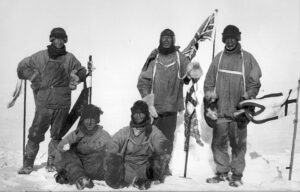
Why did Captain Scott’s Antarctic expedition fail? Captain Scott’s Antarctic expedition basically failed because of mismanagement and the weather.
Captain Robert Falcon Scott was a British naval officer and explorer. He led two major Antarctic expeditions. The first was the Discovery Expedition (1901–1904). It produced a large amount of scientific work, but it did not reach the South Pole. The second was the Terra Nova Expedition (1910–1913). Scott and a small party did reach the South Pole, but the expedition ended in tragedy: all five men of the polar party died on the return journey in late March 1912. A search party found their final camp in November 1912, with three bodies still inside the tent.
Scott’s first expedition had gone fairly well, and he became a famous Antarctic explorer. His team had come close to the South Pole, and they had made many important scientific observations. He used his reputation and worked hard to raise the money needed to fund another attempt. Around 65 men sailed from the United Kingdom in June 1910 aboard Terra Nova. They reached Antarctica and established their main base at Cape Evans, about 1,350 km from the South Pole, in early 1911. They built a hut and set up a supply system for the journey inland.
They stayed in the hut through the winter months and then got ready to leave as spring came. They started out as multiple groups of men with loaded sledges. The plan was to lay depots of food and fuel along the route south, and as each group finished its task it would return to base. In the end, only Scott’s polar party was left to make the final push on to the South Pole. They reached it on 17 January 1912 and discovered that the Norwegian explorer Roald Amundsen had arrived 35 days earlier. He had left a flag, a tent, and a note.
The party turned around and began the long return journey. By March 1912, the situation was desperate. The men were weakened by cold, injury, and starvation, and their progress slowed. By the time the end came, only three were still alive. On 21 March they sheltered in their tent to wait out severe weather, but they never recovered the strength to break out. Scott wrote his last diary entry on 29 March 1912, and the three men died soon after. Their final camp was only about 16 km from one of their supply depots.
So, what went wrong?
The main problem was mismanagement. Scott had Antarctic experience, but not at the level he implied, and several decisions reduced the expedition’s margin for error. The clearest comparison is with Amundsen’s expedition, which returned safely.
Scott’s transport plan left his team vulnerable. He used a mixed system: motor sledges, ponies, and dogs, with man-hauling as a fallback. The motor sledges failed early. The ponies struggled in deep, soft snow and extreme cold and were eventually lost. Dogs were used during parts of the expedition, but they were not used in the way that would have helped most on the polar journey. In practice, Scott’s men ended up hauling heavy sledges themselves for long distances, which was exhausting work. Amundsen relied much more heavily on well-trained sled dogs, and his men were skilled skiers, which Scott’s were not.
Clothing and technique mattered too. Amundsen had learned a great deal from Arctic Indigenous peoples about cold-weather travel and the value of layered fur clothing and efficient movement. Scott’s team relied more on wool and fabric layers, and once men began sweating, damp clothing could freeze and become a serious problem. Even small differences in warmth, dryness, and pacing compound over weeks on the ice.
Scott didn’t consider the food they took carefully enough. The men carried rations, but in intense cold and wind those rations were hard to prepare and sometimes hard to eat. They were burning huge amounts of energy each day while hauling loads, yet the rations did not reliably replace it. This meant progressive weight loss, fatigue, and slower movement. Vitamin deficiency was also a danger on long journeys without fresh food. Scurvy had long been a known risk in polar travel, and deficiency plus starvation can make an already weakened body far less able to keep going.
Scott also tightened his margins at the last minute by adding a fifth man to the final polar party, shifting the plan from four to five. That increased daily demand for food and fuel, and it complicated sharing and pacing, because rations and equipment had been planned around a different number. He underestimated how much each man would need to eat every day.
Then, once they had reached the pole and realized they were not first, Scott’s party continued to do scientific work on the way back. That work was valuable, but it also meant extra weight. They collected and carried geological specimens, including fossils, and that added to the load at the very moment when every kilogram mattered. By contrast, Amundsen lightened his loads for the return journey because he knew that would be the hardest part.
The last reason they failed was the weather. Scott left later than Amundsen, and the return leg ran into the colder, stormier part of the season. In late February and March 1912, conditions became unusually severe, with lower temperatures, stronger winds, and frequent blizzards. In their weakened state, the men could not keep moving. They sheltered in their tent to keep out of the worst of it, but they did not have the strength to push on.
They did have bad luck, but better planning and management would have reduced their dependence on luck. With more suitable transport, better-calculated rations, and a tighter schedule, the expedition might have returned in one piece. And this is what I learned today.
Sources
https://nzaht.org/conserve/explorer-bases/scotts-hut-cape-evans/history-of-scotts-expedition
https://www.history.co.uk/articles/reasons-captain-scotts-antarctic-expedition-failed
https://en.wikipedia.org/wiki/Robert_Falcon_Scott
https://en.wikipedia.org/wiki/Discovery_Expedition
https://en.wikipedia.org/wiki/Terra_Nova_Expedition
Image By Henry Bowers (1883–1912) – Image originally uploaded on 5 Dec 2003 by en:User:AlexPlank and edited by Ian Dunster on 24 Apr 2005), Public Domain, https://commons.wikimedia.org/w/index.php?curid=3197551