
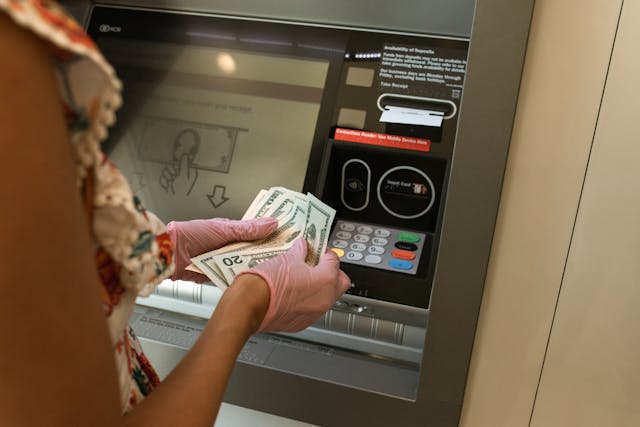
When was the first ATM? The first ATM (cash machine) was used on 27 June 1967. It was installed in the Enfield branch of Barclays Bank in London, UK. It was first used by a British actor called Reg Varney, which was part of the publicity to showcase the new machine and persuade people to use it. A lot of different banks released ATMs at roughly the same time, and many of them claim to be the first, but it appears the Barclays Bank one may win that competition.
These days, we are gradually becoming a cashless society, and a lot of people don’t use ATMs. That probably started in earnest with the invention of the iPhone and electronic payment systems. It really took off after the COVID-19 pandemic because people didn’t want to touch cash that other people might have touched. However, before that, banks closed very early, and the only way to get cash was from an ATM. If you grew up in that era, as I did, cash machines were everywher,e and it was easy to assume that they always had been, but they were a relatively new phenomenon.
The ATM was invented by John Shepherd-Barron, who worked for a company called De La Rue Instruments, which made banknote counting machines. Apparently, he was lying in the bath thinking of how he hadn’t been able to withdraw money earlier because the bank had closed for the weekend. He wondered if there wasn’t another way, and, in one of those flashes of inspiration that change the world, he started to think about vending machines. If there are vending machines that dispense chocolate and drinks, why couldn’t there be a vending machine that dispensed money. He took the idea to Barclays Bank, and they loved it. However, it wouldn’t have worked without a Scottish engineer called James Goodfellow, who patented the encrypted card-and-PIN system in 1966.
The first ATM machines were a little different from the ones we know today. They were not as automatic as they are today. Customers first had to get special paper vouchers from the bank during opening hours. Later, when the bank was closed, they fed a voucher into the machine and entered a PIN/code to receive their cash. The vouchers were seeded with carbon-14 so that the machine could authenticate them.
The idea was popular, and it started to spread, but the machines were still a little different from what we have now. There was one in Scotland where the customers had to get vouchers for money that they fed into the machine in exchange for real money. There was one in Australia where the machine took the bank card, and the bank posted it back to the customer at a later date. There was another one in Spain that gave customers a ten digit pin number. Then there was one in Germany that was inside a safe. Customers had a key to the safe, an account card, and a punched card that had the amount of money they wanted on it. The customer used the key to open the armored front door, inserted their card into one slot, the punched card with the money amount in another slot, and the machine dispensed the money.
In the 1970s, they became more advanced. They used newly invented microprocessors, and they started to use encryption for the data on the customer’s card. They were still only located by banks, but in the late 1970s, networking became possible, and a single ATM could service multiple banks. Once this happened, ATMs could basically be located anywhere, and their popularity took off.
As ATMs have become more popular, they have needed to become more secure. Early thefts often revolved around stealing the machine or breaking into it to get at the cash. ATM makers tried to stop this by armoring the cabinets, anchoring them more securely, and improving locks and alarms. Over time, many machines also adopted systems that “neutralize” stolen cash by staining it with ink. These are often built into the cash cassette or safe, and if the cassette is attacked, removed, or tampered with, the system releases ink that marks the banknotes. The notes may still be physically money, but they become difficult to spend, easy to spot, and much easier to trace. This kind of ink-staining security has helped reduce the payoff from ATM theft, because stealing the cash no longer guarantees that the cash can be used. And this is what I learned today.
Sources
https://en.wikipedia.org/wiki/Intelligent_banknote_neutralisation_system
https://www.spiegel.de/geschichte/1968-in-tuebingen-deutschlands-erster-geldautomat-a-1208937.html
https://en.wikipedia.org/wiki/ATM
https://en.wikipedia.org/wiki/John_Shepherd-Barron
https://content.time.com/time/specials/packages/article/0,28804,1914560_1914558_1914559,00.html
Photo by RDNE Stock project: https://www.pexels.com/photo/person-counting-money-in-front-of-atm-5699376/