
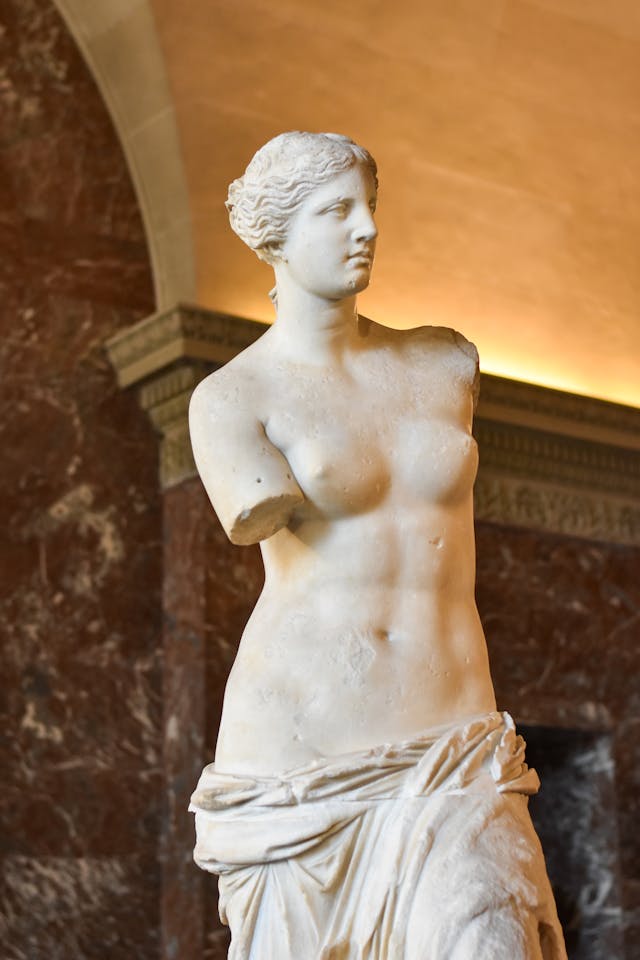
Why does the Venus de Milo have no arms? They could have been knocked off after the statue was found, but they were most likely lost before the Venus de Milo was buried.
The Venus de Milo is probably one of the most famous statues in the world. The whole statue is about 2 meters tall, and it is made of marble. It is generally identified as Aphrodite, the Greek goddess of love, but there is no definitive label on the statue itself, so it isn’t certain. It is also not known who made the statue, but an inscription found not far away said that it was the work of Alexandros from Antioch on the Maeander. This inscription has been lost. The statue is most well-known because of the fact that it has no arms. It is also missing one foot and both earlobes as well.
The statue was found by a Greek farmer on the island of Milos, which is where its name came from. Venus comes from the Roman goddess of love, the equivalent to Aphrodite. In 1820, the Greek farmer found the top half of the statue buried in the ground, and he dug it up. He was helped by a French sailor, Olivier Voutier, who had an interest in antiquities. They found the bottom half and dug that out as well. They also found parts of an arm holding an apple, a foot wearing a sandal, some pieces of arm, and a piece of the base in the same place. These could have been from the statue’s arm, or perhaps something else, there is no way of knowing. The hand with the apple and the foot are displayed in the Louvre, but the other pieces have been lost. Seeing as they were found in the same place, it is likely that they are from the same statue, but there is no way to tell for definite.
After the statue was dug out, another French officer, Dumont D’Urville happened across it, and he was very impressed with its style. He passed the story on to the Comte de Marcellus, who was given permission to buy the statue. He returned to Milos but found the Ottoman Empire was also trying to buy the statue, while the citizens of Milo didn’t want it to go. After a tense dispute involving local people and Ottoman officials, the French ultimately secured the statue and shipped it to France, where King Louis XVIII had it put in the Louvre. Ever since 1960, the Turkish government has petitioned the French government to return the statue because they said it belonged to Turkey, which used to be the Ottoman Empire. Although seeing as the statue was found on the Greek island of Milos, maybe it should be returned to Greece.
The statue was made sometime between the 5th and the 1st centuries BC. Nobody can pin it down, and opinions vary because the artist combined elements of both classical Greek art and Hellenistic art. There is also no consensus on how the statue became buried in the first place. It could have naturally been buried as the building it was displayed in front of fell into ruin and collapsed. The statue could have been placed in its location to be recycled. There was some evidence of a lime kiln in the are,a and old statues were often broken up and burned to make lime, or used as building materials. Or, and this is probably unlikely, it could have been buried to keep it safe during a period of war or conflict.
Suffice it to say, however it was buried, it is most likely that its arms fell off during that process. Whether the pieces found with the statue are the arms will never be known. It is also impossible to know in what position the arms were in, although there are some theories. The top of the statue’s robe, hanging on her hips, looks like it might have had something attached to it, so a hand could have been there. Another theory is that she was holding a shield. The left side of her robe is not as intricately carved as the right side, which could mean that it was hidden behind a shield. Her posture, leaning slightly back with one foot raised, could also indicate a shield. Aphrodite was often pictured holding a shield. Scientific analysis shows that the hand with the apple is most likely part of the same statue, which makes things even more complicated. If she was holding an apple in one hand, did she have a shield in the other? Some people say that she would have been next to a second figure, possibly even Mars, the god of war. I wonder if we will ever know. Still, if the statue had both arms and her foot, maybe it wouldn’t have become so famous. And this is what I learned today.
Sources
https://greekreporter.com/2025/10/19/venus-de-milo-arms-statue
https://www.history.com/articles/what-happened-to-the-venus-de-milos-arms
https://en.wikipedia.org/wiki/Venus_de_Milo
https://greekreporter.com/2024/04/08/the-discovery-of-the-venus-de-milo-statue
Photo by Gagan Kaur: https://www.pexels.com/photo/white-concrete-statue-of-an-armless-woman-13711088/