
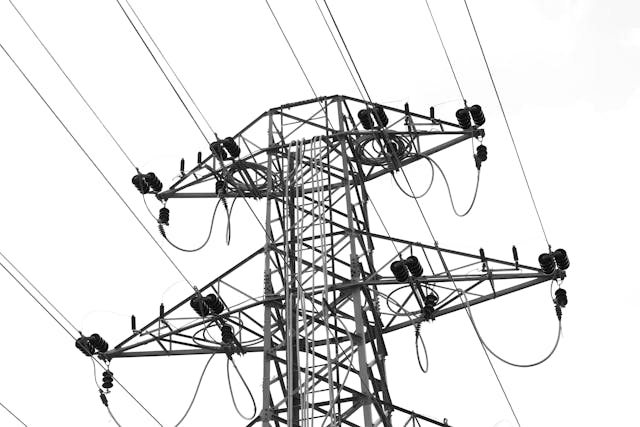
How does electricity get to my house? Electricity gets to my house in three stages. These are generation, transmission, and distribution.
The first step is obviously to make the electricity. Most countries use either coal, natural gas, or nuclear power stations. They also use renewables such as solar, wind, and hydro power. These ratios break down depending on the country, but here are the latest figures for the USA. In 2025, the US generated 4,260 billion kilowatt hours. Natural gas accounts for 40%, nuclear is 18%, coal is 17%, wind is 11%, solar is 7%, hydropower is 6%, and the rest is “other”. Encouragingly, all of the fossil fuels are declining year by year, nuclear is staying the same, and the renewables are in an upward trajectory, with solar increasing the fastest. Renewables are not just better for the environment, they are cheaper, which, as we are projected to use 1 to 3% more electricity every year from here on, is very important.
Electricity generation power stations are spread out around the country, and each one serves roughly 750,000 homes, although that obviously depends on how they are generating the electricity and the size of the power station. Once the power has been generated, it is sold to the network provider. The electricity is sent from the power station to a transmission substation, where the electricity is converted for transmission into the network. The main job of the substation is to take in the electricity from the power station, which will have different voltages, and step it up to a higher voltage. This is done because as voltage goes up, current goes down. Voltage is the electrical potential difference in the power between two points, and current is the flow rate along the transmission lines. If current is high, a lot of the power gets lost to resistance as heat, and it won’t be possible to transmit the power very far. By increasing the voltage, the current comes down, and the power can be sent further without losing as much. The voltage is stepped up by using two coils of wire wrapped around an iron core. The current in the first coil makes a changing magnetic field in the iron. The changing magnetic field induces voltage in the second coil. The voltage changes depending on how many turns there are in each wire. If the output coil has 10 times more turns than the input coil, the voltage becomes ten times higher.
The main power lines that carry the power from transmission substations have voltages of over 300,000 volts, and can be dangerous. They are not insulated and are usually made of seven strands of steel cable surrounded by four layers of aluminium cables. They are dangerous if you touch one of the lines and then touch something else, giving the electricity a route to travel through. That is why birds can happily sit on power lines.
Once the electricity reaches a town, it enters another substation where the voltage is stepped back down again. This is done with the exact reverse of the process that stepped the voltage up in the first place. Substations are also where the grid is controlled and protected. Inside a substation are huge circuit breakers, switches, and protective relays that can disconnect a damaged line in a fraction of a second. This matters because faults happen constantly (lightning strikes, trees, accidents), and the grid needs to isolate the problem area while keeping the rest of the network running. Substations can also help keep voltages steady as demand rises and falls.
Once the electricity is close enough to be used, the final transformer (often on a pole or in a small ground-level box) steps the voltage down to “house” voltage. The exact number depends on the country (for example, Japan uses 100/200 V and the US uses 120/240 V), but the idea is the same: it is low enough to use safely inside buildings. From there, the electricity travels along a service cable to the house and passes through an electricity meter, which measures how much energy is used in kilowatt-hours so the bill can be calculated. After the meter, the electricity goes into a main service panel (breaker box). This contains a main switch and a set of circuit breakers, and it splits the electricity into separate circuits for lights, wall outlets, the kitchen, heating, and other high-power equipment.
The breakers are an important safety feature. If too much current flows (for example, because of a short circuit, a damaged wire, or too many appliances on one circuit), the breaker trips and disconnects that circuit before the wiring can overheat. Houses also have grounding, which is a safety connection to the ground. If a live wire ever touches a metal case, the earthing wire provides a low-resistance path for the fault current, which helps the breaker trip quickly and prevents the metal from staying dangerously live.
The company that runs the local grid has to balance electricity minute by minute. They need to predict when demand will spike, keep voltages stable, and fix faults quickly to avoid long or widespread blackouts. In many areas, several companies share the job: one generates electricity, another operates the transmission network, another runs local distribution, and a separate retail company may handle the billing. So if there is a blackout, the problem might be on equipment owned by a different part of the system than the company that sells the electricity to customers. And this is what I learned today.
Sources
https://en.wikipedia.org/wiki/Electric_power_transmission
https://www.nationalgrid.com/stories/energy-explained/where-does-electricity-come-from
https://www.nationalgrid.com/stories/energy-explained/what-is-a-substation
https://www.eia.gov/todayinenergy/detail.php?id=67005
Photo by Efe Burak Baydar: https://www.pexels.com/photo/high-voltage-power-lines-against-clear-sky-35212110/