
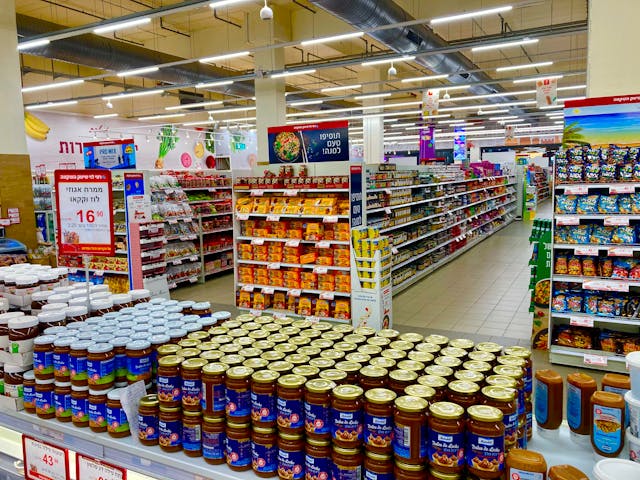
How do supermarkets employ psychology? Supermarkets employ psychology by manipulating your senses, tracking your route through the store, understanding where you look, shaping how you feel, and knowing when you are most likely to buy something.
Supermarkets appeared at the beginning of the 20th century. The very first supermarket was the Piggly Wiggly in Memphis, and it changed the way people shopped and the way they thought about shopping. Before this, most shops were designed in pretty much the same way. A shop would specialize in a product. The customer would enter with a list of what they wanted to buy and hand it to a clerk, who would move around the shop gathering the items. The customer would then pay and leave. Finding ways to get people to buy more things wasn’t usual. A shop would often have only one brand of a product, so if you wanted coffee, for example, you would get the only coffee they had.
The Piggly Wiggly changed all of that. Customers carried their own shopping baskets and moved around the shop choosing what they wanted. When they were ready, they took the basket to the cash register and paid. That is really the default way of shopping in a brick-and-mortar store now, but it was extremely unusual at the time. This system meant the store didn’t need as many clerks and could sell cheaper products.
The first large out-of-town supermarkets appeared in the 1950s as car ownership increased. People could drive farther out of the city to shop, and they could buy more at once because they could transport it in their car. Land outside the city was cheaper, so supermarkets could build more cheaply and pass those savings on to the customer. They could also have much larger premises, which meant that they could stock far more products. In turn, people could get most of what they needed in one trip. Now that people were making all their own choices about what they bought, it became important to get them to go to the right places in the store and buy the right products, and more of them. Psychology had entered the game. So, how do supermarkets use psychology?
The first thing they do is manipulate our senses as soon as we walk in the door. They do this through sight and smell. Almost all supermarkets have flowers near the entrance, and then fruit and vegetables as you go in. On entering the supermarket, you get the fresh scent of the flowers, followed by the bright and colorful fruit. This not only lifts your mood, it can also make you feel healthier and more positive. This is sometimes described as a health halo effect, and using bright colors and scents can act as implicit priming. When people feel happy and positive, they spend more. Many stores also pipe the smell of the bakery toward the entrance, because nothing makes people as happy as the smell of baking bread. This smell also stimulates our appetite, and hungry people buy more.
The second thing they do is the layout of the store. There are often gates or one-way entrances that stop you from leaving back the way you came, which means that if you want to get out of the store, you have to navigate past a lot of products first. You probably won’t buy anything if you are just trying to leave, but you might. They also place daily necessities that people have to buy toward the back of the store. Bread, milk, and eggs are often as far from the front of the shop as they can be.
Supermarkets have also spent a lot of time working out where people look on the shelves. We tend to buy things at eye height, so expensive brands often go there, and cheaper own brands are usually lower. Conversely, bright and colorful children’s breakfast cereals and snacks are lower down because this is the eyeline of children. We also tend to pay more attention to items at the ends of aisles, and many people naturally turn right rather than left, so this gives supermarkets a lot of information about where to place products.
Then there is the size of the trolley. Just as a larger plate at a buffet can make people eat more, a larger trolley can make people buy more. It doesn’t look like you have bought as much when it is spread out in a large trolley. And finally, supermarkets understand that willpower can be an exhaustible resource, so they put impulse buys right by the cash register: snacks, magazines, and small, inexpensive things that can be picked up and added to the shopping.
There are many other things they do as well, but these are some things to think about next time you go shopping. And these days, we are moving to online retailers, where there is a whole different set of psychological tricks at work. And this is what I learned today.
Sources
https://appliedpsychologydegree.usc.edu/blog/psychology-of-the-grocery-store
https://www.nationalgeographic.com/culture/article/surviving-the-sneaky-psychology-of-supermarkets
https://tnmuseum.org/junior-curators/posts/the-story-of-piggly-wiggly-the-first-supermarket
Photo by Aqsawii: https://www.pexels.com/photo/fully-stocked-supermarket-interior-5951182/