
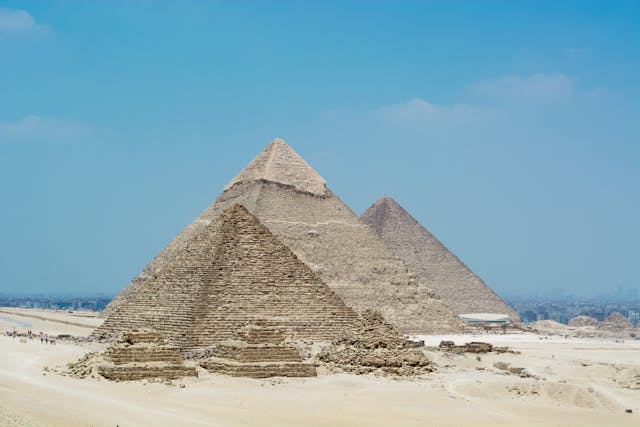
Which of the Seven Wonders of the Ancient World still exists? The Great Pyramid at Giza is the only one of the Seven Wonders of the Ancient World that still exists.
The Great Pyramid of Giza is both the oldest of the Seven Wonders and the only one still standing. It was completed in roughly 2560 BC and has been standing for over 4,500 years. All of the outer layer of bricks have been stolen, but the majority of the structure is still as it was thousands of years ago. The main reason it is still in one piece is because of its sheer size. Earthquakes can damage it, but they cannot destroy it. When the pyramid was finished, it was covered in a layer of smooth white limestone. It would probably have shone in the sun and been a very impressive sight. Earthquakes loosened these outer blocks, and when they fell off, they were stolen to be used in other nearby building projects. Some of the casing stones can still be seen at the bottom of the pyramid. Early European explorers reported finding large piles of rubble at the bottom of the pyramids, which was mostly the casing blocks.
The pyramid has survived for this long because a pyramid is a very strong shape and it is made from a huge number of blocks. A pyramid is a strong shape because all of its weight is supported equally over its base. Unlike many buildings were more weight is supported at some points than others, a pyramid doesn’t have any weak points where it is likely to fail. Earthquakes might crack it, but it will still not collapse because it is well balanced. It is also made of over 2 million blocks, weighing more than 6 million tons, so there is no way for wind, water, and other sources of erosion to reach its core. Just like a mountain, it will erode away if give long enough, but it will take an awfully long time.
None of the other six wonders still exist. The second oldest wonder was the Hanging Gardens of Babylon. They were built in 600 BC by Nebuchadnezzar II, and Babylon is roughly where Iraq is today. The gardens were said to have been destroyed in the 1st century AD, but there is not actually any written evidence or archaeological evidence that they actually existed. They may have done, and they may have existed in a slightly different place, but it is very difficult to prove.
The third oldest wonder was the Statue of Zeus at Olympia, which is in Greece. It was said to be a 12.4 meter tall statue of the god Zeus sitting on a throne. It was built in 456 BC and was housed inside an enormous temple. It was made by a famous sculptor called Phidias. The giant statue is one of the only wonders that was lost rather than destroyed. The Christian Roman emperor Theodosius I closed all the temples, and it was abandoned. The statue vanished from history. There are legends that it was destroyed in different fires, but nobody knows for sure.
The fourth oldest wonder was the Temple at Artemis at Ephesus, which is in modern day Turkey. It was built in 550 BC for the first time, then in 323 BC for the second time. It was a Greek temple dedicated to the goddess Artemis. The first version of the temple was destroyed by an arsonist, and the second version was probably destroyed by fire in 268 AD. There are a few small surviving ruins that can be seen, but that doesn’t count as still standing.
The fifth oldest was the Mausoleum at Halicarnassus, which was built in 351 BC, also in modern day Turkey. It was a tomb for a king called Mausolus, which is incidentally where the world mausoleum comes from. It was a very impressive building, 45 meters high, and it had 400 statues. Unfortunately, it was slowly destroyed by earthquakes until, by 1409, only the base remained. The stones were used to build Bodrum Castle on the base, which still stands today. The bricks of the Mausoleum still exist, but I don’t think that can be considered to be free standing either.
The sixth oldest was the Colossus of Rhodes, built in 280 BC. In Greece. It was a 33 meter tall statue of the Greek sun god Helios, and it overlooked the harbor in Rhodes. It was the shortest lived of all of the wonders and was brought down by an earthquake in 226 BC, only 54 years after it was built. The remains of the statue have never been found, but a possible base has been discovered.
The youngest of all the wonders was the Lighthouse at Alexandria. It was built in 280 BC in Alexandria, on the north coast of Egypt. It was said to be 140 meters tall, and it had a light at the top. It guided ships in and out of the harbor until it was severely damaged by earthquakes in 796, 951, 956, and 1303. After the last earthquake, the building was too damaged to use and lay empty until it was completely destroyed when the sultan of Egypt had the last pieces knocked down and built a fort in its place. Pieces of the lighthouse have been found in the harbor, and many of them have recently been raised. And this is what I learned today.
Sources
https://en.wikipedia.org/wiki/Seven_Wonders_of_the_Ancient_World
https://en.wikipedia.org/wiki/Hanging_Gardens_of_Babylon
https://en.wikipedia.org/wiki/Statue_of_Zeus_at_Olympia
https://en.wikipedia.org/wiki/Temple_of_Artemis
https://en.wikipedia.org/wiki/Mausoleum_at_Halicarnassus
https://en.wikipedia.org/wiki/Colossus_of_Rhodes
https://en.wikipedia.org/wiki/Lighthouse_of_Alexandria
https://kids.nationalgeographic.com/history/article/seven-wonders
https://en.wikipedia.org/wiki/Great_Pyramid_of_Giza
Photo by Mouad Mabrouk: https://www.pexels.com/photo/great-pyramid-of-giza-under-the-blue-sky-3689863/