
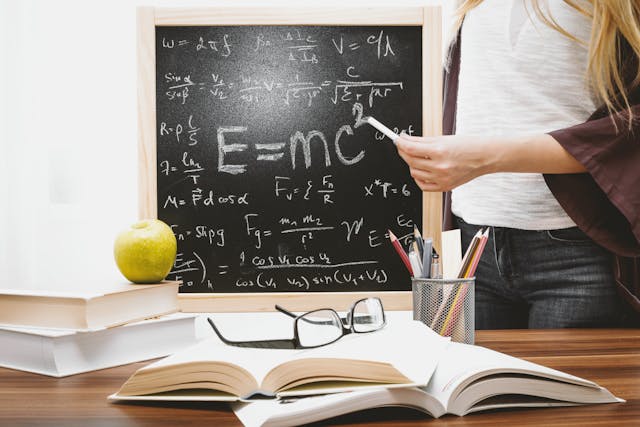
What does E = mc² mean? E = mc² means that mass and energy are two ways of describing the same physical thing. In everyday life, mass feels like “stuff” and energy feels like “activity,” but Einstein showed that they are connected. If a system loses energy, it also loses mass. If it gains energy, it gains mass. Usually the change is far too small to notice, but the relationship is always there.
In the equation, E stands for energy, m stands for mass, and c stands for the speed of light. The c comes from the Latin celeritas, meaning “speed.” The speed of light in a vacuum is about 300,000,000 meters per second. In Einstein’s relativity, that speed is special because everyone measures the same value for it, even if they are moving relative to each other. If you stand on a train moving at 100 km/h and throw a ball forwards at 30 km/h, the ball is moving away from you at 30 km/h. However, a person standing on a train platform watching the train move past will see the ball moving at 130 km/h. This doesn’t happen for light. Everybody, no matter where they are, will see the speed of light at exactly the speed of light. That strange fact forces physics to treat space and time differently than was once thought, and it is one reason c appears in so many relativity equations.
A common source of confusion is that E = mc² is really about rest energy. Rest energy is the energy an object has simply because it exists and has mass, even when it is not moving. Physicists sometimes write it as E₀ = mc² to make that clearer. There are lots of different types of energy. There is potential energy, kinetic energy, thermal energy, chemical energy, and others. The rest energy that Einstein was talking about is the energy that every object in the universe just has all the time.
Why is c squared? One simple answer is that it makes the units work. Mass is measured in kilograms, energy in joules, and multiplying by c² converts between them. But the deeper message is about scale. Because c is so large, c² is unimaginably large. That means even a tiny amount of mass corresponds to a huge amount of energy. A single gram of matter has an enormous rest energy. That does not mean that a gram of matter can easily be turned into usable energy in everyday life. It means that if a process can convert even a small fraction of mass into other forms of energy, the result can be dramatic.
This is where nuclear reactions enter the story. In the Sun, energy is produced mainly by fusion. Hydrogen nuclei combine through a chain of reactions that ends with helium, plus energy carried away as light and heat. The surprising part is that the final helium nucleus has slightly less mass than the starting hydrogen nuclei. That missing mass is called the mass defect. It is not “lost” in a mysterious way. It left the system as energy. When energy leaves, the mass of the system goes down by an amount equal to E/c².
The same basic idea applies to fission reactors. In fission, a heavy nucleus such as uranium splits into smaller nuclei, along with energy and particles. Again, the products end up with slightly less mass than the original nucleus. The difference shows up as released energy. E = mc² is the conversion rule that connects that tiny mass change to the large amount of energy that comes out.
An easier way to think about the mass defect is to connect it to binding energy. When particles bind together into a stable nucleus, energy is released. That released energy reduces the total energy of the bound system compared to the same particles separated far apart. Because mass and energy are linked, a bound nucleus can have less mass than the sum of its parts. The “missing” mass is really the energy that was given off when the nucleus formed. This is not only true for nuclear physics. In principle, any bound system has a total mass that includes all its energy—motion, heat, and binding energy—though in chemistry the changes are usually too small to measure easily.
E = mc² also helps explain the speed limit of the universe. As an object with mass moves faster and faster, its total energy rises. Near the speed of light, enormous amounts of energy are required for smaller and smaller increases in speed. In the limit, reaching the speed of light would require an infinite amount of energy. That is why objects with rest mass can approach c but cannot reach it. Light and other massless particles travel at c because they do not have rest mass in the first place.
Einstein first came up with the mass–energy connection in 1905 in a short German paper translated as “Does the Inertia of a Body Depend Upon Its Energy Content?” Using a thought experiment involving an object emitting light, he argued that if an object gives off energy, its inertia must decrease. Einstein imagined an object emitting light. The light carries away energy, and light also carries momentum. To keep the laws of physics consistent for observers in different states of motion, the emitting object must lose a tiny amount of inertia. Since inertia is what mass measures, the object must lose a tiny amount of mass when it loses energy. When energy leaves an object, the object becomes very slightly easier to accelerate, so its mass must have dropped — which means energy and mass are connected. That is the link behind E = mc².
Sources
https://en.wikipedia.org/wiki/Mass%E2%80%93energy_equivalence
https://www.theguardian.com/science/2014/apr/05/einstein-equation-emc2-special-relativity-alok-jha
https://en.wikipedia.org/wiki/Speed_of_light
https://www.energy.gov/science/doe-explainsrelativity
Photo by JESHOOTS.com: https://www.pexels.com/photo/woman-illustrating-albert-einstein-formula-714698/