
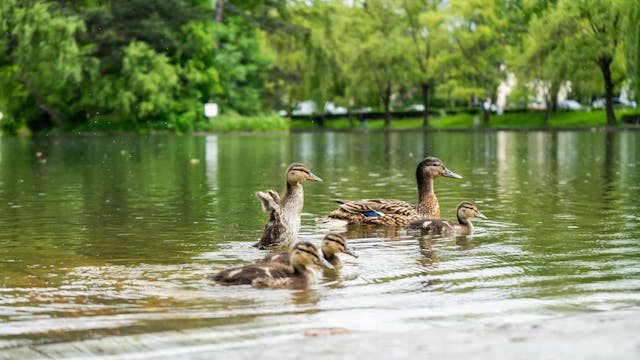
Do all animals have imprinting? No, not all animals have imprinting, but a lot do.
Imprinting is where a newborn animal learns to follow its protector as soon as it is born. When the animal is born, it imprints the closest animal, usually its mother, into its brain and then follows that animal exclusively. The first animal that the baby sees is almost always the newborn baby’s mother, which stands to reason because the mother has either just given birth to the baby or hatched the eggs, and will be the closest thing to the baby. However, it doesn’t necessarily have to be the mother and animals without a mother have imprinted onto other species. Some experiments have shown that animals will imprint onto a human or even a stuffed toy sometimes.
This kind of imprinting, where a newborn animal imprints the image of its mother on its brain, is known as filial imprinting. It happens with many animals, but it is most obvious with nidifugous birds. Nidifugous animals are animals that leave their place of birth shortly after being born or hatching, such as geese and zebras. The opposite of nidifugous is nidicolous, and these are animals that stay close to where they are born for a long time because they are dependent on their mother for food and protection. Humans and all other primates are examples of nidicolous animals. “Nidi” comes from the Latin for nest, and “fugere” means flee, while “colus” means inhabit.
Nidifugous animals are born immediately able to walk and move. They can very easily stray away from their nes,t and imprinting is very important for them because it tells them who their mother is, what their species is, and how to avoid predators. The shape of their mother is imprinted on their brain, and they follow it, which stops them from wandering off and being eaten. Nidicolous animals also imprint, but they do it because they need to know who their primary caregiver is. In these animals, it might be more clearly termed “bonding” than “imprinting”.
Geese are a well studied example of nidifugous animals that imprint. It seems that they have a critical period of 13 to 16 hours after hatching, and within that time frame, they will imprint on the first moving stimulus that they see. Geese have imprinted on people and inanimate objects. A hang glider pilot called Bill Lishman actually used this to reintroduce a threatened species of geese. They had no parents to teach them their migratory route, so he hatched them under his hang glider. They imprinted on him and then he was able to use his hang glider to lead them on their migration.
There is not one single part of the brain involved with imprinting, rather it is a process, although nidifugous animals have a brain hub where it centers. Some animals depend more on visual signals, such as many mammals, and some animals depend more on olfactory signals, such as salmon. When the majority of animals are born, their brains are extremely plastic, and they are primed to lock their attention onto certain cues. Once they have found those cues, their brains get flooded with neuromodulators and hormones, which signal to the brain that “this matters”. Then their synapses strengthen very quickly. It happens straight after birth because the brain is at its most plastic and has lots of open slots for these permanent memories to slip into. It happens very quickly, and the memories are almost impossible to shift. For nidifugous animals, there is a hub in the forebrain called the intermediate medial mesopallium, which could very likely be where the imprinted images reside.
There are many species of animals that don’t have a parent figure in their life. The parent lays eggs and then leaves. The offspring are born with no parents around and fend for themselves from the very beginning. Sea turtles and snakes are good examples of this. Their parents lay eggs and then leave. When the young sea turtles are born, they have to make their way to the sea and survive. They are born with a set of instincts hardwired into their brains, so they don’t need a parental figure to teach them. Snakes, as well, hatch without a parent present. They have many innate behaviors already in their brains and learn to survive very quickly. A lot of these animals are eaten shortly after birth because they don’t have the protection of a parent. To get around this, sea turtles lay an enormous number of eggs, and snakes hide their eggs in a burrow. And this is what I learned today.
Sources
https://en.wikipedia.org/wiki/Imprinting_(psychology)
https://en.wikipedia.org/wiki/Nidifugous_and_nidicolous_organisms
https://www.niwra.org/post/what-is-imprinting-and-why-is-it-a-problem
https://www.zoobasel.ch/en/aktuelles/news/1380/nestfluechter-und-nesthocker
Photo by Vlad Chețan: https://www.pexels.com/photo/ducks-2409151/