
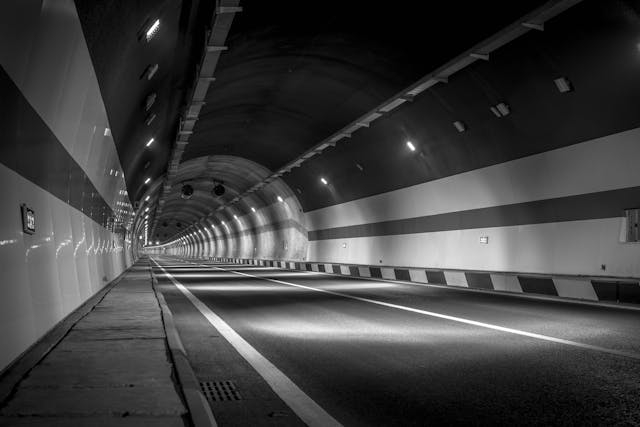
How does a tunnel ventilation system work? A tunnel ventilation system either uses evenly spaced air vents to pull in air or powerful fans to push it along. They also use extractor fans to remove the car emissions, and they rely on the piston effect of vehicles entering the tunnel.
As tunnels get longer, designers need to be aware of the toxicity of the emissions from the cars that are using them. Petrol cars burn petrol to move the pistons in the engine. Every time they burn petrol, they produce carbon dioxide, water vapor, nitrogen, nitrogen oxide, carbon monoxide, hydrocarbons, benzene, and sulfur dioxide. Carbon dioxide is a greenhouse gas, hydrocarbons become smog or the black dirt on the inside of a tunnel, nitrogen is an inert gas, and sulfur dioxide contributes to acid rain. They are obviously not good for us, but they are not the most dangerous emissions from a car. Carbon monoxide is highly toxic and can reduce the blood’s ability to deliver oxygen. Nitrogen oxide can get into the lungs, causing irritation and harming the immune system. And all of the particulate matter produced in the smoke can get into the lungs and bloodstream, causing a lot of damage. If you are outside in the air, then most of these gases will be carried away from you, and you won’t be harmed. If you are in a tunnel, you very well might be harmed.
Because of the way that gases and toxins can build up, any tunnel longer than 500 meters needs to have a ventilation system. Shorter than this, and the outside air at either end is close enough to the center that winds can blow in and push or suck out the tunnel air. Longer than this, and the outside wind cannot penetrate far enough into the tunnel. Short tunnels are also adequately kept clean by the piston effect. When a car drives along, the air in front of it is pushed to the sides of the car or over the top. In a tunnel, the air cannot get round the car because of the tunnel walls, so an area of low pressure develops behind the car, and this sucks air along with it. The car pushes the tunnel air ahead of it and sucks clean air in behind it. This is the same way a piston works, hence its name. This happens far more in railway tunnels because trains fill the tunnel far more than cars do, and there is almost no space for the air to get around the train.
The idea of a tunnel ventilation system is to control the flow of air in the tunnel and to remove contaminants from that air. There are two ways of doing this with fans: longitudinal and transverse ventilation systems.
Longitudinal, as the name suggests, is a ventilation system that goes the length of the tunnel. Jet fans are used, along with the piston effect produced by vehicles. The jet fans push air along the tunnel, where it exits at the other end. They are called jet fans because they basically work in the same way as a jet engine does. There is often a vent for fresh air that runs the length of the tunnel as well. It is a more simple system and cheaper than the transverse system. However, it doesn’t work if there is a lot of vehicle traffic in the tunnel. It is also difficult to have a two way air system. Smoke from fires caused by accidents can build up in areas of the tunnel as well. Unless they are well controlled, smoke can build up and cut off escape from the tunnel.
A transverse ventilation system has ducts at carefully calculated distances along the tunnel. These ducts pull in fresh air in sections. Then there are exhaust ducts with extractor fans that expel the air into the outside air. These exhaust ducts have filters to remove the particles and dangerous gases from the air before it is released into the atmosphere if the tunnel passes underneath a built up area. If there are no houses around, the air is often unfiltered. Transverse systems can be safer in a fire because they use dampers to keep the smoke in one area and extract it through the exhaust duct. This doesn’t cut off either tunnel exit. Transverse systems are better suited for longer tunnels of 3 km or more. They are more complicated and more expensive.
Most modern tunnels use a combination of the longitudinal and transverse systems. They also have smart systems installed so the systems can ramp up or turn down when necessary. They have fire containment settings as well that go into action when smoke is detected. The purpose of this is to contain or remove the smoke and allow the emergency services to get in. You also might see some fans that are not moving when you drive through a tunnel. This is part of the backup system. If the whole ventilation system fails, people could suffocate, so there are multiple backups. And this is what I learned today.
Sources
https://www.premel.ch/IT/Types-and-Importance-of-Road-Tunnel-Ventilation-ff7f1f00
https://www.uswitch.com/gas-electricity/green-energy/car-emissions
https://lp.staticair.com/hidden-dangers-study-reveals-increased-pollution-in-road-tunnels
https://www.premel.ch/IT/Road-Tunnel-Ventilation-Principles-00e73000
https://news.panasonic.com/global/stories/882
https://en.wikipedia.org/wiki/Tunnel
https://en.wikipedia.org/wiki/Ventilation_(architecture)
Photo by Pixabay: https://www.pexels.com/photo/grayscale-photography-of-empty-tunnel-210008/