
How does bleach kill microbes? Bleach sterilizes by oxidizing molecules in the cells of germs, viruses, and bacteria, killing them. When something is oxidized, electrons are taken away, which disrupts the function of important molecules. Rust is a familiar example of the kind of damage oxidation can do.
There are two main types of bleach. One type is chlorine-based, and the other type is peroxide-based. Sodium hypochlorite is the most common type of chlorine-based bleach, and it is the type most people have at home for cleaning. It is usually dissolved in water at a concentration of around 3 to 6 percent. This bleach is an oxidizer, and that is how it kills germs.
When sodium hypochlorite is mixed with water, it forms hypochlorous acid, which is a small molecule that can pass through the cell walls of many microbes and bacteria. Once inside, the hypochlorous acid starts to oxidize different parts of the microbe. It oxidizes the fats in the cell membrane, which makes it leaky. The bacterium or other germ can no longer control what enters and leaves the cell, and important molecules start to leak out. Bleach also oxidizes parts of the enzymes that bacteria and other microbes need in order to function. Enzymes are proteins, and bleach changes their shape so they can no longer do their jobs. This prevents the microbe from producing energy, repairing damage, and carrying out other metabolic functions. Bleach also damages DNA and RNA, so the microbe can no longer replicate or repair itself properly. Any one of these effects would be harmful, but together they are enough to kill almost all bacteria and many other microbes.
Bleach is incredibly effective, but it cannot kill everything, and many bleach products are rated as being 99.9% or higher effective under specific testing conditions. There are always going to be some organisms that bleach misses, and spores are especially hard to kill. Some bacteria can form spores, which are a way of becoming dormant until the environment becomes more suitable. Spores are dry, tough, and highly resistant. They are resistant to many chemicals, and it is much more difficult for bleach to kill them than it is to kill active bacteria. However, with a strong enough concentration of bleach and enough contact time, bleach can still be effective. Some bacteria can also survive if they are in a protected space. Bacteria shielded by a biofilm, such as the slimy layer found in drains or on dirty work surfaces, may survive because it is harder for the bleach to actually reach them.
Bleach has only been used as a chemical cleaner relatively recently. For most of history, to bleach something meant to remove its color, and the first chemical bleaches were made for that job. The word “bleach” entered English from Proto-Germanic roots related to “making white.” The idea of bleaching something, however, goes back much further than the English language, and people have bleached fabrics for thousands of years. One common method was to spread cloth out in direct sunlight. The pigments in the material are held together by chemical bonds, and the high-energy ultraviolet radiation in sunlight can break those bonds. When the pigments are damaged, they stop absorbing light in the same way, and the material appears lighter or white.
The journey of bleach from a way of whitening clothes to a way of killing germs took time. In 1774, the chemist Carl Wilhelm Scheele discovered chlorine, and in 1785 the French chemist Claude Berthollet realized that this new substance could bleach fabrics much more quickly than existing methods. He developed one of the first commercial chlorine bleaches. It was not until the early 1800s that bleach began to be used for its disinfecting effects, even though the people using it did not yet understand the exact biological reason it worked, because germ theory had not been developed yet. A French chemist called Antoine Germain Labarraque began using chlorine-based solutions to remove odors from latrines, abattoirs, morgues, and hospitals. He did not know it at the time, but his solutions were killing bacteria, molds, and other microbes that were producing those odors, and they were also breaking down many of the foul-smelling chemicals and proteins present in those places. He was removing the smell, but he was also making those areas safer and more hygienic at the same time. These solutions were even used during cholera outbreaks.
Bleach is so effective at destroying cells and damaging DNA that criminals sometimes clean a room with bleach after committing a crime in an attempt to remove genetic evidence. Bleach can break down biological material and make recovery much more difficult, although modern forensic methods can sometimes still detect traces. And this is what I learned today.
Sources
https://home.howstuffworks.com/bleach.htm
https://en.wikipedia.org/wiki/Bleach
https://en.wikipedia.org/wiki/Hypochlorous_acid
https://www.etymonline.com/word/bleach
https://en.wikipedia.org/wiki/Sodium_hypochlorite
https://en.wikipedia.org/wiki/Antoine_Germain_Labarraque
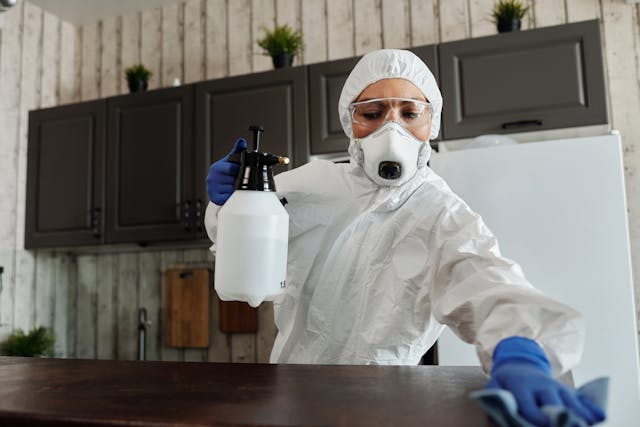
Photo by Matilda Wormwood: https://www.pexels.com/photo/photo-of-person-disinfecting-the-table-4099462/