
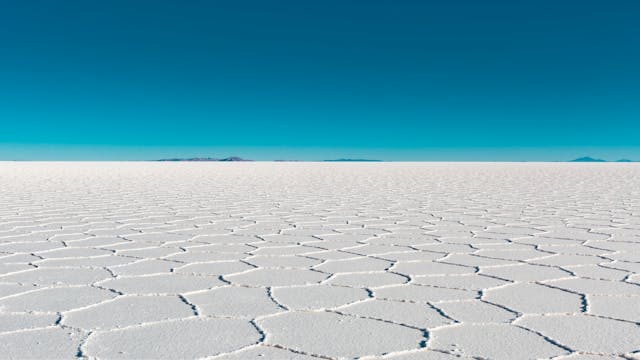
How do salt flats form? Salt flats form when water with a high mineral content gets trapped and evaporates more quickly than it can be replenished. Salt flats are sometimes called salt pans. They are a large expanse of land that used to be a lakebed but is now covered in a hard crust of salt and other minerals mixed with fine sediment.
There are many salt flats around the world, and they range from tiny to enormous. The largest is the Salar de Uyuni in Bolivia. It is about 10,852 km², which makes it larger than a lot of cities, and it sits at an elevation of around 3,656 meters. There is also the Bonneville Salt Flats in Utah, USA, which are famous for the many land speed records that have been attempted there. They are extremely flat, which makes them perfect for going fast.
Salt flats are usually the bottoms of dried-up lakes, but they will not form in just any dried-up lake. Salt flats form when the water is salty, the drainage basin is completely enclosed, and the climate is dry enough that the water evaporates more quickly than it can be replaced. It also helps if this wet-and-dry process repeats, because each cycle leaves a little more mineral behind.
All water has dissolved minerals in it, but some water carries far more than other water. Rivers and freshwater lakes contain small amounts of salt, but it is washed downstream by the current. They are also replenished by rainfall, which dilutes the mineral content. The oceans have more salt because they lose water through evaporation and, when water evaporates, it leaves its dissolved salts behind.
Some rivers pick up more dissolved minerals than others depending on the rocks they run through. If the surrounding rock is highly weathered, it breaks down more easily and minerals leach into the water. Those rivers can carry salts and other dissolved ions into a lake, slowly making it more and more salty. This is the first step in the formation of a salt flat.
The second step is to have a lake that does not drain anywhere. Most lakes are fed by rivers at one end and drain into other rivers at the other end. For a salt flat to form, the lake cannot have an outlet. The only way water can leave is by soaking into the ground or evaporating into the air.
The third step is to cut off, or at least reduce, the rivers that feed the lake. In very arid regions this can happen naturally because the climate shifts, the sources of water dry up, and the rivers weaken or disappear. At that point, little new water is flowing into the lake and none of the water is flowing out of it. The remaining water becomes a concentrated brine.
If the area is hot and dry enough, the water in the trapped lake starts to evaporate. The main idea is that water evaporates easily but dissolved minerals do not. Table salt (sodium chloride) has a boiling point well above 1,000°C (around 1,400°C), so it is not going anywhere at normal temperatures. As the water evaporates, the brine becomes more concentrated, and eventually minerals begin to crystallize out and settle. Over time, this builds up an evaporite layer: mostly salt in many places, but often with other minerals as well.
Many salt flats do not form in a single, dramatic drying event. They grow through cycles. During wetter periods, a shallow lake can return and dissolve some of the surface crust. Then, when the water evaporates again, a fresh layer of crystals forms. Brine can also rise slowly through the sediment, evaporate at the surface, and leave another thin deposit. Repetition smooths the surface, fills small dips, and produces the wide, level plains that make salt flats so striking. The polygon patterns that appear on some flats are thought to form as the crust shrinks, cracks, and is re-cemented over time.
Salt flats are often popular tourist destinations. The Salar de Uyuni in Bolivia can turn into a mirror when it rains. A thin layer of rainwater covers the flat salt and creates near-perfect reflections, especially when the air is calm.
However, salt flats are also used as a resource. People have used surface salt for food in some places, but much of the salt from large natural flats is used for industrial purposes because it can be contaminated with sand, dirt, and other minerals. In some regions there can also be trace elements such as arsenic, depending on the local geology. If salt is intended for food, it usually needs careful processing, which can be expensive. Salt for consumption can be produced in controlled areas that are kept very clean, where salty water is spread out in shallow ponds and left to evaporate. And this is what I learned today?
Sources
https://en.wikipedia.org/wiki/Salt_flat
https://en.wikipedia.org/wiki/Salar_de_Uyuni
https://www.thoughtco.com/salt-flats-geography-1435836
https://my.nsta.org/resource/6277/science-101-why-are-oceans-salty-and-lakes-and-rivers-not
Photo by Leonardo Rossatti: https://www.pexels.com/photo/uyuni-salt-flat-2613110/