
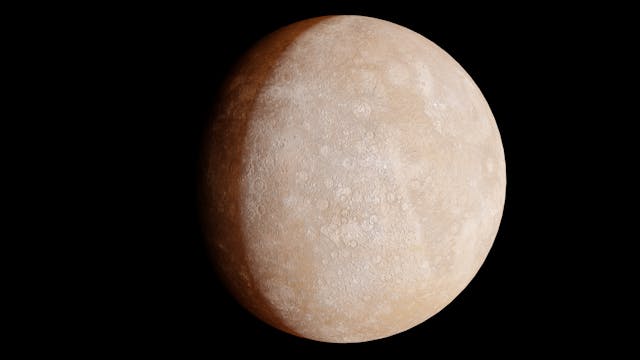
Why is Mercury so difficult to visit? Mercury is difficult to visit because, among other things, it is moving so fast, it is very close to the Sun, and it doesn’t have an atmosphere.
Out of all the planets in the solar system, Mercury has been visited the least. So far, Mars is the most frequently visited. There have been many probes sent past Mars, several inserted into orbit, and numerous landings on the surface. In 2021, a helicopter was successfully flown on Mars. All of these missions are part of the long-term effort to understand Mars better and prepare for possible human exploration in the future. Venus is probably the second most probed and visited planet in the solar system. The Soviet Union managed to land on the surface of Venus eight times between 1970 and 1982, despite its high temperature and crushing pressure. Because we often think of Mars as our “sister” planet, it is easy to imagine that it is the closest planet to us, but that is actually Venus at its closest approach. Mars just has a more similar environment. After Venus, Jupiter and Saturn are the next two most visited planets. Several probes have been sent past them and to their moons. Uranus and Neptune have been passed only once each as well, but they are so far away that it is not easy. Which leaves Mercury as the least visited planet in the solar system. There have only been two successful robotic missions to Mercury so far, and nobody has managed to land on its surface yet.
There are several reasons why we haven’t visited Mercury more often, and distance is not the main one. Mercury is much closer than the outer planets, so if distance was the only factor, it would not be especially difficult to send a probe there.
The first problem is the speed with which Mercury orbits the Sun. Mercury is very close to the Sun, only about 58 million kilometers away, which means it has a very tight and very fast orbit. It takes 87.9 Earth days to complete one orbit of the Sun and it moves at roughly 47 km/s, much faster than Earth. That means that for a space probe to go into orbit around Mercury, or to land on its surface, it has to arrive in just the right way. The difficulty is not simply getting there. The difficulty is slowing down enough for Mercury to capture it.
The second problem is losing speed once the spacecraft is on its way. To insert a probe into orbit around Mercury, it has to approach the planet and then slow down enough for Mercury’s gravity to catch it. If it is going too fast, it will just zoom on by. For spacecraft flying away from the Sun toward the outer planets, this is not too hard because they are increasing their distance from the Sun. When a spacecraft flies toward Mercury, it is flying toward the Sun, and the Sun’s gravity gradually increases the spacecraft’s speed, like a bicycle going down a hill that gradually gets steeper. Shedding that speed at the last moment is very difficult. It is not the same as a car putting on its brakes, or even a fighter plane landing on an aircraft carrier.
And the third problem is that Mercury doesn’t have an atmosphere. If a spacecraft is flying toward a planet with a thick atmosphere, that atmosphere can be used to slow the craft down. Friction with the atmosphere can bleed energy away from the craft. Because Mercury doesn’t have an atmosphere, that isn’t possible, and engineers need other ways to remove its speed. This usually can’t be done with rockets alone because the spacecraft would have to carry far more fuel than is practical. The main way to reduce speed is with a gravity assist. This is where a spacecraft is steered close to another planet to either gain speed or lose speed. A spacecraft flying to Mercury may have to head past several other planets to lose enough speed, which is why it can take so long to get there.
The BepiColombo mission was launched in 2018. It used a gravity assist from Earth, then two from Venus, and then multiple flybys of Mercury so that it could gradually lose enough speed to be captured by Mercury’s gravity. That process takes years.
If a spacecraft could be landed on Mercury, it would not have the same problems with pressure that spacecraft on Venus did. Mercury has no thick atmosphere, so it does not suffer from the crushing pressure that Venus has. However, its temperatures are still extreme. The side facing the Sun can become hotter than 400°C, while the night side becomes extremely cold. So, it is not impossible to get to Mercury, but it is much harder than the short distance makes it seem. And this is what I learned today.
Sources
https://promenade.imcce.fr/en/pages5/582.html
https://en.wikipedia.org/wiki/List_of_Solar_System_probes
https://science.nasa.gov/mercury/exploration
https://en.wikipedia.org/wiki/Mercury_(planet)
https://en.wikipedia.org/wiki/Exploration_of_Mercury
Photo by Zelch Csaba from Pexels: https://www.pexels.com/photo/planet-of-solar-system-20376399/