
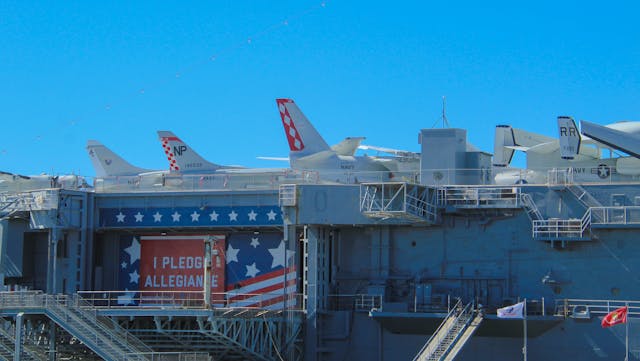
How do planes take off and land on an aircraft carrier? Planes take off on an aircraft carrier by using a catapult, and they land by using a hook.
Planes take off from an aircraft carrier by using a high-powered catapult. To fly, an airplane needs to have air move over its wings at a fast enough speed to overcome its weight and provide lift. Planes usually need long runways in order to reach a high enough speed to get that lift. Aircraft carriers don’t have much space, so they have to reach takeoff speed in a shorter distance. The amount of speed required for takeoff can be reduced by pointing the aircraft carrier into the wind and sailing at full speed. This brings some air flow over the wings, but it is not enough for take off. To get the speed they need, the plane is attached to a high-powered piston catapult.
On the deck of the aircraft carrier is a slot with a shoe to hold the nose wheels of the plane. The shoe is connected to a piston that is pulled back into position and locked. The piston is filled with steam from the ship’s boiler until the pressure is very high. The catapult officer has to measure the steam pressure because too much will break the plane, and not enough will leave it without enough velocity to take off. A steel deflector is raised behind the plane so that it can turn on its jets to full power before takeoff. When everything is ready, the pilot takes their hands off the steering column to avoid any sudden movements, and the catapult officer releases the pistons. The plane accelerates to 250 km/h in two seconds and leaves the end of the flight deck. The afterburners are on, so the plane keeps accelerating and climbs. In the unlikely event that the plane doesn’t have enough speed, the pilot has no alternative but to eject.
Taking off is relatively simple. The pilot sits there, and the catapult does all of the work. Once they are airborne, they have to fly the plane, but getting airborne is the easy part. Landing is much more difficult. Landing is always the most dangerous part of any plane journey, but most pilots can use a long runway. Fighter pilots landing on an aircraft carrier have to contend with a very short runway that is only about 150 meters long, perhaps 10% of a normal runway. They also have to cope with a runway that is moving up and down constantly. When the weather is bad, the ship can move up and down by several meters. Pilots also have to do all of this in the dark, as well.
Landing on an aircraft carrier is far more difficult than taking off, but, technologically, it is very simple. Each plane has a tailhook that hangs down at the back of the plane. Across the runway are four wires that are raised slightly above the ground. The pilot has to snag one of these wires with the tailhook, and it will stop the plane. It can bring a plane travelling at flight speed to a full stop in roughly two seconds. The pilots are supposed to catch the third wire, which means they have to get a perfect angle. The other three wires are there for safety purposes. The second the pilot hits the runway, they push their throttles to full power in case they don’t manage to catch any of the wires. They need to be travelling at full speed if they miss so that they can take off again. Because of this, the runway planes land on is diagonally across the deck of the ship so that they don’t hit any other planes if they need to do a go around.
Larger planes have been modified to use aircraft carriers, but it is much safer with smaller planes the size of fighter jets. They have to be fitted with a reinforced nose wheel and the tailhook. In World War 2, some heavier aircraft were launched from aircraft carriers. B-25 bombers were launched for special raids, but this was not very common, and they had to be heavily modified. All of their non-essential parts were removed to make them lighter. The pilots were intensively trained, and they waited for a very strong headwind. The ship sailed directly into the headwind, and this just about gave the planes enough speed to fly. They launched 16 planes in an hour. And this is what I learned today.
Sources
https://en.wikipedia.org/wiki/Aircraft_catapult
https://science.howstuffworks.com/aircraft-carrier3.htm
https://science.howstuffworks.com/aircraft-carrier4.htm
https://www.pacificwarmuseum.org/visit/exhibits/artifacts/b-25
Photo by Karen F: https://www.pexels.com/photo/aircraft-carrier-with-jets-and-patriotic-banner-29320328/