
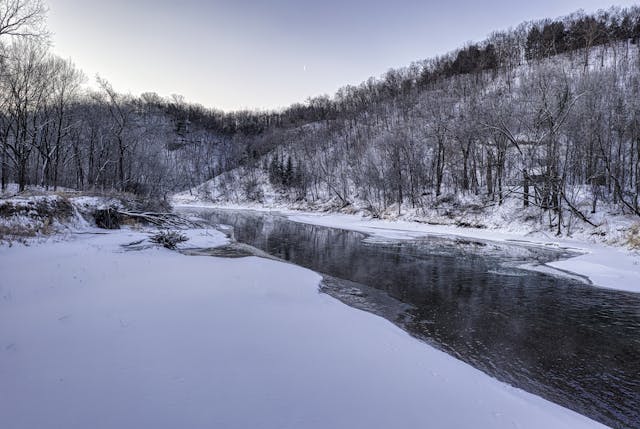
Why doesn’t moving water freeze? Moving water does freeze, but it takes a lot longer and the temperature has to be lower than for still water. This is because of turbulence and heat transfer.
It is difficult to make ice in both moving water and standing water. Water does not change temperature quickly, because it has a very high specific heat capacity. This means it can absorb or release a lot of heat while its temperature changes by only a small amount. Specific heat capacity is how much heat energy it takes to raise the temperature of 1 gram of a substance by 1 degree Celsius. Water must lose a lot of energy to cool down to 0°C. Then, even at its freezing point, it still does not instantly turn to ice. To actually freeze, water must also release the latent heat of fusion. This is the extra energy that must be removed from liquid water to turn it into ice, and it is about 334 joules per gram. This is true whether the water is moving or not.
Obviously, this latent heat of fusion can be removed, because water does freeze, but it is very difficult to remove it from moving water. The energy in a pond or a river is lost to the air. It takes time for the air to remove this heat, and it helps if the water is sitting still, waiting for the heat to be removed. Moving water doesn’t sit still. This is where the turbulence comes in. Turbulence in the stream of water mixes up the surface, taking molecules that have started to lose heat down below the surface and replacing them with molecules that have more energy. The surface layer is constantly disrupted and doesn’t have the time to form into an ice sheet. If ice does start to form, it gets broken up by the moving water. Ice crystals can form, but they don’t stay at the surface and get mixed up in the stream of water forming frazil ice.
Heat transfer also happens in a body of moving water. In a pond, the air removes the heat from the surface of the water, down to a depth of about 30 cm or more and that layer freezes. In moving water, the heat energy taken out of the water at one point is replaced by warmer water moving in from further up the river. Heat can also be transferred up from lower down in the body of water as well. It can be warmed by the riverbed or from groundwater that mixes in with the river. The speed of the water is also a factor. Slow moving water, such as shallow streams, can freeze, but faster moving water, such as rivers, usually don’t.
Still water freezes when the temperature is low enough, but it doesn’t freeze all the way down. This is because of a peculiar property of water. As the temperature of water decreases, its density increases, until, that is, it reaches 4℃. This is where the density of water is at its maximum. If the water continues to cool below this, it becomes less dense again. In the beginning of winter, the water at the surface of the lake starts to cool. As it cools, it gets denser and sinks, forcing warmer water to the surface, where the heat loss continues. This causes mixing until the temperature of the whole lake is 4℃. At this point, the water at the top cools even further, but it can’t sink because it is now less dense than the rest of the lake, so it stays at the top, cutting the warmer deeper water off from the cold air. The surface water cools even more and becomes ice. The ice forms a lid over the lake, which insulates it from the cold air, meaning that even though there is a thick layer of ice on the top of the lake, the water underneath is still 4℃. That is cold enough to seriously injure or even kill any of us if we fell through the ice, but it is a temperature that fish can survive in. That is how fish can survive the winter when the air temperature is -30℃ or colder. And this is what I learned today.
Photo by Tom Fisk: https://www.pexels.com/photo/river-in-winter-scenery-11815763/