
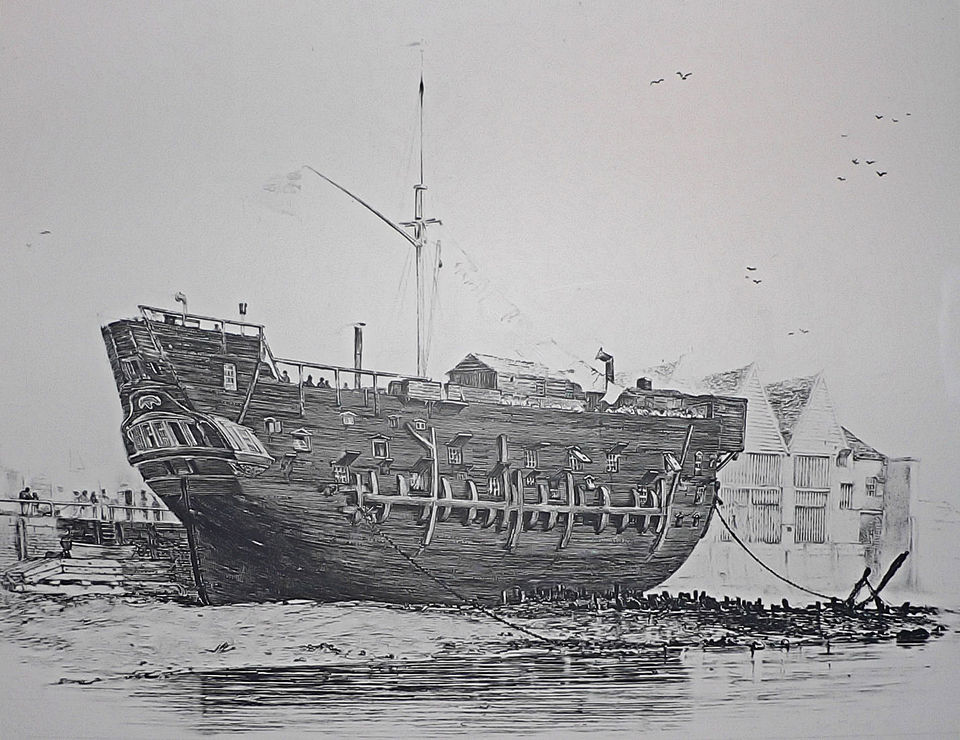
What were prison ships? Prison ships were ships floated in the River Thames and other places around Britain in the 18th and 19th centuries to cope with overflowing prisons.
Britain was not the only country to use prison ships, but it probably made greater use of them than other countries. In the late 18th century and early 19th century, the number of people sentenced to prison in Britain expanded far too rapidly to be housed in the existing prisons. This was a direct result of the Industrial Revolution. When Britain industrialized, industries moved away from skilled artisans to unskilled people who could work machines. To find these people, they encouraged migration from the countryside to the cities. Britain had been primarily an agricultural country before the Industrial Revolution, but it quickly adjusted to becoming an industrial country. The new inventions, such as steam power, could be used on the farms so that fewer people could do all the work that a huge number of farmers had done previously. The influx of people into the cities was relatively rapid, and there was not enough time to rebuild the cities to give everybody adequate housing. People were crammed into small, unsanitary houses, and they worked long hours for not much money. Poverty was rife, and wherever there is poverty, there is crime.
As crime rose, the government tried to crack down, and they gradually increased the number of offenses that were considered serious crimes worthy of the death penalty. A number of laws were passed that increased the number of crimes carrying the death penalty from 50 to 200. Someone could be executed for stealing goods valued at more than 12 pence, which was one shilling, which is roughly $20 today. The problem was that a lot of judges and jurors didn’t agree with this system, and they refused to execute the rising number of criminals. They had to do something with them, and the prisons were full to capacity. Theft was the leading cause of imprisonment, and four out of five prisoners were imprisoned for theft. People didn’t have enough to eat, so they had to steal food. It was incredibly difficult to fix the underlying causes of the poverty, so the answer was to imprison the thieves. It is easy to judge with hindsight, but the people in 18th-century Britain were dealing with a whole new problem in a whole new world.
A common strategy was to send many of these prisoners to the colonies in North America. Australia had only just been discovered, and prisoners weren’t being sent there yet. The American War of Independence made it impossible to transport prisoners to the Americas. Someone came up with the idea of housing the prisoners in ships. They couldn’t use working ships because those were needed to fight the war in America, and all the other conflicts Britain was involved in, so they used decommissioned ships. These were called hulks, and they were ships that could still float, but couldn’t sail or put out to sea. They were often just the floating side of wrecks. The first hulk was moored in the Thames at London on 15 July 1776 and was filled with prisoners. The prisoners slept and ate on the ship, and performed hard labor on the land nearby during daytime.
Using one ship didn’t fix the problem because the number of prisoners continued to grow. By the middle of the 19th century, there were over 40 hulks moored in the Thames holding prisoners. The conditions were terrible. Prison ships were used by the British to hold American prisoners of war as well. They were moored near New York city and the conditions were atrocious. 12,000 American prisoners died due to starvation and disease.
When colonies were set up in Australia, transportation became possible again, and a lot of prisoners were sent there, but the prison ships were still in service. Between 1788 and 1868, roughly 160,000 prisoners were transported from Britain to Australia. The number of hulks used as prison ships slowly declined from the latter part of the 19th century, but they didn’t completely disappear until very recently. Prison ships were used to hold prisoners in both world wars, and Britain had a prison ship from 1997 to 2006. There was even a move recently to create a prison ship for asylum seekers, but the government gave up the idea after significant protests. And this is what I learned today.
Sources
https://en.wikipedia.org/wiki/Convicts_in_Australia
https://en.wikipedia.org/wiki/Prison_ship
https://en.wikipedia.org/wiki/Hulk_(ship_type)
https://www.nationalarchives.gov.uk/education/resources/19th-century-prison-ships
https://mhnsw.au/whats-on/exhibitions/convict-hulks-life-prison-ships
https://en.wikipedia.org/wiki/Bloody_Code
https://www.bankofengland.co.uk/monetary-policy/inflation/inflation-calculator
Image By Unknown author – http://en.wikipedia.org/wiki/File:Discovery_at_Deptford.jpg, Public Domain, https://commons.wikimedia.org/w/index.php?curid=10050203