
How do we make blood? Blood is made in our red bone marrow in a process called hematopoiesis.
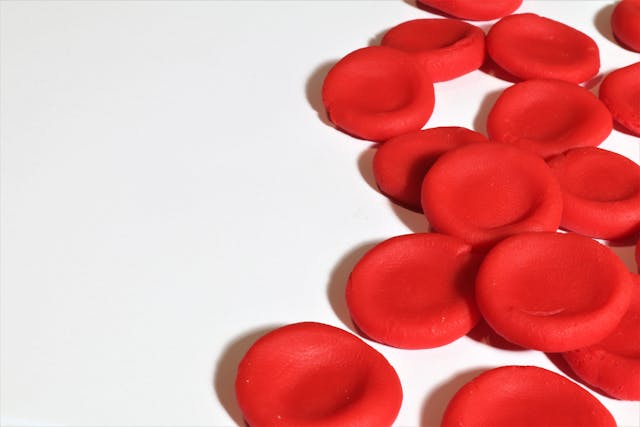
People have different quantities of blood depending on their size, but it is usually about 8% of a person’s body weight. 55% of the blood is made up of plasma, and the other 45% is a combination of red and white blood cells and platelets. The plasma is a mixture of water, sugar, fat, protein, and salt. It is mainly there to carry the blood cells around our bodies, but it also carries nutrients, antibodies, necessary proteins, hormones, and waste products in and out of our bodies. The red blood cells look like donuts that haven’t had the hole cut all the way through. They are the most abundant cells in blood, and they carry a protein called hemoglobin which can carry oxygen and carbon dioxide into and out of the lungs. Hemoglobin is based on iron, and it is what gives red blood cells their color. There are so many red blood cells in the blood that it appears red. The white blood cells only make up about 1% of the cells in the blood. There are many different types of white blood cells, and their job is to attack infected cells and invading organisms. We can produce more of them when we are sick. The platelets are small fragments of cells that are used to plug wounds and stop us from bleeding.
Blood cells only last for about 120 days before they die. They don’t have a nucleus, which means they have much more space to hold hemoglobin, and it makes them more flexible so they can change shape to suit the different vessels they have to travel through. However, because they are flexible and can fit through smaller shapes, they get damaged far more easily and only last for about 4 months. Our bodies have to constantly remake our blood, and it produces about 2 million new red blood cells every second, over 500 billion a day.
New red blood cells are made in the bone marrow, but the process starts in the kidneys. Red blood cells carry oxygen, so when the number of red blood cells gets low, the amount of oxygen in the blood also gets low. This triggers special cells in the kidneys called peritubular cells to release a protein called erythropoietin. This protein flows with the blood until it comes to the bone marrow and tells it to start producing red blood cells.
Bone marrow is a soft, spongy tissue that is in the center of bones. There are two types of bone marrow: red and yellow. Red bone marrow produces red blood cells, white blood cells, and platelets. Yellow bone marrow is primarily for storing fat, which is where the yellow color comes from, and is used for giving sustenance to bones. It also produces cartilage and bone. Yellow bone marrow doesn’t produce blood cells.
Red bone marrow contains stem cells called hematopoietic stem cells. A stem cell is a cell that can become any other cell, but a hematopoietic cell is a stem cell that can become a red blood cell, a white blood cell, or platelets. Once it is activated, it goes through several steps to gradually become a red blood cell. The stem cells have a nucleus and all of the other parts that cells carry. As the cell transitions into a red blood cell, it has the nucleus for a while and is fairly large. Once it passes a certain point, the cell begins to shrink and to produce more hemoglobin. The amount of hemoglobin builds up, and the cell gets even smaller, which squashes the nucleus. When the cell is completely full of hemoglobin, it ejects the nucleus and becomes an immature red blood cell. So many red blood cells are produced that the nuclei have to constantly be cleared away. The immature red blood cell stays in the bone marrow for another three days while it matures, and then it is released into circulation. It takes a further two days in the bloodstream before it is a completely mature blood cell.
A blood cell takes roughly a minute to do a complete circuit of the body. Obviously, that varies according to an enormous number of factors. The average blood cell lives for about 120 days, so it will make roughly 172,800 trips around your body before it dies. Once they die, they have to be removed from the body. Old red blood cells are broken down mainly in the spleen and liver. Their iron is recycled to make new blood cells, and the waste pigments are processed by the liver and leave the body mostly in feces, with a small amount in urine. And this is what I learned today.
Sources
https://en.wikipedia.org/wiki/Hematopoietic_stem_cell
https://www.moffitt.org/treatments/blood-bone-marrow-transplant/what-is-bone-marrow
https://www.hematology.org/education/patients/blood-basics
https://www.blood.co.uk/the-donation-process/after-your-donation/how-your-body-replaces-blood
https://medicalxpress.com/news/2016-07-reveals-body-disposes-red-blood.html
Photo by Roger Brown: https://www.pexels.com/photo/red-bloodcells-on-white-surface-5149400/