
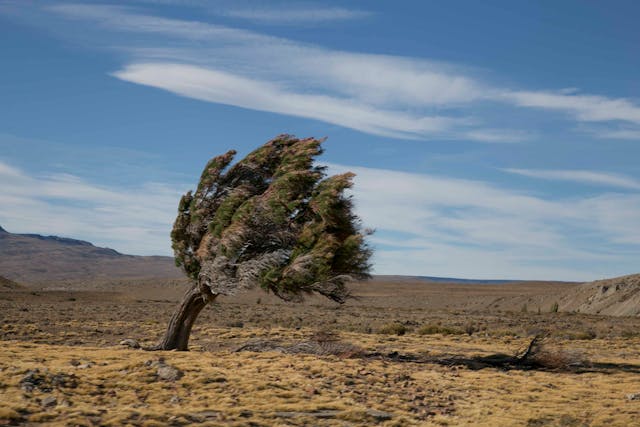
Why are some places windier than others? There are many reasons why some places might be windier than others. Some of those reasons are temperature differences, topography, the amount of surface friction, and wind funneling.
Wind is caused when air moves from an area of high pressure to an area of low pressure. Air behaves like a fluid, and a fluid will always move in a way that tries to balance differences in pressure and energy. The atmosphere is constantly trying to even itself out. If one place has warmer air, cooler air, denser air, or thinner air than another, the imbalance creates movement. This is a little like the reason hot coffee cools down or a chilled drink warms up. Energy tends to spread out until things are more balanced. In the atmosphere, that balancing process often shows up as wind.
One of the biggest reasons why some areas might be windier than others is because of temperature differences. When land is heated strongly by the sun, the air above it warms up, expands, and rises. This can help create lower pressure at the surface. If there is cooler air nearby, that cooler air is denser and can move in to replace the rising warm air. The greater the temperature difference between two nearby areas, the stronger the movement of air can be. This is one reason coastal places often get strong breezes. The land heats up and cools down faster than the sea, so air is always shifting between the two.
The topography of an area matters greatly in how windy it is. Mountains can act as huge obstacles to the movement of air. The mountain does not stop the wind, but it forces it upward and around the slopes. This can create very strong winds on ridges and summits. Once air has crossed a mountain barrier, it can descend on the other side and sometimes speed up as it goes. As air rises up one side of a mountain, it cools, and moisture in it may condense and fall as rain or snow. By the time the air comes down the other side, it is often much drier. This is one reason why deserts sometimes form in the lee of mountains. The area behind the mountain can end up both drier and affected by distinctive wind patterns.
Valleys can also cause strong winds because they can act like funnels, concentrating the movement of air. When a fluid moves through a constricted space, it often accelerates. This is related to what is called the Venturi effect, named after the Italian physicist Giovanni Venturi. In a valley or mountain pass, the shape of the land can channel the air into a narrower route. As the air is squeezed into that smaller space, it can move faster. This is why some valleys and gaps are famous for strong winds. The land does not create the wind from nothing, but it can make an existing flow much stronger and more focused.
The amount of surface friction is important as well. Wind carries energy, and anything that takes some of that energy away will slow it down. Friction with the Earth removes energy from the moving air. Objects on the ground, such as trees, hills, and buildings, also disrupt the flow and weaken the wind near the surface. The smoother the ground is, the less energy is taken away. Open areas such as lakes, deserts, grasslands, or broad plains have less surface roughness, so winds can often get much stronger there than they can in forests or crowded urban neighborhoods.
Built-up areas can experience all of these effects in a small space. Cities with parks can have significant temperature differences over short distances. Asphalt and concrete heat up more than green spaces do, and that can help create local air movement. Cities also have tall buildings that block and redirect the wind, pushing it upward, around corners, and down into the streets. Streets lined with high buildings can funnel the wind and make it feel much stronger at ground level. At the same time, the roughness of a city can slow the wind in some places while accelerating it in others. This is why cities often have odd patches of calm air and sudden gusty corners only a block apart.
Some cities are windier because of where they are located as well as how they are built. Chicago is a good example. It sits next to Lake Michigan, which is a large open body of water with very little surface roughness compared with the land. Air moving across the lake can pick up speed because there are few obstacles to slow it down. Then, when that moving air reaches the city, the buildings can redirect and funnel it, creating strong gusts. So when a place feels especially windy, it is usually not because of one single cause. It is often the result of temperature differences, the shape of the land, surface friction, and the way the wind is directed by the environment around it.
Sources
https://www.berito.nl/blog/why-are-some-places-more-windy-than-others
https://education.nationalgeographic.org/resource/wind
https://weatherology.com/trending/articles/Professor-Paul-Venturi-Effect.html
Photo by Jan Zakelj: https://www.pexels.com/photo/a-big-tree-swaying-by-the-wind-under-blue-sky-9059257/