
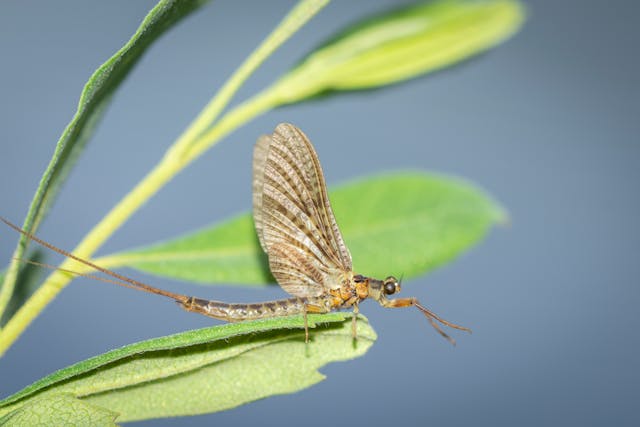
Why do insects have such short lives? Many insects seem to have short lives because they have evolved to prioritize rapid reproduction over a long life. However, it only seems that way if we focus on certain kinds of insects, or if we only look at their adult stage. Not all insects have short lives. There are millions of different species of insects, and some of them can live for a very long time. Termite queens have been known to live for decades. Some jewel beetles can also live for many years. Some species of cicadas spend 13 or 17 years underground before they emerge as adults. At the other end of the spectrum, adult mayflies may only live for a day or two. Fruit flies live for a matter of weeks. Houseflies often live for a few weeks. Mosquitoes generally do not live very long either, and many butterflies only survive as adults for a short period of time. With so many different species of insect, a question like this is only really going to apply to a certain percentage of them. There are around 1 million described insect species, and the real number of living species is thought to be far higher. They are the most diverse group of animals on Earth.
One important thing to understand is that the life of an insect is often divided into different stages, and those stages do different jobs. In many species, the young stage is for eating and growing, while the adult stage is mainly for mating and reproducing. That means the adult stage does not always need to be built for long-term survival. If an animal is going to live for a long time, it needs to be able to eat, rest, avoid predators, and survive changes in temperature and season. Each of these things requires different adaptations. It needs a body that can keep repairing itself, a way to find and process food, and some kind of strategy for escaping danger. If it is going to live through changing weather, it also needs a way to deal with heat, cold, drought, or lack of food. All of that takes energy. If evolution can get better results by putting energy into rapid reproduction instead, then that is often the strategy that gets favored.
This is why many short-lived insects are so focused on reproduction. They are not built to last. They are built to mature quickly, reproduce, and pass their genes on to the next generation. A creature that only needs to survive for a short adult phase does not need the same investment in maintenance that a long-lived animal does. In that sense, a short life can actually be an advantage. The insect does not need to spend as much energy on repair, protection, or surviving the bad season. It only needs to survive long enough to reproduce successfully.
Mayflies are one of the best examples of this. They are famous for having some of the shortest adult lifespans of any insect. The goal of an adult mayfly is to mate and reproduce. That is almost all it is there for. In fact, adult mayflies do not even have a functioning digestive system, so they cannot really feed once they reach that stage. They spend most of their lives earlier on, living in water as immature forms. Then, once they emerge as adults, they have a very short window in which to mate and lay eggs. Mayflies also emerge in very large numbers at the same time, something called synchronous emergence. This overwhelms predators and gives at least part of the swarm a better chance of surviving long enough to reproduce. Their strategy is not to survive for a long time. Their strategy is to appear in huge numbers, reproduce quickly, and let the next generation continue the cycle.
Another advantage of short lifespans is that populations with short generations can evolve more quickly. Because generations pass so quickly, useful mutations can spread through the population faster. A good example is the peppered moth in Britain. As pollution from industry darkened tree trunks and buildings, darker moths had a better chance of blending in and avoiding predators. Later, when pollution levels dropped, the lighter form became more common again. A short generation time allows this kind of change to happen more quickly than it would in a long-lived animal.
Even longer-lived insects often avoid surviving winter as active adults. Many species have adapted so that the egg, larval, or pupal stage can survive the cold better than the adult can. The insect spends its active life feeding, growing, and mating, and then the next stage carries the species through the difficult season. In some cases, the adult dies, but the eggs remain. In other cases, the young stages wait underground, underwater, or in sheltered places until the weather improves. So, in a way, the insect itself may not survive the winter, but its life cycle does.
So, how do termite queens live so long? They have several advantages that most insects do not have. First, they live deep inside the nest, which protects them from weather and predators. They are surrounded by the colony and cared for by worker termites. They do not have to search for food, escape enemies, or expose themselves to the environment in the same way other insects do. Their whole existence is centered on reproduction, but in a protected and stable setting. Research also suggests that they have unusually strong biological defenses against the damage that builds up in living tissue over time. The other termites in the colony do not live nearly that long. The queen is a special case, and her lifespan shows that insects can live a long time if the conditions and the evolutionary strategy are right.
So, insects do not all have short lives. However, many of them do have short adult lives because evolution has favored a strategy of growing quickly, reproducing fast, and leaving survival of the next season to the next generation. A long life is only useful if it helps an animal leave more offspring. For many insects, it seems that a short life works perfectly well. And this is what I learned today.
Sources
https://www.arrowexterminators.com/learning-center/blog/these-bugs-live-forever-almost
https://www.ifaw.org/international/journal/animals-shortest-lifespans
https://www.orkin.com/pests/flies/house-flies/life-expectancy-of-house-flies
https://phys.org/news/2018-05-exceptionally-fertile-termite-queens.html
https://www.thenakedscientists.com/articles/questions/why-do-some-insects-only-live-day
https://aptivepestcontrol.com/blog/the-lifespan-of-insects
Photo by Tom Christensen: https://www.pexels.com/photo/close-up-macro-of-mayfly-resting-on-leaf-32652887/