
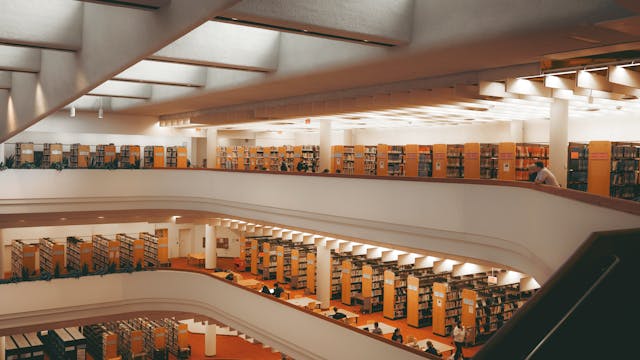
When and why did public libraries start? Public libraries started in the mid-19th century as a way to give democratic access to information and education to the working classes.
A library is a purposefully assembled collection of books or manuscripts, and the first libraries were literally that. The Babylonians wrote on clay tablets, and these tablets were stored in libraries. They were stacked on shelves with a title on the edge of the tablet so they could be located. This was where writing began, and it was first used to record inventories of stock and commercial transactions, because writing was invented to keep track of things. It was only later that writing evolved to keep track of ideas as well as things. This was some time during the middle Bronze Age. Libraries existed to store texts and to allow the people who needed to read them to find them. The majority of people could not read and would not have had the ability to get to a library even if they could. And this is the way it was for well over a thousand years.
As writing evolved, the methods for writing also evolved. Tablets made way for papyrus, vellum, parchment, and paper in Asia. These were far easier to store than tablets. Libraries grew larger and became centers of education. The Library of Alexandria is probably the most famous. It was said to have held over 500,000 scrolls that covered an enormous range of academic subjects. It was a repository of human knowledge. The Library of Alexandria, along with almost all other libraries that existed at the time, was not public. It was a private and elite institution, and scholars needed permission to view the manuscripts, sometimes even from the king. The first public library is said to have been built in Rome in the first century BC and was called the Atrium Libertatis, but, again, the majority of people could not read what was in it. Literacy rates in Rome were said to be no higher than 15% of the population.
Over the next thousand years or so, libraries grew in the Middle East, which became the seat of much of the world’s scientific learning. Many of the libraries in Europe were based on religious texts, and many books were written out by hand by monks. The invention of the printing press and the slow spread of paper helped libraries to blossom, but literacy rates still had not increased very much and nearly all of the libraries were private. There were a few public libraries, but the books were chained to desks so people could not simply walk out with them.
In the middle of the 18th century, in some European cities, a few circulating libraries opened up. These were libraries that lent customers books for a yearly subscription. They carried a lot of fiction, which was rapidly becoming more popular. Paper was easier to make and there were many more books than before, but these libraries were not really “public” libraries. People could only borrow books if they could afford the fees, could read, and had time to read during the daylight, or could afford lighting at night, which was not true of a very large percentage of the population.
Several things then began to change. The Industrial Revolution brought huge numbers of people into cities to work in the new factories. There was also a rise in literacy rates, climbing from 30% in 1650 to 40% by 1754. Schools were introduced for the working classes and by 1850 literacy rates were at roughly 80%. They would reach 97% by 1900. However, crime rates were also rising because of the poverty and the conditions people were forced to live in. Several people in the British government, led by James Silk Buckingham, thought that one way to keep crime rates down would be to give people the chance to read. They believed that free libraries and museums would give people the chance for self-improvement. The Museums Act of 1845 brought free museums with attached libraries. Then the Libraries Act of 1850 brought libraries. The law was there and it allocated tax money, but there was never enough, and it often took the help of rich philanthropists to get libraries built. This was also a good example of wealthy Victorians thinking that the poverty the working class lived in was largely due to a lack of ambition and laziness. They believed that if only the working classes would try to better themselves, their lives would improve.
The same thing happened in the United States. There was not enough public money, so it fell to wealthy philanthropists to build the libraries. Over half of all the libraries in the USA were built by Andrew Carnegie. Carnegie funded the construction of the library and helped stock it with books. The town then had to promise to raise money every year to maintain the building. And this is what I learned today.
Sources
https://www.weforum.org/stories/2022/04/world-book-day-libraries-history
https://en.wikipedia.org/wiki/History_of_libraries
https://en.wikipedia.org/wiki/Public_library
https://www.bookbrunch.co.uk/page/free-article/the-british-and-reading-a-short-history
Photo by Arvind Krishnan: https://www.pexels.com/photo/vast-interior-of-toronto-s-modern-library-32449398/