
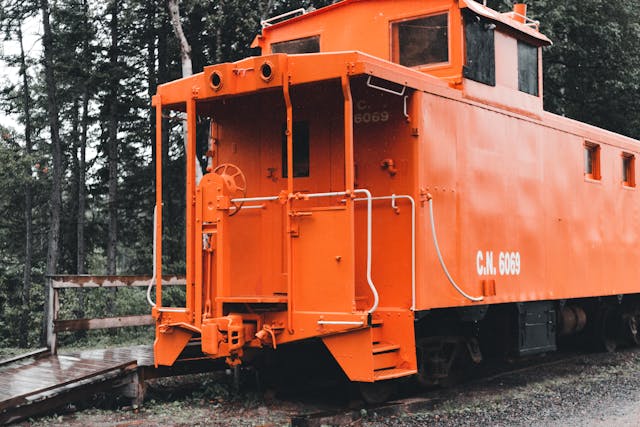
What is the Janney coupler? The Janney coupler is a device that goes between train cars to join them together. It was a revolutionary jump in railroad technology and is still used today, over 150 years later.
If you have ever ridden on a train and you have looked at the coupling that hold the train carriages together, then chances are high that you have seen a Janney coupler in action. From above the Janney coupler looks like a human hand, curled up, but with a gap in the middle, in a hook shape. They are often called “knuckle couplers” because of their resemblance to the hand. They are attached to the front and back of carriages, with the gap pointing in opposite directions. When the carriages are brought together, and the knuckles automatically slide inside each other. There is a spring loaded hook inside each coupler to keep it in place. When railway workers want to uncouple a carriage, they just pull a lever that opens the knuckle. Because of its shape, the Janney coupler can hold a lot of weight and it will not slip out of place. These days, trains are getting longer and carrying more freight, but the Janney coupler has no problem with that. It is also not a rigidly fixed coupling, which means that the carriages can move a little and this increases their ability to stay on the tracks.
The Janney couple is an incredible invention, but its biggest advantage came in its safety feature. In the early days of trains, carriages were joined together with a lock and pin system. The carriages had to be brought close together until the two locks were in alignment. Then a pin had to be dropped through the locks and secured. The locks were on a hinge so that they could move slightly, and when the carriages were brought together, a railway worker had to guide the one lock into the other. This was incredibly dangerous. Many railway workers lost hands and arms when they were caught between the two locks. Many workers were crushed between the railway cars as well. In the 1880s, 38% of all deaths and injuries on the railway were caused in coupling accidents. On top of this, no two train companies used the same kind of lock and pin, so it was very difficult to get different carriages to couple. By the time that the Janney coupling was invented, there were 8,000 different types of coupling systems.
The Janney coupler was invented by Eli H. Janney in 1873. He had heard about all of the injuries on the railroad and thought he could come up with a better system. He was not an engineer but served in the Confederate Army during the Civil War and then became a dry goods clerk. He had an idea for a better system, and he whittled his prototype out of wood during his lunchtime. In 1893, the US Congress passed the Safety Appliance Act and the Janney coupling was chosen to be the standard coupling used on US trains. The number of injuries related to coupling rail cars dropped to 4%. A second man, Andrew Jackson Beard, who was an inventor and someone who had lost a leg while coupling train cars, improved on the design, to what is pretty much the design that is still in use today.
The Janney coupler is one of two inventions that reduced accidents on the early railways enormously. The second was the Westinghouse air brake. The Westinghouse air brake was invented by George Westinghouse, better known as a competitor to Edison and a pioneer of AC electrical power.
The air brake he invented was a way of braking all of the wheels on a train at the same time. All of the cars were connected to each other with a high-pressure air pipe. When the brakes were triggered in the driver’s compartment, it triggers all of the brakes on all of the cars at the same time. His system also had a failsafe wherein a loss of pressure would automatically trigger the brakes. Before the invention of air brakes, every railway carriage had its own brakes operated with a lever. The railway company employed brakemen, who rode on top of the train and jumped from car to car to apply or release the brakes as necessary. This was obviously an incredibly dangerous job, and many people were killed doing it. Together, the air brake and the Janney coupler saved hundreds, maybe even thousands of lives. And this is what I learned today.
Sources
https://en.wikipedia.org/wiki/Railway_air_brake
https://en.wikipedia.org/wiki/George_Westinghouse
https://en.wikipedia.org/wiki/Janney_coupler
https://en.wikipedia.org/wiki/Railway_coupling#Link_and_pin
https://www.invent.org/blog/inventors/andrew-j-beard-railroad-industry
https://www.asme.org/wwwasmeorg/media/resourcefiles/aboutasme/history/landmarks/267.pdf
https://en.wikipedia.org/wiki/Eli_H._Janney
Photo by Erik Mclean: https://www.pexels.com/photo/old-locomotive-on-tracks-on-station-9395038/