
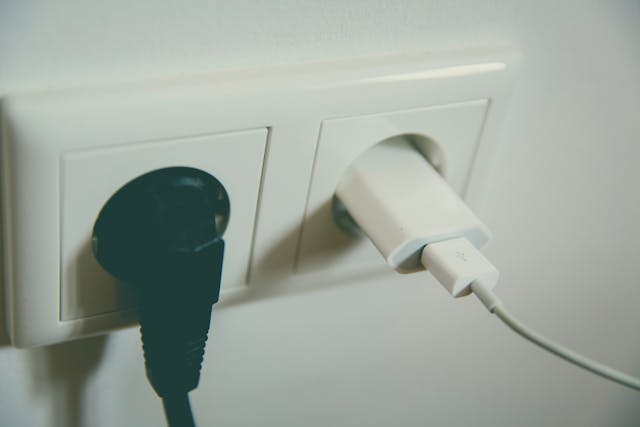
Why do plugs spark when you pull them out? Plugs spark when you pull them out because, for a very brief moment, the electrical current can continue across the tiny gap as the plug loses contact with the socket. It does not continue for long, but it can continue just long enough to ionize the air between the metal parts. That hot, ionized air produces heat and light, and that is the spark that can be seen.
When we see a spark from electricity, we are not really seeing the electricity itself. What we are seeing is the air around it being turned into a conductive plasma. The electrical energy heats the air so intensely that electrons are stripped from some of the atoms. This process is called ionization. Once the air is ionized, it can briefly carry current, and it glows. That glow is the spark. It is basically lightning in miniature, though on a far smaller and safer scale than a real lightning strike.
A plug connects an appliance to the electrical supply in the house. The electricity from the power network does not sit in the wires waiting like water sitting in pipes. It is a little different from that. The wiring in the house is kept at a voltage, and when an appliance is plugged in and switched on, it completes a circuit and current begins to flow. That is why nothing much happens when a device is plugged in but turned off. The connection is there, but the circuit inside the appliance is still open.
It is tempting to imagine electricity moving through the wires exactly like water flowing through a hose, but that is not really what happens. A better comparison is a long tube full of marbles. If one marble is pushed in at one end, the effect is passed along the line very quickly and a marble at the far end moves almost immediately. In the same way, the energy is transferred through the electrical system very quickly even though the individual electrons in the wire do not shoot from the power station to the toaster in one great rush.
Different countries use different kinds of plugs, but most ordinary plugs have two main metal prongs, and many have a third for grounding. The two main prongs connect the appliance to the power supply so that current can move through the circuit. In normal operation, the electricity follows the path provided by the wiring and the appliance. If it finds an easier or unintended path, that is when things become dangerous. A metal object pushed into a socket can create a path for current where there should not be one. That is why outlets must be treated with great care. Circuit breakers can help protect the wiring from overloads and faults, and special safety devices such as GFCIs or RCDs are designed to cut the power quickly if current is leaking along an unsafe path.
So, why do plugs spark when they are pulled out? The answer is that the electrical connection does not always break cleanly and instantly. As the metal contacts separate, the current may still try to continue flowing. For a split second, the voltage across the tiny air gap can become strong enough to ionize the air. The air then becomes a conducting plasma, allowing the current to jump across the gap for an instant. This creates heat and light, which appear as a spark.
Some appliances are more likely to produce a spark than others. Devices with motors, transformers, or coils can be especially prone to it because they resist sudden changes in current. A vacuum cleaner, blender, heater, or charger may therefore produce a slightly more noticeable spark when unplugged, especially if it is still switched on. Usually this is harmless if it only happens occasionally and the spark is small. However, repeated large sparks, a burning smell, discoloration, or crackling sounds can suggest a worn socket, a damaged plug, or a loose connection, and that should be checked.
The voltage in ordinary household electricity is relatively low compared with the enormous voltages needed to make long dramatic arcs through the air. Air is normally a very good insulator, so the spark from a plug can only jump a tiny distance and lasts for a tiny fraction of a second. That is why it disappears almost immediately. To create much larger arcs, much higher voltages are needed. A huge electrical discharge, such as lightning, can jump through long distances of air because the voltage involved is vastly greater.
The familiar plug that is used every day is a fairly modern invention. The detachable electric plug was developed by the American inventor Harvey Hubbell in the early 1900s. Before convenient wall outlets became common, people often had to connect electrical devices in awkward ways, sometimes even by using light sockets. As houses became more widely wired for electricity, dedicated wall outlets became standard, and the plug-and-socket system became one of those inventions so useful and ordinary that hardly anyone thinks about it. Until, of course, a tiny spark appears and makes the whole thing suddenly seem much more dramatic. And this is what I learned today.
Sources
https://en.wikipedia.org/wiki/Electric_spark
https://en.wikipedia.org/wiki/Circuit_breaker
https://en.wikipedia.org/wiki/History_of_AC_power_plugs_and_sockets
https://electronics.stackexchange.com/questions/300869/how-far-can-mains-voltage-arc-in-air
Photo by Markus Spiske from Pexels: https://www.pexels.com/photo/black-and-white-electric-plug-218445/