
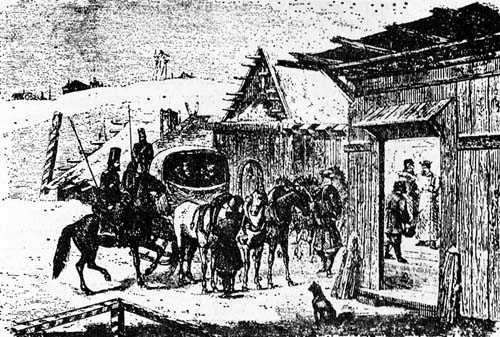
What was the Mongol postal system? The Mongol postal system was called the Yam and it was extremely fast and reliable.
The Mongol Empire was one of the largest empires in history and at its peak it covered 17.8% of the world’s land area. At its greatest extent, it spanned from the edge of Europe in the west all the way to China and Korea in the east. The Mongol Empire only lasted for about one hundred years, but it split into four smaller empires that affected the world for hundreds of years afterwards.
The Mongol Empire began when Genghis Khan (born Temujin) united the Mongol tribes living on the great plains. He began to target the Jin dynasty of China and enlarged his lands. After Genghis Khan’s death, his son Ogedai defeated the Chinese and advanced into Europe, increasing the size of the empire significantly. Later, Genghis Khan’s grandson, Kublai Khan, took power and pushed the Mongol Empire to its greatest size. On his death, the empire was broken up into four pieces, one of which was the Yuan dynasty that ruled China for the next 70 years.
The Mongols could only control such a wide empire because of their trade networks and their excellent postal system. It was called the yam and it could get messages from one side of the empire to the other surprisingly rapidly. It was not the first postal system in the world, but it was the largest and the fastest. The yam could send a message up to 300 km per day, which was unheard of at the time.
The postal system worked well because of its logistics and because of the high standards the messengers were held to. The system consisted of manned relay stations at a distance of roughly every 50 km (sometimes less, sometimes more). The relay station would have messengers ready to leave at a moment’s notice, fresh horses, food and supplies, and a place to rest. A messenger would ride his horse as fast as he could to get to a relay station. He would tell his message (they were usually verbal) to the rested messenger in the relay station, who would jump on a fresh horse and ride as fast as possible to the next station. In this way, messages could get from one side of the empire to the other in a matter of days. The messengers were held to very high standards. If they failed to deliver their message, or if they slowed down for any reason, they could expect to be severely punished. The ability to spread and gather intelligence very quickly was a huge advantage to the Mongol army. The Mongols also used the route to help control their empire administratively and to collect tax as well.
Access to the yam was tightly controlled. Official messengers carried a kind of passport, often described as a paiza: a tablet or pass that proved they had the right to demand fresh horses, food, and lodging at stations. Without it, a traveler could be turned away. This mattered because the yam was expensive to run. Supplying thousands of horses, fodder, and staff required taxes and strict organization, and local communities sometimes resented the burden. There were also abuses, with people trying to borrow or steal passes to travel quickly for personal reasons. Even so, the system worked well enough that it became one of the Mongols’ most important tools for governing at long distance.
The Mongol Empire was constantly expanding and more and more relay stations were added to the system to keep pace with the army and the new borders. This had other benefits as well. Messengers could ride more quickly over roads, so a road network developed across the empire. Small communities sometimes formed around the relay stations. And the yam brought one benefit that would change the world.
The yam was primarily for messages, but the Mongols also allowed traders to use it. They could transport goods both ways along the route. The Mongol Empire lived and died on trade, so it was vital for them. In order to make sure their messengers and the trade travelling along the yam route was safe, the Mongols used roving bands of mounted soldiers to patrol along the way. This made the yam a very safe route. The famous Silk Road was a trade route out of China and ultimately ending up in Europe. The Silk Road had become dangerous and trade was suffering along it. When the Mongols secured their yam route, they inadvertently secured the Silk Road and trade flourished again. Without the Mongol postal service, the Silk Road and the world might be very different.
Sources
https://en.wikipedia.org/wiki/Yam_(route)
https://www.richmondfed.org/publications/research/econ_focus/2021/q4_economic_history
https://www.historyofinformation.com/detail.php?entryid=3480
https://en.wikipedia.org/wiki/List_of_largest_empires
https://en.wikipedia.org/wiki/Mongol_Empire
https://en.wikipedia.org/wiki/Yuan_dynasty
Image By Unknown author – http://fotki.yandex.ru/users/myg2001/view/257663/?page=343, Public Domain, https://commons.wikimedia.org/w/index.php?curid=31860758