
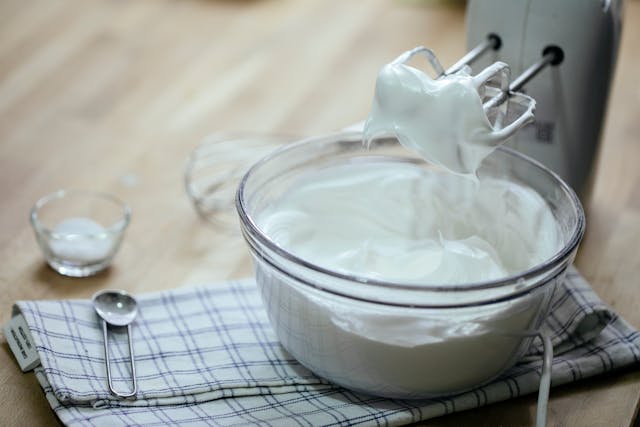
Why can you whip cream but not milk? Whipped cream becomes thick because air bubbles are trapped in the cream, creating something called a semi-solid colloid. Milk doesn’t have enough fat to hold the air bubbles in place. You can whip milk into a foam if you whisk it fast enough. This is similar to the foam baristas put on a latte, but the bubbles will pop and the foam will return to its liquid state after a few minutes.
A colloid is a mixture that has microscopically dispersed insoluble particles of one substance suspended in another substance. Colloids can be a gas, liquid, or solid. Milk is an example of a liquid colloid. Fat is suspended in water. Smoke is an example of a gas colloid. Carbon, soot, and ash are dispersed throughout air. Marshmallows and Styrofoam are examples of solids. Marshmallows consist of air dispersed through a solid matrix of gelatin and sugar. Styrofoam is a colloid of air suspended in solid polystyrene. There are natural colloids and there are human-made colloids. Whipped cream is a colloid as well. It is a foam, with air bubbles dispersed through a thickened mixture of water, protein, and fat.
Cream is made by skimming the fat off the top of fresh milk. Milk from a cow, because the contents of milk depend on the animal it is from, is made up of about 87% water, fat, protein, lactose, and minerals such as calcium, phosphorus, and potassium. About 3 to 4% of whole milk is fat. Inside the cow, the fat is broken down into tiny globules that are suspended in the water. The fat globules are surrounded by a thin protective membrane, and this helps them stay suspended. If you take a glass of fresh, unhomogenized milk and leave it, the fat is less dense than the water, so it will gradually rise to the top. This is the part that is skimmed off to make cream. (The process of homogenizing is where the milk company pass the milk through tiny filters to break the fats into microscopic pieces so they stay suspended in the liquid milk.)
When you start to whisk the cream, you are folding air bubbles into the mixture. With milk, these air bubbles are not trapped for very long and they simply float back to the surface. With cream, they start to get trapped in the fat. However, even cream is not all fat and there is still a lot of water. Creams range from about 10% fat to almost half fat. That means they do still have a lot of water, and the fat globules are suspended in that water. Each one of the fat globules has a protective membrane, which keeps them separate and keeps the cream as a liquid.
When you start to whisk the cream, air bubbles are folded into the liquid, but most of them simply rise to the surface, as with milk. If you keep whisking, the force of the whisk begins to damage the protective coating around the fat globules and some of the fat is exposed. This makes it easier for the fat globules to stick to each other. When fat globules join together, they trap some of the air bubbles. In the beginning, there is no discernible difference, but more and more fat globules start to stick together. At some point, known as the setting point, enough of these fat globules join together to make a continuous network. This holds the air bubbles far more easily. Before that point, the cream is a liquid with some air bubbles. After that point, it is a fat scaffold holding all of the air bubbles. It thickens and starts to hold peaks. This can take a long time depending on whether it is being whisked by machine or by hand, and it can be a sudden change. Nothing can happen for ages, and then suddenly the cream sets. When this happens, the fats have partially coalesced. The fat network will stay solid enough to hold the air in place, which means it won’t turn back to a liquid in the same way that milk foam does.
If you keep whipping the cream past this point, you will end up with butter. In whipped cream, enough of the fat globules have joined together to make a frame, but many of them are still floating separately with their protective membranes. This is why whipped cream is called a semi-solid colloid. If you keep whipping, more and more of the fat globules will be damaged until they are all sticking together. When this happens, the air bubbles are knocked out and the watery part of the cream is forced away from the fat. That watery liquid is buttermilk, and the clumped-together fat is butter. Butter is basically the opposite structure to cream. In cream, fat is suspended in water. In butter, water droplets are trapped inside a mass of fat. And this is what I learned today.
Sources
https://en.wikipedia.org/wiki/Milk
https://www.bbcgoodfood.com/glossary/cream-glossary
https://en.wikipedia.org/wiki/Whipped_cream
https://en.wikipedia.org/wiki/Colloid
https://www.sciencefocus.com/science/how-does-cream-get-whipped
https://www.chm.bris.ac.uk/~paulmay/webprojects2002/pdavies/examples.html
Photo by Katerina Holmes: https://www.pexels.com/photo/composition-on-bowl-with-delicious-whipped-cream-near-mixer-5908003/