
Why does friction produce heat? Friction produces heat because mechanical energy has to go somewhere, and some of it is converted into the random movement of atoms and molecules, which is heat.
Sometimes we need friction to produce heat and sometimes we don’t want it to. If you have ever been out in the cold and rubbed your hands together to warm them up, that is an example of friction producing heat. If you have ever tried to start a fire by rubbing two sticks together, that is another example of wanting friction to produce heat. On the other hand, if you have tripped over and slid along a carpet, the resulting carpet burn is an example of when we don’t want heat from friction. Or, if you ride a bicycle and touch the gears after cycling, they may feel hot. That is another example, because some of the energy put into the bicycle has been wasted as heat.
Why does friction produce heat? It comes down to the First Law of Thermodynamics, which is also called the conservation of energy. In our universe, we cannot make energy from nothing and we cannot destroy energy. All we can do is convert it from one form into another. When dinner is cooked over a gas burner, the chemical energy stored in the gas is converted into thermal energy and light.
There are two basic kinds of energy: kinetic energy and potential energy. Kinetic energy is the energy something has because it is moving. Potential energy is stored energy. Gas has chemical potential energy because of the way its atoms are bonded together. When the gas burns, that stored energy is released and converted into heat, light, and the movement of hot gases. Heat is basically the random kinetic energy of atoms and molecules. Friction takes organized kinetic energy, such as a moving hand, wheel, or car, and turns some of it into this disorganized thermal energy.
Friction happens on a microscopic level. The surface of anything may look smooth to our eyes, but if it is magnified enough, nothing is perfectly smooth. Every surface has tiny bumps, pits, and rough areas. These are sometimes called asperities. When two surfaces rub together, these tiny high points press into each other, catch, bend, break, and slide. The atoms in the two surfaces are pulled and pushed around. They vibrate more strongly, and that extra vibration is heat.
This is the important point. When a hand moves across another hand, the movement is organized. The whole hand is moving in one direction. But when the surfaces rub together, some of that organized motion is broken up into tiny, random motions inside the skin. Atoms and molecules jiggle faster. The faster they jiggle, the hotter the material becomes. The energy has not disappeared. It has just become harder to use.
That is why friction usually feels like a loss. If a bicycle chain and gears get hot, that heat came from the energy used to pedal. Some of the energy moved the bicycle forward, but some of it was converted into heat by friction in the chain, gears, bearings, and tires. Engineers try to reduce this wasted energy by using smooth surfaces, good bearings, and lubricants such as oil. Oil does not remove friction completely, but it keeps surfaces from grinding directly against each other, so less energy is turned into heat.
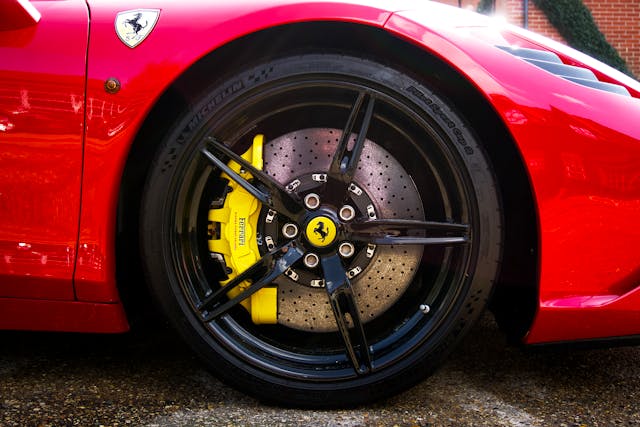
Sometimes, however, converting kinetic energy into heat is exactly what is needed. Brakes are a good example. When a car is moving, it has a lot of kinetic energy. To stop the car, that kinetic energy has to go somewhere. In ordinary brakes, friction between the brake pads and the brake discs converts much of that energy into heat. The brakes can become extremely hot, which is why they are designed to handle high temperatures. This causes wear over time, but it is necessary because the kinetic energy of the car has to be removed somehow. Regenerative braking, used in many electric and hybrid vehicles, reduces this waste by converting some of the kinetic energy into electrical energy and storing it in a battery. Even then, friction brakes are still needed.
A spacecraft reentering the atmosphere is another example of motion turning into heat, although it is not quite the same as rubbing two solid objects together. When a spacecraft enters the atmosphere at enormous speed, it compresses the air in front of it and collides with air molecules. The air becomes extremely hot, and heat transfers to the outside of the spacecraft. This slows the spacecraft down to a speed where it can land or deploy parachutes safely, but the heat is so intense that spacecraft need heat shields or special protective tiles to protect the people and equipment inside.
Friction can be reduced, but it can never be removed completely in ordinary life. Air resistance can be reduced by making cars, trains, and planes more streamlined. It can be reduced even more in a vacuum because there are fewer air molecules to collide with. Contact friction between solid objects can be reduced with smoother surfaces, wheels, bearings, or lubricants. However, as long as objects touch or move through matter, some energy will usually be converted into heat. And this is what I learned today.
Sources
https://cs.stanford.edu/people/zjl/pdf/friction.pdf
https://en.wikipedia.org/wiki/Conservation_of_energy
https://www.eia.gov/energyexplained/what-is-energy/forms-of-energy.php
Photo by Mike Bird: https://www.pexels.com/photo/photo-of-a-ferrari-tire-11629476/