
Why do we get altitude sickness? I want to say that we get altitude sickness because we are too high up. More specifically, altitude sickness happens because the body cannot get enough oxygen at high altitude. It is more likely the higher we go, but it depends a lot on the individual. Some people get it quickly, while others can go to the same height and feel almost nothing. The Sherpa people of the Himalayas are one example of a group that has adapted over many generations to living and working at high altitude.
Altitude sickness is caused by the lack of oxygen at higher altitudes. Or rather, it is caused by the lower air pressure, which makes it harder for us to get the same amount of oxygen into our lungs and then into our blood. This happens for two connected reasons. Firstly, the percentage of air that is oxygen, about 21%, does not really change at the altitudes where people climb mountains. What changes is the pressure of the air. As we get higher, air pressure drops, which means the air spreads out. If a person goes to a higher altitude, every time they breathe in, they breathe in the same volume of air, but because all of the particles are more spread out, that breath contains fewer oxygen molecules than it would at sea level. Secondly, oxygen moves from the lungs into the blood by diffusion. Oxygen moves from an area where its partial pressure is higher, inside the lungs, into an area where its partial pressure is lower, in the blood. At higher altitude, the air coming into the lungs has a lower oxygen pressure, so the pressure difference is smaller. This means less oxygen diffuses into the blood.
Altitude sickness varies from person to person, but it becomes a real risk from about 2,500 meters above sea level. It also depends very much on how quickly a person ascends. The body can get used to the lack of oxygen, to a certain point, but it takes time. Many guides suggest increasing sleeping altitude slowly once above about 3,000 meters, often by no more than about 300 to 500 meters a day. Altitude sickness symptoms are usually a headache, dizziness, nausea, tiredness, weakness, and possibly difficulty breathing. At lower altitudes, mild altitude sickness can often be fixed by stopping the ascent, resting, and descending if the symptoms do not pass. However, if a person continues to go higher, or if it develops at a very high altitude, it can become fatal. Altitude sickness can become high-altitude pulmonary edema (HAPE) or high-altitude cerebral edema (HACE). Both of these can be fatal.
Edema is swelling caused by excess fluid trapped in the body’s tissues. Small blood vessels leak fluid into the surrounding tissue. With HAPE, these vessels leak fluid into the lungs, and with HACE, fluid builds up in or around the brain. When fluid enters the lungs, it becomes harder and harder for oxygen to get from the air into the blood. The person may cough, struggle to breathe, and become dangerously short of oxygen. With fluid in the brain, there is very little room for swelling because the brain is inside the skull. HACE can lead to confusion, clumsiness, loss of coordination, and eventually loss of consciousness. The best response to HAPE or HACE is immediate descent, but that can be difficult with HACE because a person may not be thinking clearly enough to understand the danger.
HAPE happens at high altitude because the body’s response to low oxygen levels is to constrict some of the blood vessels in the lungs. This is usually useful because it can move blood away from poorly ventilated parts of the lung and toward better-ventilated parts. The trouble is that at high altitude, the whole lung is receiving less oxygen, so the constriction can become widespread and uneven. This raises the pressure in the lung’s small blood vessels and can force fluid out of the capillaries and into the lung tissue and air spaces. It generally gets worse the higher a person goes. This is also why altitudes on mountains above 8,000 meters are called the death zone. At that height, the atmospheric pressure is so low that the human body cannot properly acclimatize. Even with training and experience, people can only stay there for a limited time before the lack of oxygen begins to cause serious damage.
The Sherpa people who live in the Himalayas have adaptations that help them use oxygen more efficiently. This does not mean they are immune to altitude sickness, but they are better suited to high altitude than people whose families have lived for generations at sea level. Sherpa muscles appear to use oxygen very efficiently and rely less on burning fat for energy, which is useful because fat needs more oxygen than carbohydrates. Some studies have also found differences in genes connected with the body’s response to low oxygen, including EPAS1, EGLN1, and PPARA. These adaptations appear to help regulate hemoglobin and blood flow so oxygen can circulate without making the blood too thick. Their advantage comes from both inherited adaptations and lifelong experience living and working at altitude. And this is what I learned today.
Sources
https://en.wikipedia.org/wiki/Altitude_sickness
https://en.wikipedia.org/wiki/High-altitude_cerebral_edema
https://en.wikipedia.org/wiki/High-altitude_pulmonary_edema
https://www.healthdirect.gov.au/altitude-sickness
https://en.wikipedia.org/wiki/Edema
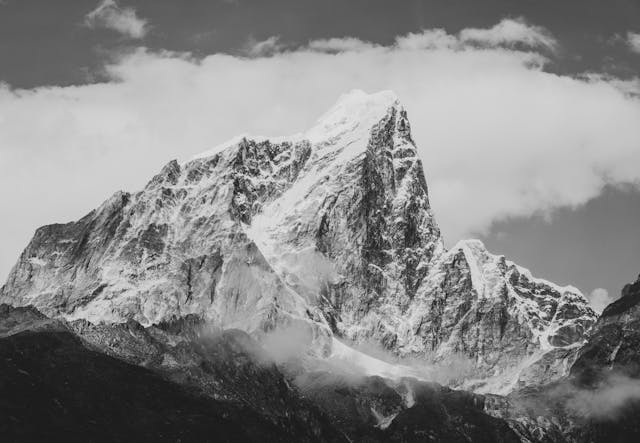
Photo by Alvin Chin: https://www.pexels.com/photo/grayscale-photo-of-snow-covered-mountain-4144563/