
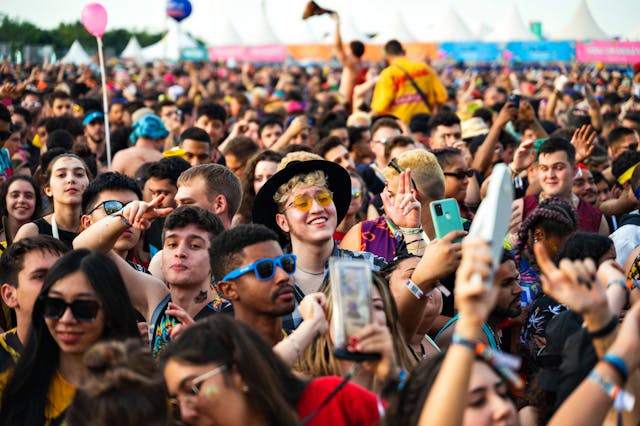
Why do we forget names but not faces? We forget names but not faces because our brains have evolved to give more weight to visual information than to arbitrary labels. We have a powerful brain network for recognizing faces, but names have to be attached to those faces separately, and that connection is often much weaker.
To each of us, our name is one of the most important things about us. A large part of our identity is rolled up in our name. If someone cannot remember our name, it feels as though they cannot remember us. But that is not really true. Most of us know several hundred people through our daily lives. We see the same people day after day, even if we only pass them on the way to work in the morning, and we remember those faces. If a person was being followed by the CIA and they saw the same stranger twice, it would probably register, and the CIA would have failed. We are primed to recognize and remember faces. We don’t do the same thing with names.
In many ways, names are arbitrary. We know the word “chair” and we can recognize all chairs on sight because they all bear some similarity to each other. We can’t recognize all “Stevens” on sight because they don’t share any visible similarity at all. Names are also abstract labels because they don’t have much contextual information built into them. If we learn that someone is a doctor, we can imagine visually what doctors do, and that helps the information stick in our brains. If someone tells us they are called Steven, there is no visual meaning attached to that word because all Stevens are different. That makes names harder to remember. Names have to be learned, attached, and recalled.
So, how do we learn faces and how do we learn names?
Faces are handled by a large face-processing network in the brain. One of the most famous parts of this network is the Fusiform Face Area. It is part of the visual system, and it helps analyze the stable features of a face that make one person different from another. However, faces are not simply stored in one small place. Other areas help process expressions, eye gaze, movement, emotion, and memories connected to that person.
Names work differently. The left anterior temporal lobe appears to be very important for retrieving proper names, especially people’s names, but it does not work on its own. Remembering a name also involves language networks, memory networks, and the wider knowledge a person has about someone.
When a familiar face is seen, visual information travels through the eyes and into the brain’s visual system. From there, it enters the face-processing network. The Fusiform Face Area helps analyze the shape and features of the face, while other areas look at expression, gaze, and movement. The brain then compares that information with stored memories of faces. If there is a match, a feeling of familiarity is produced. This is the moment when someone thinks, “I know that person,” even if the name has not arrived yet.
After that, a wider person-identity network is activated. The brain starts to recall the things attached to that face: “She works in a shop. She has two children. She went to Spain last summer.” These details may come back before the name does because they are richer and easier to connect. They contain images, places, emotions, and stories. The name, however, is often just a label. If the connection is strong enough, the left anterior temporal lobe and language networks help retrieve the person’s name. But this is one of the last steps, and it can fail even when the rest of the memory is working.
This is why the experience of forgetting a name feels so strange. The face is familiar. The person is familiar. Many facts about them may be familiar. But the exact sound of the name is missing. It is like opening a file and finding all of the contents inside, except the label on the front.
Unless a name is strongly linked to extra information, repeated often, or attached to emotion, it can be difficult to recall. There is no easy natural connection between an arbitrary name and one of the thousands of faces stored in memory. The best way to strengthen that connection is through repetition, as when learning a foreign language, or by attaching something visual or emotional to the name.
Why can we remember faces so much more easily than names? A lot of it probably comes down to social survival. Humans, like many animals, need to recognize individuals quickly. Is this person familiar or unfamiliar? Are they safe or dangerous? Are they part of my group or outside it? These judgments have to be fast because they can matter for trust, cooperation, friendship, and sometimes survival. Names are useful because humans live in large, complex social groups and need to talk about individuals when they are not present. But recognizing the face comes first. Not remembering someone’s name is embarrassing, but it is rarely dangerous. Not recognizing a face might be. And this is what I learned today.
Sources
https://en.wikipedia.org/wiki/Fusiform_face_area
https://www.bbc.com/future/article/20120209-why-names-and-faces-are-so-vexing
https://www.jneurosci.org/content/33/10/4213
https://medicalxpress.com/news/2018-01-blame-left-side-brain.html
Photo by Daniel Duarte: https://www.pexels.com/photo/crowd-on-festival-14670407/