
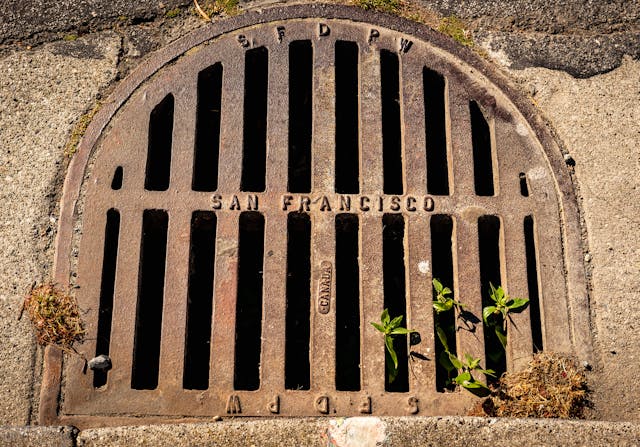
How do storm drains work? Storm drains work by directing rainwater from roads, sidewalks, roofs, and streets into underground channels, where the water can be controlled and carried away.
Before there were cities, storm drains were obviously not necessary. When it rains in nature, the water hits the ground and either soaks into the soil, collects in low areas, or flows downhill toward streams and rivers. Rocks, plants, soil, roots, and slopes all help control where the water goes. If there is too much rain for the ground to absorb, the water runs over the surface until it reaches a river, a lake, or the sea. If the land is in a dip, it might flood for a while, and the water will stay there until it soaks into the ground or evaporates. This is natural. It only becomes a serious problem when we build cities.
The majority of a city is covered with hard surfaces, such as asphalt, concrete, roofs, sidewalks, and parking lots. These surfaces do not absorb water very well. Some cities have a lot of parks, trees, gardens, and open land, which helps because soil and plants can absorb some of the rain. However, the amount of green space varies enormously from city to city. In dense areas, most of the rain falls on surfaces that cannot soak it up. Unless there is a system to remove that water, it can flood streets, damage buildings, wash away roads, and make travel impossible.
With no storm drains, water would collect in low-lying parts of the city. Roads would become temporary streams and rivers because streets naturally guide water downhill. This would happen very quickly in heavy rain. If humans disappeared, storm drains would eventually become blocked with leaves, mud, trash, and broken pieces of the city itself. Over time, these uncontrolled streams would be one of the things that helped break cities apart.
Storm drains start with the inlets that can be seen at the side of many roads. These are the grates or openings where rainwater disappears from the street. The area around a storm drain is often slightly lower than the surrounding road, just like the plughole in a bathtub, so water naturally flows toward it. The location of storm drains is carefully planned. Engineers look at the slope of the land, the shape of the road, the nearby buildings, and how much rain the area is likely to receive.
A road that is in a dip needs more drainage than a road on a hill because water will naturally gather there. An area with many buildings may also need more drains because roofs and gutters send rainwater down to the street or directly into the drainage system. Modern buildings often have their own drainage pipes that connect to the stormwater system, so the water from the roof does not simply pour onto the sidewalk.
The drain inlet usually has a grate over it. This helps catch large pieces of debris, such as branches, leaves, plastic bottles, and trash, before they enter the underground pipes. The grate is also a safety feature because it stops people or animals from falling into the drain. However, the grate can also become blocked, especially in autumn or during heavy storms. This is why storm drains have to be cleared and maintained. A storm drain that is covered with leaves cannot do its job, no matter how good the pipes underneath it are.
Under many storm drain inlets is a catch basin. This is a small underground chamber with a deeper section at the bottom. Water flows into the catch basin first, and heavier material, such as sand, grit, leaves, and small pieces of trash, can settle in the lower part. The water then flows out through a pipe, while much of the heavier debris stays behind. This helps stop the underground pipe system from clogging too quickly. The catch basin has to be cleaned from time to time because, if it fills with debris, it will stop working properly.
From the catch basin, rainwater flows into a network of underground pipes. These pipes usually get larger as more water joins the system. Small pipes from individual streets connect to larger pipes, and those larger pipes may connect to culverts, channels, storage tanks, or open waterways. A culvert is basically a covered channel that carries water under a road, railway, or part of a city. In some places, these underground systems are like hidden rivers.
In many modern cities, stormwater is kept separate from sewage. Rainwater from the streets flows through one system, while wastewater from toilets, sinks, baths, and washing machines flows through another. The stormwater may be carried directly to a river, lake, or the sea. This is why water flowing out of a large pipe into a river is often rainwater, not sewage. However, this water is not always clean. As it runs along roads, it can pick up oil, dirt, rubber from tires, chemicals, and trash. That is why stormwater pollution is a problem.
Some older cities have combined sewer systems. In those places, rainwater and sewage travel through the same pipes. This can work in normal weather, but it becomes a problem during heavy rain. If too much rainwater enters the system, the pipes and treatment plants cannot handle it all. The system can overflow, and dirty water can be released into rivers or even back up into streets and buildings. This is one reason many cities try to separate stormwater from sewage when they upgrade old infrastructure.
Drainage systems have existed for almost as long as cities because water buildup is a problem wherever people build permanent settlements. Archaeologists have found drainage systems in ancient places such as Minoan Crete from around 2000 BC, and similar ideas probably existed even earlier. Early systems were often open channels in roads that carried water away, rather than underground networks like the ones used today. The technology has changed, but the basic problem has not. Cities are hard surfaces built in the path of rain. Without storm drains, our enormous cities would not be able to survive for long. And this is what I learned today.
Sources
https://www.treehugger.com/global-cities-most-and-least-public-green-space-4868715
https://en.wikipedia.org/wiki/Storm_drain
Photo by David McElwee: https://www.pexels.com/photo/drain-on-street-13319904/