
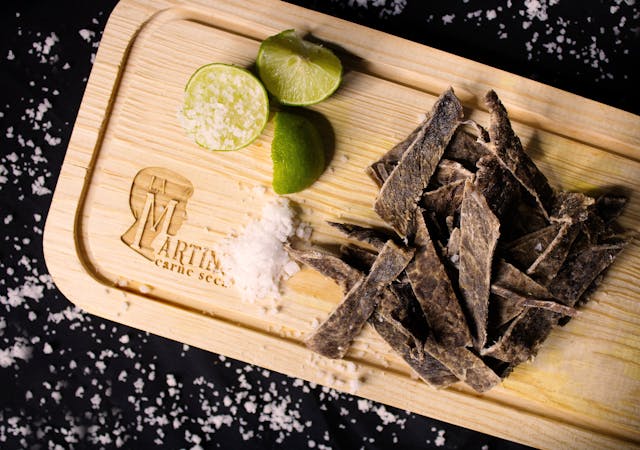
What is jerky? Jerky is traditionally strips of dried meat that are eaten as a snack or as a way to get protein and energy on long journeys where there is no access to refrigeration.
The concept of jerky has been around for thousands of years, but the word has only existed in English since the 19th century. It came into English from Spanish, which picked it up from a word used by Indigenous people of the Andes. Their word was “ch’arki,” which meant dried flesh. That changed to “charqui” in Spanish, which changed again to “jerky” in English. The Spanish took the word from the Incas, but the concept of jerky has existed in almost every culture since the early days of civilization because drying meat is an excellent way to preserve it.
As soon as any animal dies, the meat starts to spoil. Most people have probably found that carrots or potatoes can be left on a kitchen counter for a couple of weeks and still be fairly edible, albeit a little bit soft. If a piece of chicken or pork is left on a kitchen counter for a couple of weeks, even getting past the smell would be difficult, and eating it would be dangerous. Meat has a lot of protein, which bacteria can feed on. It also has a lot of moisture and a fairly neutral pH. All of these things make ideal conditions for bacteria and make meat spoil faster than many vegetables.
Some of the bacteria that can grow on meat, such as Salmonella and E. coli, can make people very sick. Other bacteria can produce toxins as they grow. Some of these toxins are not easy for the human body to deal with, and some are not destroyed just because the food is cooked. This is why rotten meat is so dangerous. Animals such as vultures and hyenas have much stronger stomach acid and different digestive systems, which allows them to eat food that would make a human very ill.
These days, meat can be frozen, which preserves it for a very long time, or it can be put in a refrigerator, which extends its life for a few days. Bacteria cannot function well in low temperatures. Freezing doesn’t necessarily kill the bacteria. It mostly just stops them from working. Once the meat warms up again, the bacteria can start multiplying again.
Before refrigeration, the main ways to stop meat from spoiling were to salt it, pickle it, smoke it, or dry it. Salt works because it pulls water out of the meat and out of the bacteria. Vinegar works because its acidity makes life very difficult for bacteria. Drying works because bacteria and mold need water to carry out their chemical reactions. With not enough available water, they cannot grow properly, and the food lasts much longer. Smoking meat can also help because smoke contains chemicals that slow down bacteria and mold, and it dries the surface of the meat. It also adds a lot of flavor.
Jerky can be made from almost any kind of meat or fish. It usually refers to meat, but the basic idea can be used with many foods. When it is prepared, the fat is trimmed off first. This is because fat does not dry in the same way as meat. Muscle contains a lot of water, so that water can be removed. Fat contains very little water, so there is not much to remove. Instead, fat can go rancid. This means it reacts with oxygen and develops a bad smell and taste. If too much fat is left on jerky, the meat will not last as long.
The meat also has to be cut very thin so that it dries quickly and evenly. If the outside dries but the inside stays wet, bacteria can still grow inside the meat. Modern drying methods use low-temperature drying ovens or dehydrators with heating elements and fans. The warm air moves over the meat and evaporates the moisture. This can dry the meat in a few hours. Commercial jerky also usually contains a lot of salt, and some types use preservatives as well. It is then sealed in packaging so that moisture and air cannot easily get back in.
Modern jerky can last a long time and still be edible. Traditionally, though, the process was much simpler. The fat was removed, the meat was cut into thin strips, and then it was dried in the sun, wind, or smoke. A hot, dry day with a strong wind would be best because that is basically what modern dehydrators are trying to copy. The goal is to remove the water before bacteria have time to spoil the meat.
Like many other methods of food preservation, people probably discovered this by accident. They would have noticed that meat left in a hot, dry place lasted longer than meat that stayed wet. From there, they improved the method over generations. They learned to cut the meat thinner, remove the fat, add salt, use smoke, and choose the right weather. Jerky looks like a simple snack today, but it is really an ancient survival technology. It allowed people to carry protein across deserts, mountains, oceans, and long journeys before anyone had a refrigerator. And this is what I learned today.
Sources
https://en.wikipedia.org/wiki/Jerky
https://www.etymonline.com/word/jerky
https://en.wikipedia.org/wiki/Curing_(food_preservation)
https://agriculture.institute/meat-science-fundamentals/drying-meat-preservation-ancient-technique
Photo by Almendra López Varela: https://www.pexels.com/photo/slices-of-meat-o-a-wooden-chopping-board-with-lime-and-salt-8144520/